
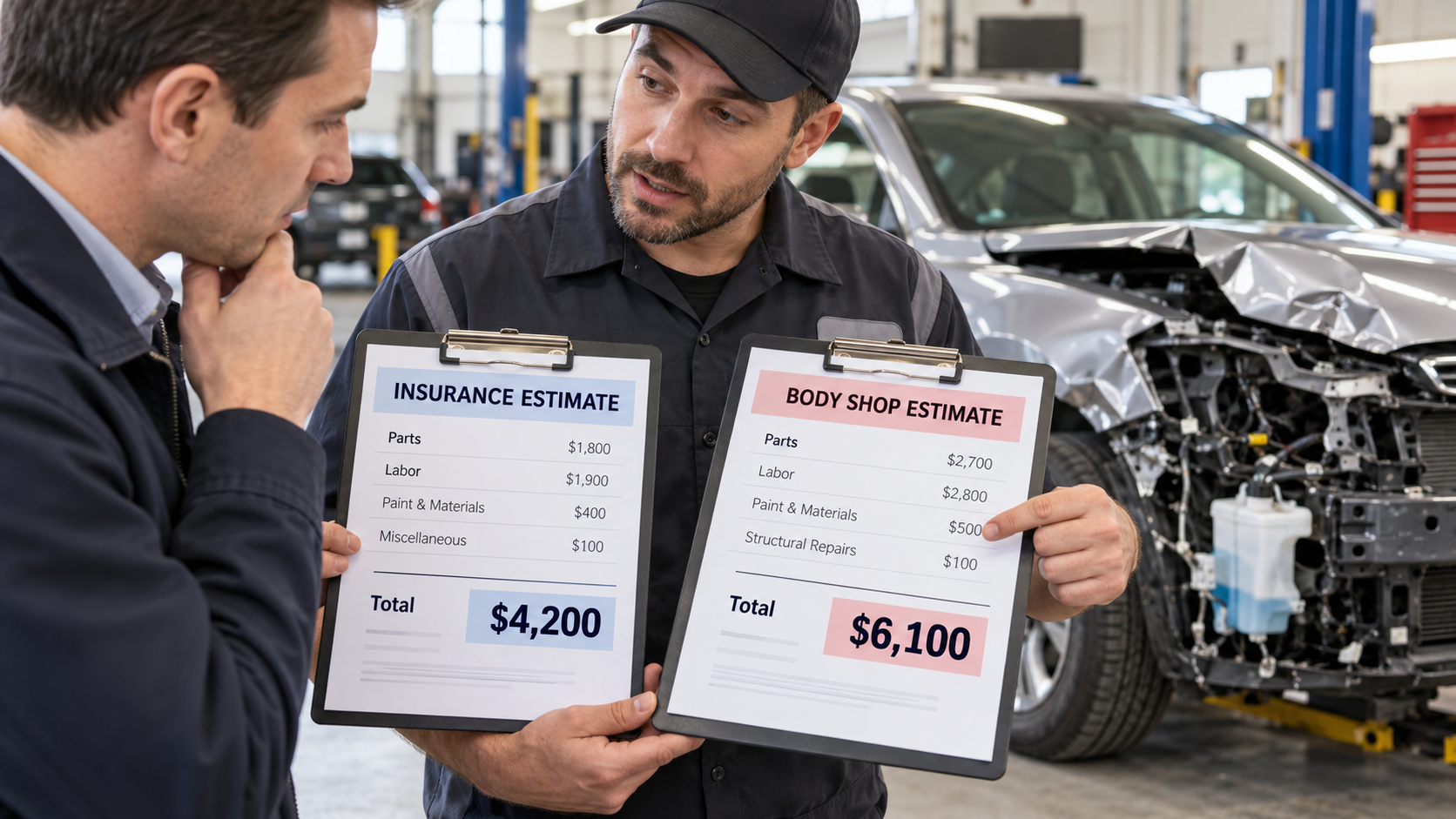
Your insurance company writes a $4,200 estimate. The body shop says the repair will cost $6,100. It is easy to look at those two numbers and assume somebody expects you to come up with another $1,900.
That is often not what is happening. Insurance estimates commonly change after a vehicle is disassembled and additional accident damage becomes visible. Insurers including Progressive and Allstate explicitly describe processes for working with a repair shop when additional covered damage is discovered after the initial estimate.
Before agreeing to pay anything yourself, figure out what makes up the gap. Most differences between a body shop estimate and an insurance estimate fall into one of three buckets, and they should not be treated the same way.
Bucket 1: The shop found more accident damage
This is the straightforward supplement situation. An adjuster or photo-estimating system can price the damage it can identify, but it cannot always see what is behind a bumper cover, body panel or damaged assembly.
Once the shop begins disassembly, it may find a bent reinforcement, broken bracket, damaged sensor, additional structural damage or another repair operation that was not visible earlier. The shop can document the additional accident-related damage and submit a supplemental estimate to the insurer.
A supplement is an addition to the original insurance estimate. If the insurer agrees that the newly discovered work is necessary and covered, it can increase the approved repair amount rather than leaving you responsible for the entire difference.
So a $4,200 initial estimate followed by a $1,900 approved supplement can simply become a $6,100 covered repair, subject to the terms of the claim and your deductible.
Bucket 2: The shop and insurer disagree about how the car should be repaired
This situation requires more attention. The insurer may know about the damage but disagree with the shop about a labor operation, repair time, labor rate, part, diagnostic procedure or other component of the repair plan.
The two estimates can therefore describe essentially the same accident damage and still arrive at different totals. The shop may believe an operation is necessary while the insurer’s estimate omits it or prices it differently.
Ask the shop to identify the disputed line items rather than telling you only that “insurance isn’t paying enough.” Then ask whether those items have already been submitted to the insurer and what explanation the insurer gave for declining or reducing them.
That distinction is important because a disagreement between two professionals is not automatically a debt you owe. The shop and insurer may still resolve the issue through documentation, a supplement, a reinspection or direct discussion of the repair procedure.
Bucket 3: The shop is charging for something the insurer does not owe for
Some estimate differences really can become the customer’s responsibility. The clearest examples are work unrelated to the accident, an upgrade you specifically requested, or a more expensive repair choice that exceeds what the policy or applicable claim rules require.
Parts disputes are a common example. If the insurer’s estimate calls for an acceptable alternative part and you insist on a more expensive new OEM part purely as a preference, you may be asked to pay the difference. That is a separate issue we cover in Can Your Insurance Company Force You to Use Aftermarket Parts?
The important point is that you should know about a genuine customer-pay item before the work is performed, not when you arrive to pick up the car.
Compare the estimates line by line
The total at the bottom of each estimate is less useful than the differences inside them. Ask for copies of both estimates and identify every line item that appears on the shop’s version but not the insurer’s, or that carries a materially different price.
| Source of the gap | Best next step |
|---|---|
| New hidden accident damage | Have the shop document it and submit a supplement |
| Additional repair operation | Ask the shop for the repair basis and submit it to the insurer |
| Different labor time or labor rate | Ask both sides to explain the discrepancy |
| Different replacement part | Determine why the shop rejects the insurer’s specified part |
| Customer-requested upgrade | Get the out-of-pocket amount in writing before authorizing it |
| Unrelated maintenance or prior damage | Do not assume the collision claim will pay for it |
This exercise can turn a vague $1,900 dispute into something much easier to solve. Perhaps $1,400 is newly discovered covered damage awaiting approval, $300 is a disputed repair operation and $200 is an upgrade you requested. Those three amounts require three different conversations.
Ask whether the supplement has actually been submitted
A surprising amount of confusion comes from timing. A shop may give you its complete repair estimate while the insurer is still working from its original inspection.
Ask the shop whether it has submitted a supplement and, if so, when. If the insurer has not reviewed the additional damage yet, the difference between the estimates is not necessarily a final denial.
Progressive says additional damage discovered during repairs is normal and that it works with the repair shop to update the estimate when needed. Allstate similarly says that when a shop finds additional covered damage, it can work with the shop to approve additional expenses.
That does not mean every supplement will be approved. It does mean you should distinguish between not yet reviewed and reviewed and denied.
Do not authorize a disputed charge blindly
The repair shop is doing work on your vehicle, and your repair authorization is separate from the insurer’s obligation to pay the claim. Read what you are signing.
Ask the shop a direct question before repairs progress: Other than my deductible, is there anything on this repair that you currently expect me to pay myself?
If the answer is yes, ask for the amount and the reason in writing. Also ask whether the charge is already disputed with the insurer or whether the shop simply assumes the insurer will not pay it.
State consumer-protection rules governing repair authorizations vary. Massachusetts, for example, requires repair shops in many circumstances to provide a written estimate and obtain additional authorization before substantially exceeding an authorized repair amount. Your own state’s rules may be different, so do not assume the paperwork works the same way everywhere.
Your deductible usually does not restart when the estimate grows
A supplement is normally part of the same covered loss. If you have a $500 collision deductible, an approved supplement does not ordinarily create another $500 deductible simply because more accident damage was discovered.
For example, suppose the insurer initially approves $4,200 of covered repairs and later approves another $1,900 after teardown. The approved repair total becomes $6,100. Your applicable deductible does not ordinarily multiply because the insurer revised the estimate.
You can still owe amounts for other reasons, such as noncovered work or an upgrade you chose. Those amounts should be separated from the deductible so you know exactly what you are being charged for.
A photo estimate deserves particular scrutiny after teardown
Photo estimates are convenient, but by definition they begin with what can be seen in photographs. Allstate says its photo estimate is based on visible damage and that it works directly with the shop if additional damage is later found.
If your insurer wrote the initial estimate from photos and the body shop’s number jumps after the vehicle is taken apart, that difference alone is not evidence that anything improper happened. The shop may simply be working with information that did not exist when the first estimate was prepared.
What matters is whether the additional work is connected to the covered accident and properly documented.
What if the insurer actually refuses to pay?
Once an insurer has reviewed a supplement and rejected part of it, ask for the specific reason. “We won’t pay it” is much less useful than knowing whether the dispute involves coverage, labor time, labor rate, a part, a repair procedure or whether the damage resulted from the accident.
Then have the repair shop respond to that reason with evidence. That might mean photographs of hidden damage, a manufacturer’s repair procedure, diagnostic results, measurements, parts-availability information or a more detailed explanation of the required operation.
If the two sides remain apart, escalate the issue within the insurance company before automatically paying the difference. Ask for a supervisor or reinspection when appropriate and keep the estimates, supplement requests, photos and written explanations.
If you believe the insurer is failing to handle the claim according to your policy or state insurance rules, your state insurance department can explain the complaint process. A disagreement over the repair price does not necessarily mean the insurer is violating the law, but you should not have to guess what its position is.
A large supplement can change the claim entirely
Sometimes the problem stops being a repair-estimate dispute. If teardown reveals enough additional damage, the revised repair cost can become high enough that the insurer reevaluates whether the vehicle should be declared a total loss.
If that happens, switch from repair questions to valuation questions. Our guide to negotiating a low total-loss insurance offer explains how to examine the insurer’s vehicle valuation rather than focusing on the repair estimate.
Find out what the difference represents before paying it
A body shop estimate that is higher than the insurance estimate does not by itself tell you that you owe the gap. The first estimate may simply be incomplete, and the supplement process exists because collision damage is often more extensive once the vehicle is taken apart.
Get both estimates and sort the differences into additional covered damage, a genuine repair dispute, and customer-pay work. Then make the shop and insurer address the specific lines they disagree about before you authorize an unexpected charge.
Write a Reply or Comment