
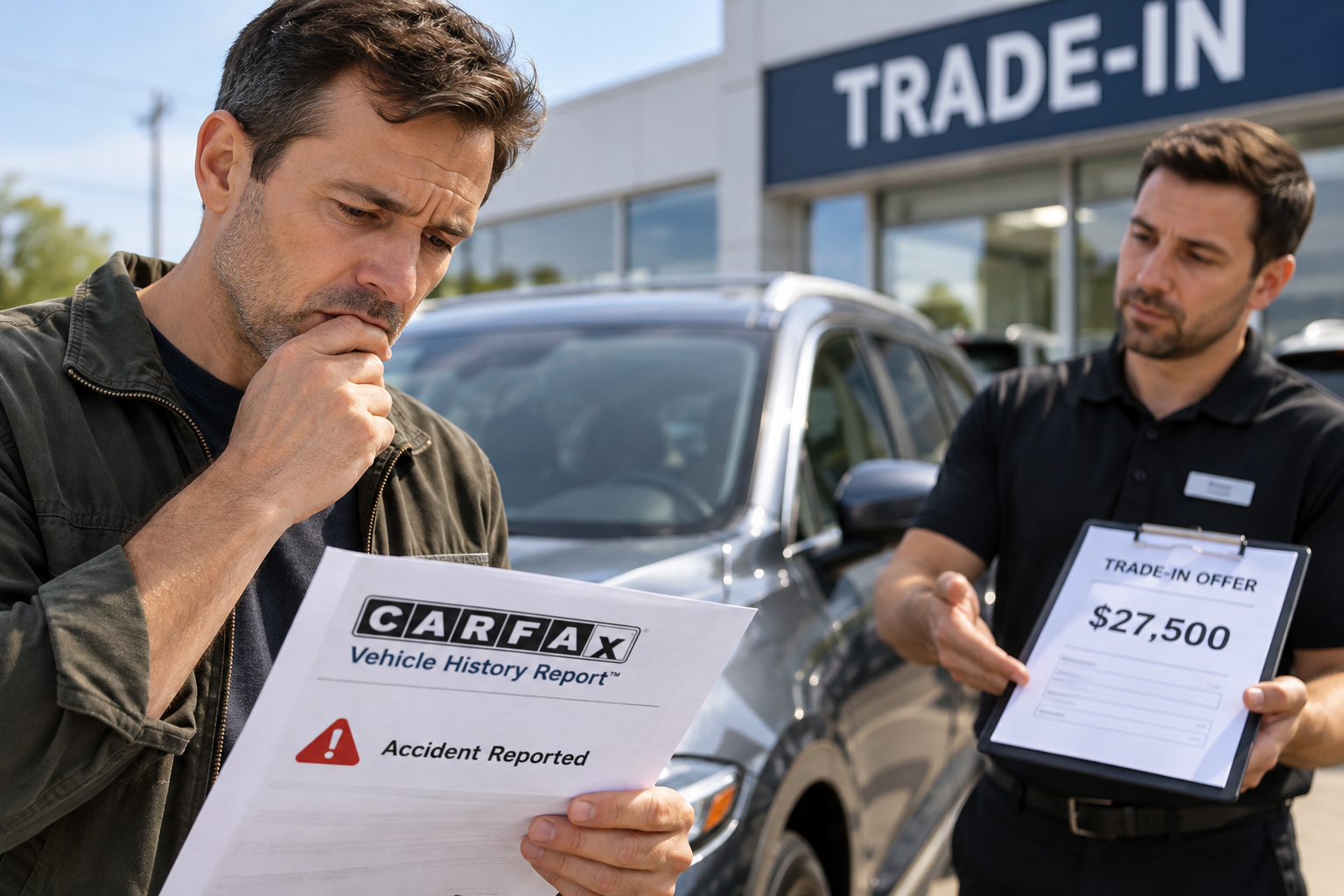
There is an awkward moment that can come months after an auto insurance claim seems finished. Your car has been repaired, everything looks right, and then a dealer gives you a trade-in offer that is thousands of dollars lower because the vehicle now has an accident on its history.
The repair bill and that lost resale value are two different losses. Depending on the state, the policy involved and who caused the accident, the second one may support a diminished value claim.
The mistake is to begin with one of the online calculators that promises to tell you exactly what your claim is worth. Start with the market instead.
First Find Out Who You Are Claiming Against
A diminished value claim against the driver who caused the accident is not the same as a claim under your own collision policy. That distinction can completely change the answer.
Washington’s Office of the Insurance Commissioner, for example, tells consumers that diminished value claims are typically made against the at-fault driver’s insurer. It also warns that the insurer does not simply add a diminished value payment after repairs; the owner has to support the claimed loss.
Massachusetts illustrates how specific the rules can become. Its Division of Insurance says the standard policy does not provide diminished value coverage when you make the claim against your own insurer. A third-party claim may be different, and a 2025 Massachusetts Supreme Judicial Court decision added another wrinkle: under the 2016 standard policy form, the other driver’s insurer may not itself owe inherent diminished value even though the at-fault driver could still be legally responsible for a provable loss.
That is why a national article claiming that diminished value is either “always covered” or “never covered” is not particularly useful. State law, policy language and whether the claim is first-party or third-party all matter.
The Best Evidence Is What Someone Would Actually Pay for the Car
Suppose your car was worth about $32,000 immediately before the crash. The repairs are completed properly, but two dealers tell you they would now pay only about $27,500 because of the accident history.
That $4,500 difference is a much more persuasive starting point than saying that an accident “must have” reduced the value.
| Valuation | Amount |
|---|---|
| Approximate value before accident | $32,000 |
| Post-repair market value | $27,500 |
| Apparent loss in value | $4,500 |
If you are trying to establish the loss yourself, ask a dealer two separate questions: what would this vehicle be worth with the same mileage and equipment but no accident history, and what would you pay for this particular car now?
Then ask whether the dealer will put the answer in writing. One trade-in quote can be dismissed as one buyer’s opinion. Several consistent valuations are harder to ignore.
Keep the final repair invoice, photographs from before the repair, the insurance estimate and the vehicle-history report as well. A claim involving major structural work is easier to explain when the paperwork shows exactly what happened to the car.
Do Not Let a Formula Become the Evidence
Search for diminished value and you will quickly encounter calculators based on the so-called 17c formula or variations of it. They usually start with the car’s value and then apply damage and mileage adjustments.
There is nothing wrong with using a formula to get a rough idea of scale. The problem begins when the formula is treated as though it determines the market loss.
Georgia is often cited in these discussions because of the state Supreme Court’s 2001 decision in State Farm v. Mabry. The important holding was that properly repairing physical damage does not necessarily restore a vehicle’s value and that the policies involved required State Farm to account for that remaining loss. The court did not establish a universal diminished value calculator for every car in every state.
If an insurer produces a formula-based number that looks implausibly low, ask what market evidence supports it. An equation should not make an actual difference in what dealers or buyers will pay disappear.
Some States Give You More Leverage Than Others
North Carolina has an unusually specific process for certain disputes. State law provides an appraisal procedure when liability is not disputed and the claimant and insurer disagree sufficiently about the vehicle’s loss in fair market value.
The procedure can be triggered when the difference between the two estimates exceeds $2,000 or 25% of the vehicle’s pre-accident fair market retail value, whichever amount is lower. Each side chooses a disinterested appraiser, and the appraisers use an umpire if necessary.
That is very different from simply emailing an adjuster a screenshot from an online diminished value calculator. If your state provides a formal appraisal process, knowing that process can matter as much as knowing the amount you want.
North Carolina also recognizes an important practical problem: the loss in value may not be apparent until the repairs are finished. Its claims rules specifically address diminished value discovered after repair.
Ask the Adjuster Exactly What Is Being Disputed
If the insurer says no, do not stop at “we don’t pay diminished value.” Ask for a more precise answer in writing.
- Are you saying the car did not lose market value?
- Are you disputing the amount of the loss?
- Are you saying this type of loss is excluded by the policy?
- Are you saying state law does not permit this claim against this insurer?
- What documents or appraisal evidence would you consider?
Those are very different positions. If the insurer agrees that the vehicle lost $4,000 in market value but says the policy does not cover that loss, collecting three more dealer quotes probably will not solve the dispute. If coverage is accepted but the insurer says the loss is only $800, better valuation evidence may help.
Washington’s insurance regulator makes the same basic point from the consumer side: diminished value is subject to proof. The owner has to show that the repaired car actually has a lower market value.
Be Careful Before Treating the Property Claim as Finished
If the vehicle has not yet been repaired, it may be too early to know the size of the loss. The quality of the repair, the severity of the original damage and what ultimately appears on the vehicle’s history can all affect the post-repair value.
Before accepting a final property-damage settlement or signing a broad release, ask whether it resolves only the repair bill or also any claim for diminished value. Do not assume you can reopen the issue later without checking the rules that apply to your claim.
This is especially important when the insurer has also been negotiating over repair methods or replacement parts. If that is happening in your claim, our guide to when an insurance company can use aftermarket parts instead of OEM parts covers that part of the dispute separately.
Not Every Diminished Value Claim Is Worth Hiring an Appraiser For
If an older car suffered a minor repair and the realistic difference in resale value is a few hundred dollars, paying hundreds of dollars for an appraisal may not make economic sense. Start with evidence you can collect without paying anyone.
A nearly new or high-value vehicle with substantial accident repairs presents a different calculation. If actual dealer offers suggest that the accident erased several thousand dollars of value, the cost of a professional appraisal becomes easier to justify.
The same logic applies before escalating a dispute. First establish whether there is enough money at stake to justify the next step.
If the Car Was Totaled, This Is a Different Fight
Diminished value generally concerns a vehicle that has been repaired and remains in service. A total-loss dispute is about what the vehicle was worth immediately before the loss.
If the insurer has totaled your car and the valuation looks too low, use our separate guide to negotiating a low total-loss insurance offer. Mixing those two arguments can make both claims harder to explain.
For a repaired vehicle, the useful question is simpler: what would this car have sold for immediately before the accident, and what would a real buyer pay for it now?
If those numbers are materially different, document the difference before arguing about formulas. Then find out whether the law and policy governing your particular claim make that lost value recoverable.
For current regulator guidance, see the Washington Office of the Insurance Commissioner, the Massachusetts Division of Insurance, and the North Carolina Department of Insurance.
Write a Reply or Comment