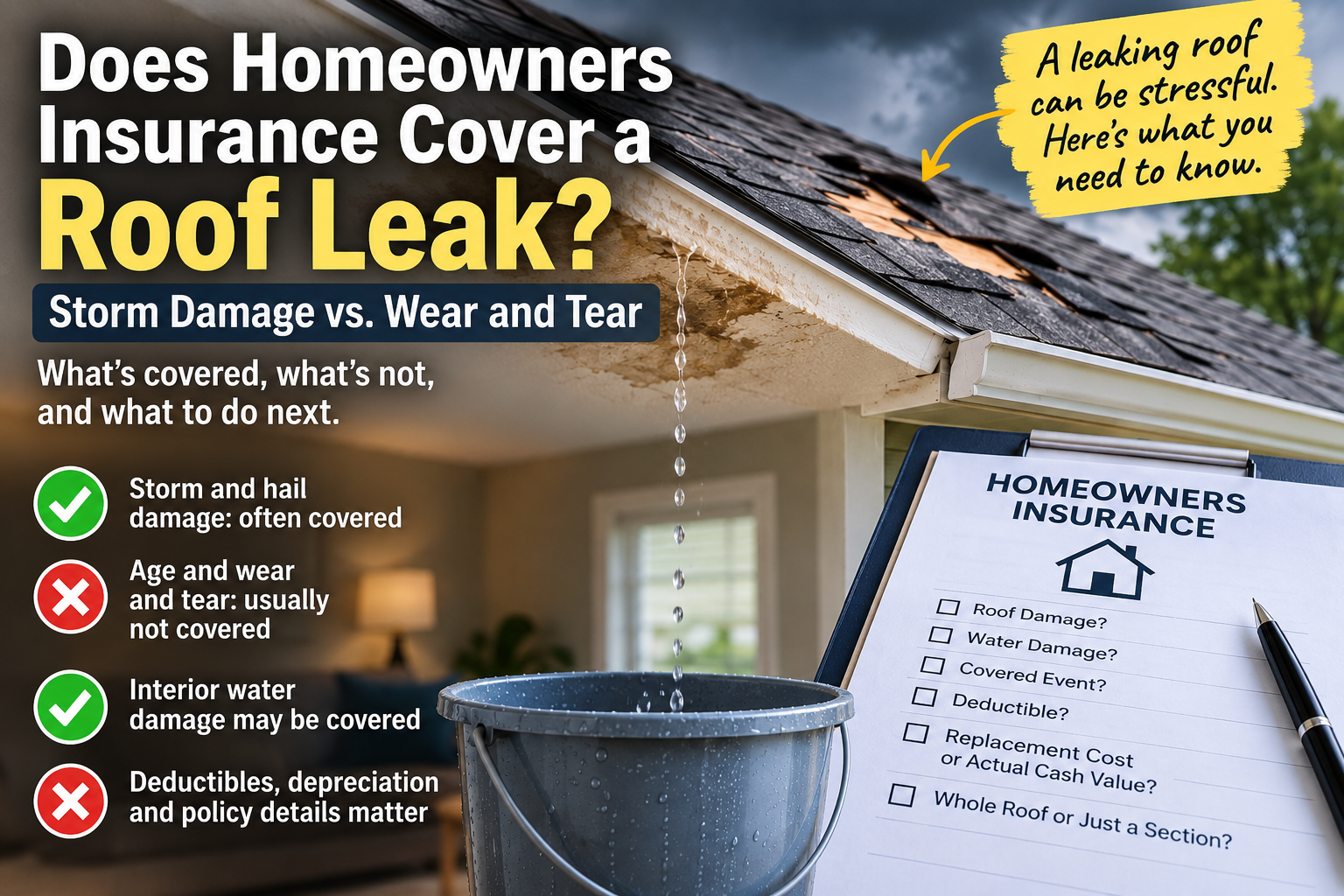
You discover a brown stain spreading across the bedroom ceiling after a storm. A roofer climbs onto the house, finds damaged shingles and tells you the roof may need substantial work.
The obvious question is whether homeowners insurance will pay for it. The answer usually depends less on the fact that your roof is leaking than on why it started leaking.
If wind tears shingles from a sound roof and rain enters through the damaged area, that can be a covered homeowners claim. If a 25-year-old roof has simply worn out and finally begins letting water through, insurance will usually not buy you a new one.
There are also several complications between those two easy examples. An old roof can still suffer legitimate storm damage. Your roof and the resulting damage inside the house may be evaluated differently. A policy that covers roof damage may pay only the roof’s depreciated value. And a large wind or hail deductible can turn an apparently covered loss into a claim with little or no insurance payment.
Here is how to think through a roof-leak claim before assuming either that insurance will replace everything or that you are entirely on your own.
The Short Answer: Does Homeowners Insurance Cover a Roof Leak?
Homeowners insurance can cover a leaking roof when the leak results from a peril covered by your policy. Common examples include wind, hail, fire, falling trees or branches, lightning, and in some cases damage caused by the weight of ice or snow.
Insurance generally does not pay because a roof has reached the end of its useful life, shingles have deteriorated gradually, flashing has been leaking for years, or maintenance was neglected.
| What Caused the Leak? | Typical Insurance Result |
|---|---|
| Wind tears off shingles | Often covered, subject to policy terms and deductible |
| Hail damages roof covering | Often covered unless hail is excluded or limited |
| Tree falls on roof | Often covered if caused by a covered event |
| Fire damages roof | Generally covered |
| Roof simply wears out | Generally not covered |
| Long-term rot or deterioration | Generally not covered |
| Poor installation or faulty workmanship | Usually not covered as the cause of loss |
| Floodwater enters house | Generally not covered by standard homeowners insurance |
The exact answer always comes from your policy. Homeowners policies differ by insurer, state, endorsements and exclusions, so the table above is a starting point rather than a promise of coverage.
The Insurance Company Is Really Asking: What Happened to the Roof?
A leaking roof is a symptom. For insurance purposes, the cause is usually what matters.
Imagine two houses on the same street develop leaks during the same rainstorm. On the first house, 60-mph winds rip shingles from the roof and rain immediately enters through the newly exposed decking. On the second, rain works its way through cracked, brittle shingles that have been deteriorating for years.
The visible result inside both homes may look nearly identical: wet insulation, stained drywall and water on the floor. The insurance analysis can be completely different.
State Farm’s current claims guidance lists wind, hail, fire, lightning and damage from a downed tree among roof losses that are typically covered. Wear and tear, rot, deterioration and improper workmanship are typically not covered. Progressive similarly says that a roof leak caused by a covered peril may be insured, while leaks caused by maintenance problems or ordinary wear generally are not.
You can review State Farm’s examples of commonly covered and excluded home losses and Progressive’s roof-leak coverage explanation.
An Old Roof Can Still Have a Covered Claim
Roof age complicates the analysis, but an old roof is not automatically uninsured.
A 17-year-old asphalt roof can still be damaged by a hailstorm. The insurance company should be evaluating whether a covered event damaged the roof, not merely whether the roof happens to be old.
Where age becomes important is in determining whether the damage was actually caused by the storm and how much the policy will pay.
After a major storm, an adjuster may see shingles that are brittle, cracked, curled or losing granules. The homeowner may see storm damage. The insurer may see long-term deterioration. A roofing contractor may identify both.
That is why documentation can become especially important on an older roof. Photographs showing the roof’s condition before the storm, maintenance records, prior inspection reports and evidence of a specific storm event can all help establish what changed.
Storm Damage and Wear Can Exist at the Same Time
Real claims are often messier than “storm” versus “old roof.”
Suppose your roof is 18 years old and approaching the end of its expected service life. Then a severe windstorm removes shingles from one slope and rain enters the attic.
The insurer does not necessarily have to pretend the roof was new, but neither does old age necessarily erase a covered storm event. The dispute may instead move to questions such as:
- Which damage was caused by the storm?
- Which deterioration already existed?
- Can the damaged area reasonably be repaired?
- What roof valuation method does the policy use?
- Is only one slope damaged or does more of the roof need replacement?
- Does the policy pay replacement cost or depreciated value?
This is one reason “My roof is old, so insurance won’t cover it” is too simplistic.
The Roof and the Water Damage Inside the House Are Two Different Problems
A roof leak can damage much more than shingles.
Water may affect:
- Roof decking
- Attic insulation
- Ceilings and drywall
- Paint and trim
- Flooring
- Furniture
- Electronics
- Clothing and other personal property
If a covered storm damages the roof and allows rain inside, dwelling coverage may apply to covered structural damage while personal-property coverage may apply to damaged belongings. If the house becomes temporarily uninhabitable after a covered loss, loss-of-use coverage may also help with additional living expenses, subject to the policy.
Progressive specifically notes that a covered roof leak may result in coverage for damaged floors, walls, ceilings and belongings in addition to the roof itself.
Do not assume, however, that every drop of water inside a house is covered. Long-term leakage, deterioration, maintenance problems and floodwater are treated very differently under homeowners policies.
Rain Through a Damaged Roof Is Not the Same as a Flood
This causes considerable confusion after severe weather.
If wind damages your roof and rain enters through the storm-created opening, you may have a homeowners claim based on the wind damage and resulting water intrusion.
If water rises from the ground and enters the house because the neighborhood flooded, that is generally a flood loss. Standard homeowners insurance normally excludes flooding, and separate flood insurance is typically required.
The fact that both losses involve “water in the house” does not make them the same insurance event.
Replacement Cost vs. Actual Cash Value Can Change the Claim by Thousands
Even when the insurer agrees that storm damage is covered, you still need to know how your roof is insured.
Two common approaches are replacement cost and actual cash value.
Replacement cost coverage generally pays the covered cost to repair or replace damaged property with comparable new property, subject to your deductible, limits and policy conditions.
Actual cash value coverage generally deducts depreciation for age and condition. An older roof can therefore produce a much smaller payment.
Some homeowners have replacement-cost coverage on most of the house but an endorsement that pays roof losses on an actual-cash-value basis. Others have age-based roof schedules that reduce the insurer’s share as the roof gets older.
The Texas Department of Insurance specifically warns homeowners that many policies now reduce roof coverage based on the roof’s age and material. Its consumer guidance says some policies pay the full cost of a new roof while others pay less because of age and condition.
See the Texas Department of Insurance explanation of replacement cost and actual cash value.
Example: A Covered Leak Can Still Produce a Disappointing Check
Suppose a hailstorm causes covered damage to a roof that would cost $20,000 to replace.
If your policy provides replacement-cost roof coverage and you have a $2,500 deductible, the ultimate covered amount could be based roughly on the $20,000 replacement cost less the deductible, subject to the insurer’s estimate and policy terms.
Now suppose the same roof is covered only for actual cash value and the insurer determines that age and condition have depreciated it by 50%. The starting value for the roof might then be only $10,000 before the deductible.
The storm did not change. The repair cost did not change. The difference is the coverage you bought.
That is why anyone shopping for homeowners insurance should ask specifically how the roof is covered rather than merely asking whether the dwelling has replacement-cost coverage.
Your Wind or Hail Deductible May Be Much Larger Than You Think
Another surprise can appear on the declarations page: the deductible for roof damage may not be the familiar $1,000 or $2,500 deductible you think you have.
Policies in storm-prone areas may have separate wind, hail, hurricane or named-storm deductibles. Some are expressed as a percentage of the home’s insured dwelling value.
For example, imagine a house with $500,000 of dwelling coverage and a 2% wind/hail deductible. That deductible is $10,000.
If a windstorm causes $8,000 of covered roof damage, there may be no insurance payment at all because the damage does not exceed the applicable deductible. Even a $15,000 loss could leave the homeowner responsible for the first $10,000.
The Texas Department of Insurance specifically advises homeowners to check whether the wind and hail deductible differs from the deductible for other losses.
Do this before a storm rather than discovering the number while water is dripping through your ceiling.
Will Insurance Replace the Entire Roof If Only Part Is Damaged?
Not necessarily.
A hailstorm might damage one slope of a roof while another slope remains intact. A tree might destroy a relatively small section. The contractor may recommend replacing the whole roof, while the insurer’s estimate pays only for the directly damaged area.
One common dispute involves matching. New shingles may not perfectly match shingles that have been exposed to sun and weather for years.
That aesthetic difference does not automatically mean every insurer must replace the entire roof. State rules, policy wording, repair feasibility and the extent of the mismatch can all matter.
The Texas Department of Insurance explicitly tells consumers that an insurer might not pay to replace an entire roof simply because replacement shingles do not perfectly match older undamaged shingles.
If this becomes an issue, ask the adjuster to explain in writing what portion of the roof the insurer believes is damaged, how it proposes repairing that area and which policy provision governs the scope of replacement.
What If the Roofer Says the Shingles Cannot Be Repaired?
This can be more significant than a purely cosmetic matching argument.
Old shingles can become brittle. Attempting to lift surrounding shingles to replace one damaged section can sometimes cause additional breakage. Certain materials may also be discontinued or difficult to repair according to the manufacturer’s required method.
If a roofing contractor believes the insurer’s proposed spot repair is not technically feasible, ask the contractor for specifics rather than a generic statement that “the whole roof needs replacement.”
Useful documentation may include:
- Photographs of the damaged area
- The exact shingle or roofing product
- Manufacturer repair instructions
- Evidence that the product has been discontinued
- Documentation of brittleness or failed repair attempts
- Building-code requirements
- A written explanation of why the proposed repair cannot be completed properly
A documented technical problem is more persuasive than a contractor simply preferring a larger job.
What If the Insurance Adjuster and Roofer Disagree?
That happens frequently enough that you should expect the two estimates to differ.
The roofer may find damaged flashing, underlayment or decking that was not visible during the initial inspection. The adjuster may conclude that some of the contractor’s proposed work is maintenance or undamaged property rather than part of the covered loss.
Instead of arguing generally about whether the estimate is “too low,” compare the documents line by line.
Ask:
- Which roof areas does each estimate say are damaged?
- How many roofing squares are included?
- Is tear-off included?
- Is underlayment included?
- Are flashing, drip edge and vents included?
- Is damaged decking included?
- What labor rates are being used?
- Are permit costs included?
- Does current building code require additional work?
If the contractor uncovers additional covered damage after work begins, ask how the insurer handles a supplemental claim rather than assuming the original estimate is necessarily the final word.
If the Leak Appears After a Storm, Document the Timeline
One of the hardest roof claims is the leak that appears after a storm on a roof that already has some age.
Write down what happened while the events are still fresh. Note the date and approximate time of the storm, when you first noticed water, which rooms were affected and whether there had been any leakage in that area beforehand.
Take photographs or video of:
- Interior water stains
- Active dripping
- Wet insulation
- Damaged belongings
- Missing or displaced shingles
- Tree or branch damage
- Hail accumulation if visible
- Any temporary repairs
If you have older photographs showing that the ceiling was clean or the roof appeared intact before the event, save those too.
Stop More Water From Coming In
Do not leave an open hole in the roof just because you are waiting for an insurance adjuster.
Insurance companies generally expect homeowners to take reasonable steps to prevent additional damage after a loss. That can mean having a qualified contractor install a temporary tarp or make another emergency repair.
Document the damage before temporary repairs when it is safe to do so, and save invoices and receipts. Avoid unnecessary permanent work that would erase evidence before the insurer has had an opportunity to inspect it.
Travelers advises policyholders to mitigate further damage, including using tarps to cover roof openings, and to retain receipts. Allstate similarly recommends documenting the loss before temporary repairs and keeping repair invoices.
If water is near electrical wiring, a sagging ceiling, a damaged tree or another dangerous condition, prioritize safety over claim documentation.
Do Not Let a Storm-Chasing Contractor Define Your Insurance Coverage
After a hailstorm or hurricane, roofing contractors may knock on doors and tell homeowners that insurance will pay for a completely new roof.
The contractor can inspect and estimate roof damage. The contractor does not control your insurance policy.
Be especially cautious about signing broad contracts, assignments, financing agreements or documents you do not understand before the insurer has evaluated the loss. A contractor’s statement that “insurance always pays for this” is not a substitute for reading the policy and the adjuster’s coverage decision.
Likewise, an insurer’s first estimate should not prevent you from presenting legitimate additional damage or repair requirements if the estimate missed something.
Should You File a Claim for Every Roof Leak?
Before treating every small leak as an insurance event, find out what caused it and what deductible applies.
If a roofer finds a $900 flashing repair and your homeowners deductible is $2,500, there may be nothing for the policy to pay even if the cause otherwise qualifies. If the same storm caused $25,000 of roof and interior damage, the economics look very different.
Do not delay reporting a significant loss while trying to perform a perfect investigation yourself. Policies can impose notice and cooperation requirements. But understanding the approximate damage, cause and applicable deductible can help you have a much more useful conversation with the insurer.
What to Ask Your Insurance Company About a Roof Leak
If you have a potentially covered loss, ask specific questions rather than simply asking, “Is my roof covered?”
- What peril does the insurer believe caused the damage?
- Which deductible applies? Ask specifically about wind, hail or named-storm deductibles.
- Is my roof covered for replacement cost or actual cash value?
- Is there an age-based roof payment schedule?
- Which sections of the roof does the insurer agree are damaged?
- How is resulting interior water damage being handled?
- Are damaged personal belongings included?
- If the contractor finds additional damage, how do I submit a supplement?
- If only part of the roof is being replaced, how is matching handled?
- If the home cannot safely be occupied, does loss-of-use coverage apply?
Getting clear answers to those questions is far more useful than arguing in the abstract about whether insurance “covers roofs.”
Check Your Roof Coverage Before You Need It
Roof insurance has been changing. Some policies cover roofs at full replacement cost. Others depreciate older roofs or use schedules that reduce payments as the roof ages. Wind and hail deductibles can also be substantially larger than the deductible that applies to other claims.
The declarations page and endorsements are worth reviewing before the next storm.
If your roof is aging, ask your insurer:
- How is the roof currently valued?
- At what age does coverage change?
- Is there a separate wind or hail deductible?
- Would replacing the roof restore broader coverage?
- Would a more impact-resistant roof qualify for a discount?
If you are considering replacement anyway, our guide to whether a metal roof can lower homeowners insurance explains how roof age, impact ratings and insurance discounts can interact.
You can also compare the longer-term economics in our metal roof vs. shingles cost guide.
The Question Is Not Whether the Roof Leaks. It Is Why.
A homeowners policy is designed to insure against covered losses, not to serve as a roof-replacement savings account.
If your roof reaches the end of its life and begins leaking because the materials have deteriorated, replacing it is normally a homeowner maintenance expense. If a windstorm, hailstorm, falling tree or another covered event damages the roof and creates the leak, the result can be very different.
Then come the second set of questions: what deductible applies, whether the roof is insured for replacement cost or depreciated value, how much of the roof actually needs replacement, and what happened to the interior of the house.
That is why two neighbors with apparently similar leaking roofs can receive dramatically different insurance settlements.
If you discover a leak after a storm, document the damage, take reasonable steps to stop further water intrusion, save receipts and determine what your policy actually says about the roof. The cause of the damage establishes whether you may have a covered loss. The details of the policy determine how valuable that coverage really is.
Write a Reply or Comment