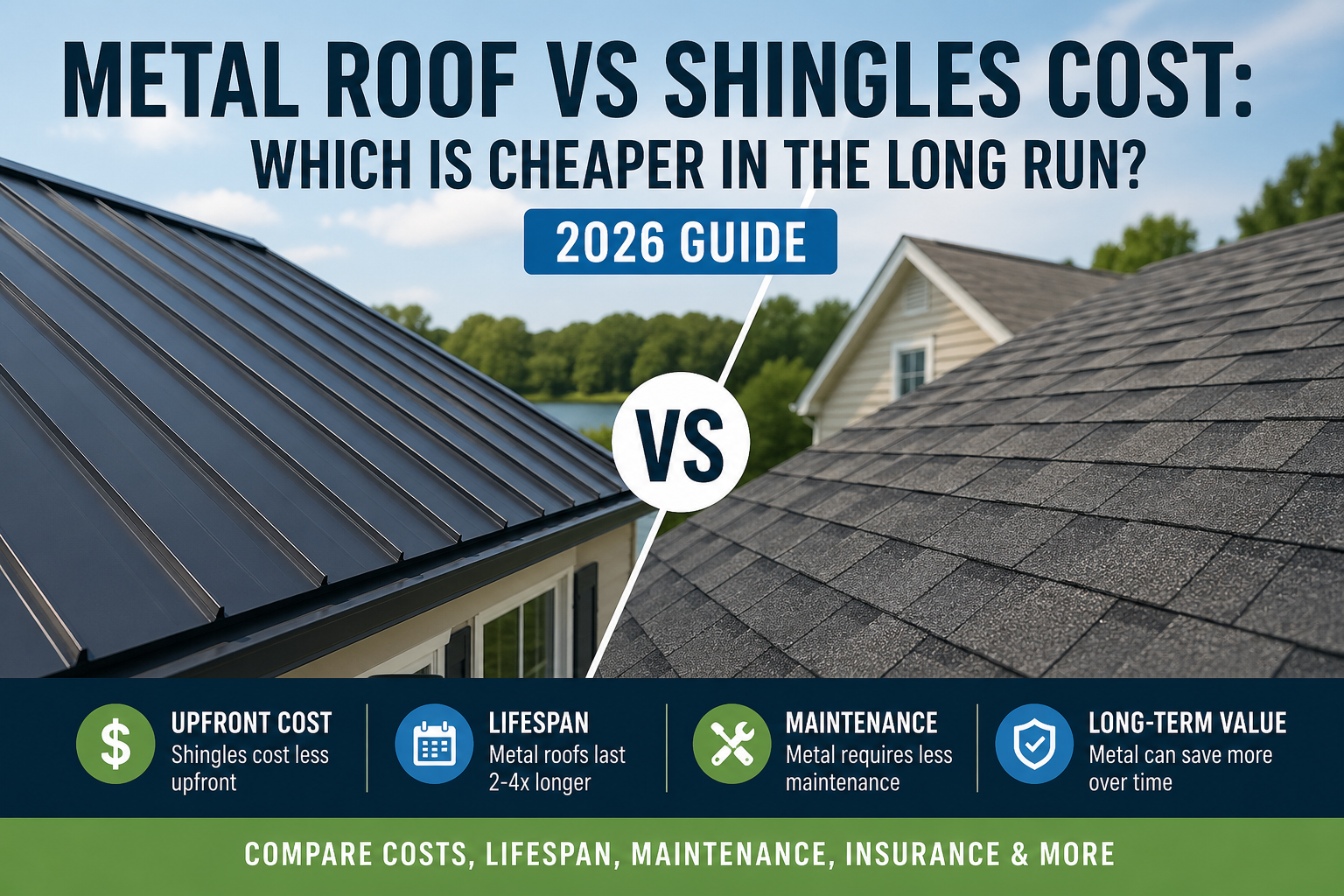
If you are replacing your roof, the cheapest choice on day one is usually obvious: asphalt shingles.
That is why shingles are so common. They are familiar, widely available, relatively fast to install, and usually much less expensive upfront than metal roofing.
But roof replacement is not only a day-one purchase. It is also a long-term ownership decision.
A shingle roof may need to be replaced after 15 to 30 years. A metal roof may last 40 to 70 years, and premium metal systems can last even longer. That means a homeowner who plans to stay in the same house for decades may pay less over time with metal, even if the first invoice is much higher.
So when comparing metal roof vs shingles cost, the real question is not simply “Which roof is cheaper?”
The better question is: which roof is cheaper for your home, your climate, your budget, and your timeline?
Quick Answer: Metal Roof vs Shingles Cost
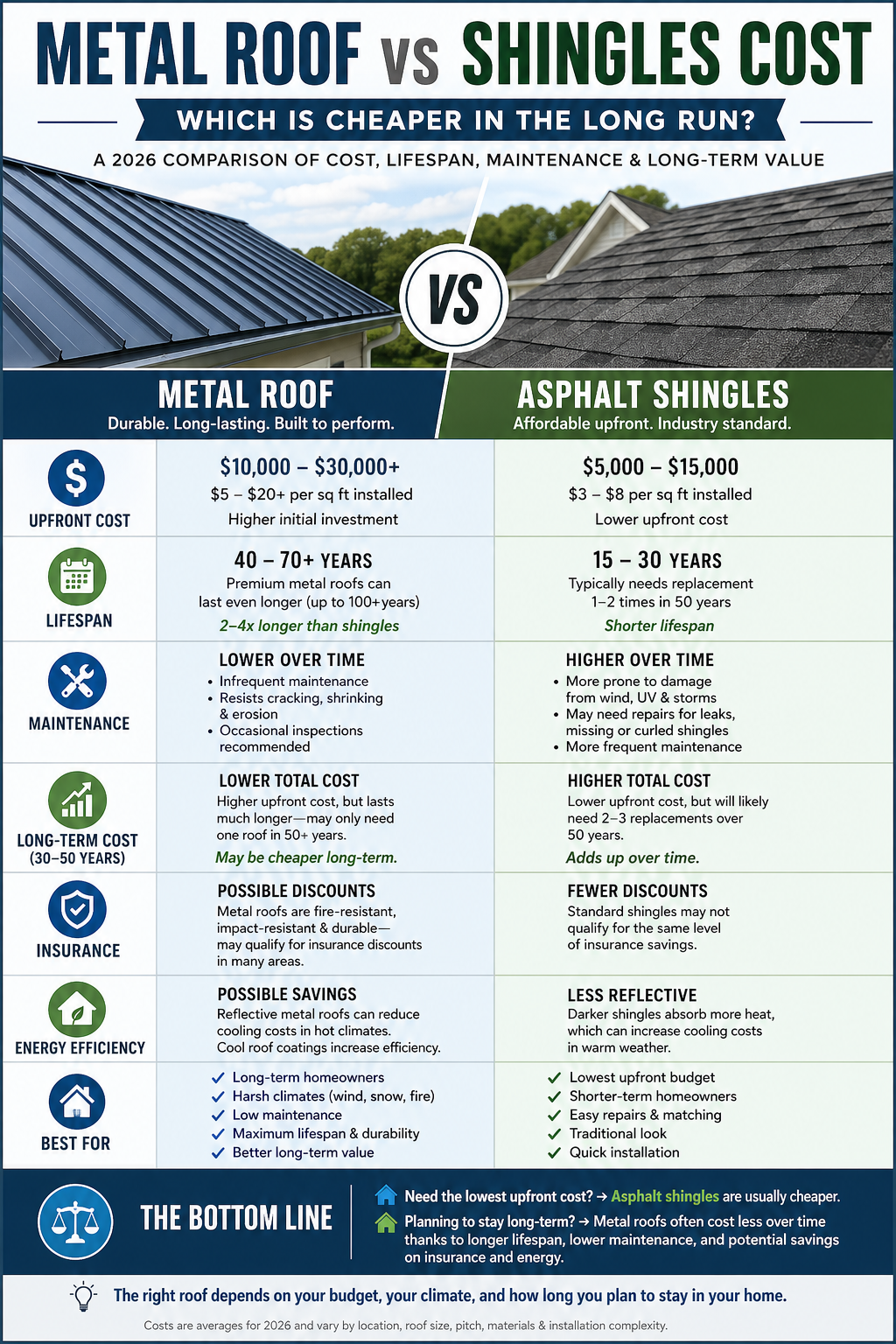
Asphalt shingles usually cost less upfront, while metal roofs may cost less over the long run. Shingles commonly cost about $3 to $8 per square foot installed, while metal roofing can range from about $5 to $20+ per square foot depending on material and style. Metal costs more initially, but it usually lasts much longer.
For homeowners who need the lowest immediate price, shingles usually win. For homeowners planning to stay in the home for decades, metal can become more attractive because it may avoid one or two future roof replacements.
Metal Roof vs Shingles Cost Per Square Foot
Roofing prices are often quoted by the square foot or by the “square.” One roofing square equals 100 square feet.
| Roof Type | Typical Installed Cost Per Sq Ft | General Cost Tier |
|---|---|---|
| 3-tab asphalt shingles | $3–$6 | Lowest upfront cost |
| Architectural asphalt shingles | $4–$8 | Moderate upfront cost |
| Corrugated or exposed-fastener metal | $5–$12 | Lower-cost metal option |
| Standing seam metal roofing | $10–$20+ | Premium metal option |
| Copper or zinc roofing | $20–$40+ | Luxury / specialty option |
Your exact cost will depend on labor rates in your area, roof complexity, roof pitch, and the number of valleys, skylights, dormers, and chimneys.
For context, NerdWallet estimates metal roofing at roughly $4 to $30 per square foot, while Fixr reports metal roofing averaging around $11 per square foot compared with about $4 per square foot for asphalt shingles. Those ranges are wide because “metal roof” can mean anything from a basic exposed-fastener panel to a high-end standing seam system.
Average Cost for a Full Roof Replacement
For an average-size home, shingles are usually the lower-cost option by a wide margin.
| Roof Type | Typical Total Installed Cost | Best Fit |
|---|---|---|
| 3-tab asphalt shingles | $5,000–$12,000 | Lowest upfront budget |
| Architectural shingles | $7,000–$15,000 | Common residential upgrade |
| Corrugated metal roof | $10,000–$20,000 | Budget metal option |
| Standing seam metal roof | $15,000–$30,000+ | Long-term premium option |
A complicated roof can cost much more. Steep pitch, multiple dormers, valleys, chimneys, skylights, and two-story access all increase labor cost.
That matters because roofing is not just a materials purchase. Installation quality is a major part of the price, especially with metal roofing. A standing seam roof requires more specialized labor than a standard shingle roof.
Why Metal Roofs Cost More Upfront
Metal roofs cost more for several reasons.
- Materials cost more. Steel, aluminum, copper, zinc, coatings, clips, fasteners, and trim components are more expensive than asphalt shingles.
- Labor is more specialized. Proper metal roof installation requires training, precision, and careful detailing around penetrations and seams.
- Roof preparation matters. Underlayment, ventilation, decking repairs, and flashing details all affect performance.
- Standing seam systems are more complex. Concealed fasteners and custom panel work cost more than exposed-fastener panels.
This is why a metal roof can cost two or three times as much upfront as shingles. That does not automatically make it a bad deal. It means the financial case depends heavily on how long the roof lasts.
Long-Term Cost Over 30 to 50 Years
The long-term math is where metal roofing becomes competitive.
Suppose a homeowner installs an architectural shingle roof for $12,000 and it lasts 22 years. If the homeowner stays in the home for 50 years, that roof may need to be replaced twice.
| Scenario | Estimated Cost |
|---|---|
| Shingle roof now | $12,000 |
| Replacement after 20–25 years | $16,000–$20,000 |
| Possible later replacement | $20,000+ |
| Total over long ownership period | $28,000–$50,000+ |
Now compare that with a $24,000 standing seam metal roof that lasts 50 years or more. The metal roof costs more on day one, but it may avoid at least one full replacement.
That is the key financial argument for metal roofing.
It is not that metal is cheaper to buy. It usually is not. The argument is that metal may be cheaper to own.
We covered the lifespan side in more detail in our guide to how long a metal roof lasts.
Cost Per Year: A Better Way to Compare Roofs
One useful way to compare metal roofing and shingles is cost per year.
| Roof Type | Example Cost | Example Lifespan | Cost Per Year |
|---|---|---|---|
| Asphalt shingles | $12,000 | 20 years | $600/year |
| Architectural shingles | $15,000 | 25 years | $600/year |
| Metal roof | $24,000 | 50 years | $480/year |
| Premium metal roof | $35,000 | 70 years | $500/year |
This is simplified math, and it does not include repairs, insurance, financing, or inflation. But it shows why the cheapest roof upfront is not always the cheapest roof over time.
Maintenance Cost: Metal Roof vs Shingles
Maintenance is another major difference.
Asphalt shingles can suffer from missing shingles, curling, cracking, granule loss, moss, algae, and storm damage. Repairs are usually straightforward, but they can add up over time.
Metal roofs usually require less routine maintenance, but they are not maintenance-free. Exposed-fastener systems may need fastener checks or replacement as rubber washers age. Standing seam systems have fewer exposed components, but seams, flashing, penetrations, and coatings still need inspection.
Over a long period, shingles are usually more likely to need patching and partial repairs. Metal roofs are usually more expensive to repair when something does go wrong, but problems may occur less often if the roof was installed correctly.
Roof Lifespan: The Biggest Cost Difference
Lifespan is the main reason homeowners consider metal roofing despite the higher cost.
| Roof Type | Typical Lifespan |
|---|---|
| 3-tab shingles | 15–25 years |
| Architectural shingles | 20–30 years |
| Exposed-fastener metal | 20–40 years |
| Standing seam metal | 40–70+ years |
| Copper / zinc | 70–100+ years |
This is why comparing “metal vs shingles” without considering roof style can be misleading.
A basic exposed-fastener metal roof is not the same product as a premium standing seam metal roof. Likewise, a basic 3-tab shingle roof is not the same as a high-end architectural shingle roof.
Metal Roof vs Shingles in Different Climates
Your climate can change the math.
Hot climates
Metal roofing can reflect sunlight and reduce attic heat, especially when paired with reflective coatings. That may lower cooling costs in hot areas.
Cold and snowy climates
Metal roofs shed snow more easily than shingles. That can reduce snow load and may help limit ice dam problems, though snow guards may be needed in some areas.
Hail-prone areas
Hail complicates the comparison. Shingles can lose granules or crack. Metal can dent, especially softer metals like aluminum or copper. Some insurers treat cosmetic denting differently from functional damage.
Coastal areas
Salt air can accelerate corrosion. Aluminum may perform better than steel in coastal environments, but proper coatings and material selection matter.
Wildfire-prone areas
Metal roofing can be attractive in fire-prone regions because it is noncombustible. That may matter for both safety and insurance.
Insurance Differences
Some insurers may offer discounts for durable, fire-resistant roofing materials. Others may not.
In hail-prone regions, some policies may include cosmetic damage exclusions for metal roofs. That means the roof might be dented but not covered if the damage does not affect function.
Before choosing a roof, ask your insurer:
- Will a metal roof lower my premium?
- Do you treat cosmetic hail damage differently?
- Are there discounts for Class 4 impact-rated shingles or metal roofing?
- Will roof age affect future coverage?
The insurance answer can vary by state, insurer, and roof type.
Energy Savings
Metal roofs can reduce cooling costs in some homes because they reflect more solar heat than dark shingles. The exact savings depend on your climate, attic insulation, roof color, ventilation, and utility rates.
A light-colored or reflective metal roof may be especially helpful in hot climates. In colder climates, the savings may be less dramatic.
Energy savings alone usually do not justify the entire price difference between metal and shingles, but they can help narrow the long-term cost gap.
Resale Value
A metal roof may improve resale value, especially if buyers in your area value durability, curb appeal, and lower maintenance.
But resale value depends on timing.
If you install a metal roof and sell the home one year later, you may not recover the full cost. If you stay for 15 or 20 years, the roof may provide value through avoided replacement, lower maintenance, and buyer confidence when you eventually sell.
For homeowners planning to move soon, shingles may be the more financially practical choice.
Can You Install a Metal Roof Over Shingles?
Sometimes, yes.
Installing metal roofing over existing shingles can reduce tear-off and disposal costs. It can also reduce landfill waste.
But it is not always appropriate.
You should not install metal over shingles if the existing roof has leaks, soft decking, trapped moisture, multiple layers, poor ventilation, or structural problems. Local building codes also matter.
Some metal roofing manufacturers allow installation over old shingles under the right conditions, but the roof must be detailed correctly.
When Shingles Are the Better Choice
Shingles may be better if:
- you need the lowest upfront cost
- you plan to sell soon
- your neighborhood mostly has shingle roofs
- you want easier matching for future repairs
- you are financing the project and interest costs matter
There is nothing wrong with choosing shingles. They are popular for a reason.
When Metal Roofing Is the Better Choice
Metal may be better if:
- you plan to stay in your home long term
- you want to avoid another roof replacement
- you live in a harsh climate
- you value lower maintenance
- you want a premium look
- insurance or energy savings improve the math
Metal roofing is often most attractive for homeowners thinking in decades rather than years.
Metal Roof vs Shingles: Which Is Cheaper?
For most homeowners, shingles are cheaper upfront.
For long-term homeowners, metal can be cheaper over the full life of the roof.
The break-even point depends on:
- installation cost
- roof lifespan
- maintenance costs
- insurance savings
- energy savings
- how long you stay in the home
If you are only looking at the first invoice, shingles usually win.
If you are looking at the next 40 to 50 years, metal deserves serious consideration.
Related Roofing Guides
- How Long Does a Metal Roof Last?
- How Much Will Your Metal Roof Cost?
- Is a Metal Roof the Best Financial Decision?
- Metal Roofing 101
The Bottom Line
Metal roofs cost more upfront, but they often last much longer than shingles.
If you need the lowest immediate price, asphalt shingles are usually the better choice. If you plan to stay in your home for decades, metal roofing may offer better long-term value.
The smartest decision is not simply choosing the cheaper roof. It is choosing the roof that fits your budget, timeline, climate, and long-term plans.
Frequently Asked Questions
Are metal roofs cheaper than shingles?
Metal roofs are usually more expensive upfront. They may be cheaper over time because they last longer and may require fewer replacements.
How much more does a metal roof cost than shingles?
A metal roof may cost two to three times as much as shingles upfront, depending on the material and installation.
Is a metal roof worth the extra cost?
It can be worth it if you plan to stay in the home long term, want lower maintenance, or live in a climate where durability matters.
Do metal roofs lower insurance?
Sometimes. Some insurers offer discounts for fire-resistant or impact-resistant roofing, but this varies by location and policy.
Do metal roofs save energy?
They can reduce cooling costs in hot climates, especially when using reflective finishes and proper ventilation.
Can you install a metal roof over shingles?
Sometimes, if local code allows it and the existing roof is dry, structurally sound, and not hiding damage.
Is a metal roof louder than shingles?
Not usually when installed with proper underlayment and attic insulation.
Which roof lasts longer?
Metal roofs usually last much longer than asphalt shingles.
Write a Reply or Comment