Updated July 2026
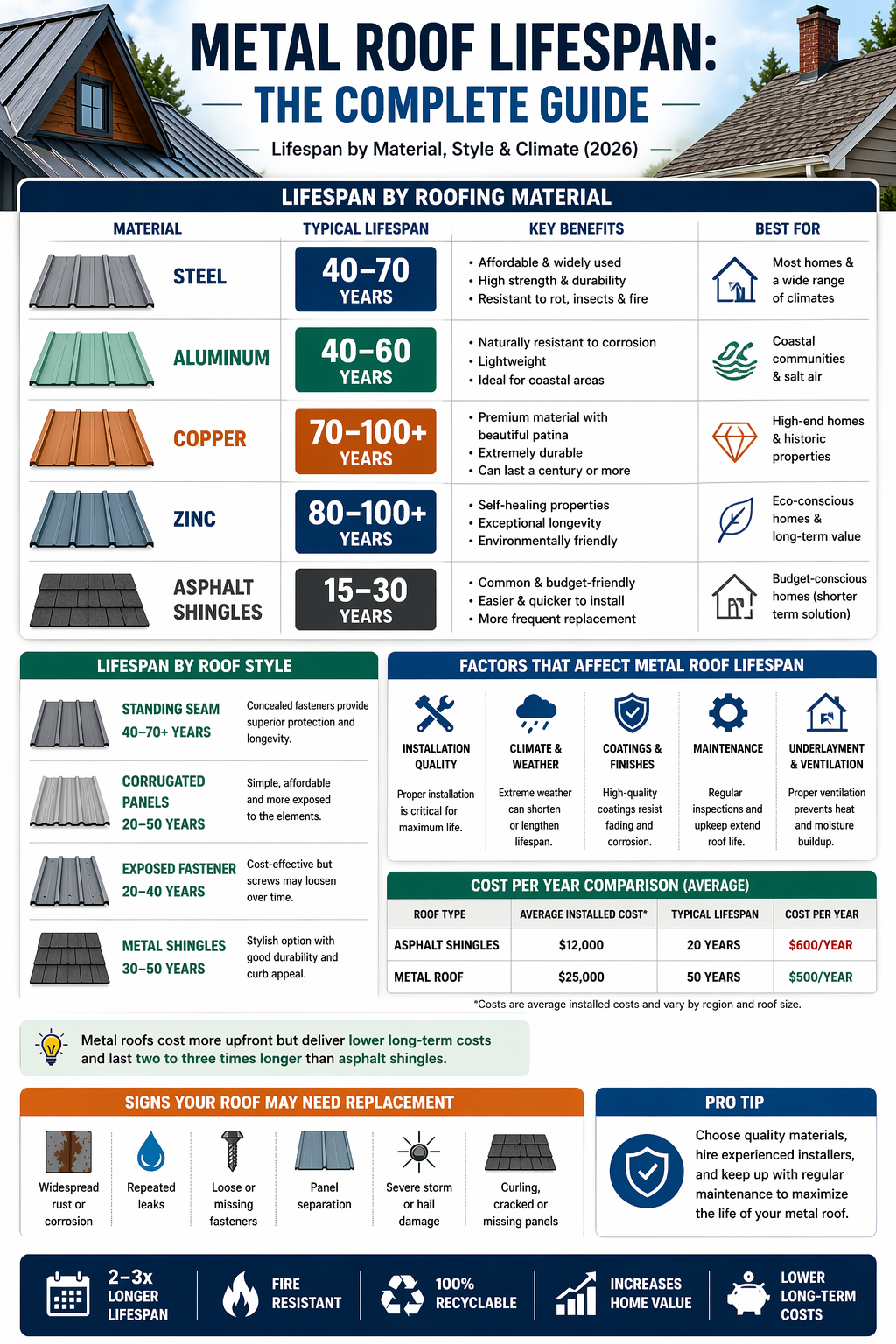
Quick answer: Most residential metal roofs last 40 to 70 years. Exposed-fastener steel systems may last 20 to 40 years, while standing-seam roofs often last 40 to 70 years or longer. Premium copper and zinc roofs can last 70 to 100 years or more.
A metal roof is not one standardized product. Its lifespan depends on the metal, protective coating, panel design, fastener system, installation quality, climate, ventilation and maintenance.
That is why two homes described as having “metal roofs” can have very different replacement timelines. A properly installed standing-seam roof with concealed fasteners should generally outlast a lower-cost panel system with exposed screws and aging washers.
If you are deciding whether the longer lifespan justifies the upfront price, see our comparison of metal roof versus shingles cost.
Metal Roof Lifespan by Material and Roof System
The material matters, but the way the roof is built may matter just as much. A concealed-fastener standing-seam steel roof can have a much longer service life than a lower-cost exposed-fastener steel roof, even though both are described simply as metal roofing.
| Metal Roof Type | Typical Lifespan | What Usually Limits Its Life |
|---|---|---|
| Exposed-fastener steel panels | 20–40 years | Aging washers, loose screws, corrosion and repeated maintenance |
| Standing-seam coated steel | 40–70+ years | Coating condition, seams, flashing, sealants and installation quality |
| Steel or aluminum metal shingles | 30–50+ years | Finish, interlocking details, flashing and storm damage |
| Aluminum roofing | 40–70 years | Denting, finish wear, fasteners and installation details |
| Copper roofing | 70–100+ years | Seams, flashing, fasteners, substrate and workmanship |
| Zinc roofing | 80–100+ years | Installation details, underside corrosion and incompatible materials |
These ranges are planning estimates rather than guarantees. A well-installed roof in a favorable environment may exceed them. A poorly detailed roof can leak or require major repairs much earlier even when the metal panels remain structurally sound.
How Long Does a Steel Roof Last?
Steel is the most common residential metal-roofing material because it offers a useful balance of price, strength and durability. Most steel roofing is protected by a metallic coating, a painted finish or both.
A properly installed standing-seam coated-steel roof can reasonably be expected to last 40 to 70 years. The Metal Construction Association has reported an expected service life exceeding 60 years for certain aluminum-zinc-coated steel standing-seam systems installed using best practices.
You can read the association’s metal-roof service-life assessment.
That does not mean every steel roof will last 60 years. The result depends on the coating, metal thickness, panel profile, roof slope, fasteners, flashing and local exposure.
Galvanized steel
Galvanized steel is protected with a zinc coating. Once the coating is damaged or consumed, exposed steel can begin to rust. Scratches, cut edges, standing water and coastal exposure can accelerate deterioration.
Aluminum-zinc-coated steel
Steel coated with an aluminum-zinc alloy is widely used for standing-seam and agricultural-style roofing. It generally provides strong corrosion resistance, although product suitability still depends on the environment and manufacturer’s specifications.
Painted steel
The painted finish may fade, chalk or lose gloss long before the steel panels need replacement. A roof can therefore look weathered while remaining serviceable.
Ask contractors to identify both the metal coating and the paint system. “Metal roof” alone does not tell you enough to estimate lifespan.
How Long Does an Aluminum Roof Last?
Aluminum roofing commonly lasts 40 to 70 years. Unlike steel, aluminum does not produce red rust, making it a common choice near salt water and in other corrosive environments.
Aluminum is lighter and softer than steel. It may be more vulnerable to visible denting from hail, falling branches or careless foot traffic. A dent is not automatically a leak, but severe impact damage can affect seams and panel attachment.
Coastal homeowners should still verify that the fasteners, clips, flashing and other roof components are compatible with the aluminum panels. A corrosion-resistant panel does not protect an incompatible fastener or poorly selected accessory.
How Long Do Copper and Zinc Roofs Last?
Copper and zinc are premium roofing materials with potential service lives of 70 to more than 100 years. Their high initial cost means they are most often used on historic buildings, high-end homes, architectural features, dormers and porches.
Both metals develop protective surface layers as they weather. Copper gradually develops its familiar brown and green patina. Zinc can form a protective patina that helps cover minor surface scratches.
The long-lived metal does not eliminate the need for careful workmanship. Seams, transitions, penetrations, flashing and attachment methods must be designed for the way the metal expands, contracts and interacts with neighboring materials.
Standing Seam vs. Exposed Fasteners
The roof system often explains more about expected lifespan than the metal name alone.
Standing-seam roofs
A standing-seam roof uses raised vertical seams and concealed fasteners. Clips beneath the panels hold the roofing to the deck while allowing controlled movement as the metal expands and contracts.
Because most fasteners are protected from direct exposure to rain and sunlight, standing-seam systems generally require less fastener maintenance and offer a longer potential service life.
Exposed-fastener roofs
Exposed-fastener panels are attached by screws driven through the face of the metal. Each screw normally includes a sealing washer.
The system is less expensive and is widely used on garages, barns, workshops and some homes. Its weakness is the number of exposed penetrations. Over time, washers can harden, screws can loosen, holes can enlarge and fasteners may need to be replaced.
An exposed-fastener roof can still provide decades of service, but it should not be sold as the maintenance equivalent of a properly installed concealed-fastener system.
What Usually Fails First on a Metal Roof?
The metal panel is only one part of the roof. A roof can begin leaking even when the panels still have decades of useful life remaining.
Fasteners and washers
Exposed screws experience temperature changes, moisture and movement. Loose, backed-out, corroded or overdriven fasteners can create leak paths. Replacing aging screws may extend the life of an otherwise sound roof.
Sealants
Sealants are used at laps, transitions, penetrations and other details. They must be compatible with the metal and installed in the correct location. Smearing general-purpose caulk over the outside of a leaking seam is rarely a durable repair.
Flashing
Chimneys, skylights, plumbing vents, walls, valleys and roof edges are common failure points. Poorly designed or installed flashing can produce leaks long before the field panels wear out.
Paint and protective coatings
Fading and chalking affect appearance but do not necessarily mean the roof has failed. Peeling, blistering or widespread coating loss is more concerning because it can expose steel to corrosion.
Underlayment and roof deck
Metal panels may outlast some concealed components beneath them. Leaks, trapped moisture or condensation can damage underlayment and roof decking without obvious panel failure.
This is one reason a contractor should inspect the entire roof assembly rather than judging lifespan from the visible metal alone.
How Installation Affects Metal-Roof Lifespan
Metal roofing is less forgiving of poor detailing than its simple appearance suggests. Common installation problems include:
- Fasteners driven too tightly, too loosely or at an angle
- Inadequate allowance for thermal movement
- Poorly formed or incompletely seamed standing-seam panels
- Incorrect flashing around chimneys, walls and penetrations
- Incompatible metals or fasteners
- Panels cut in ways that damage protective coatings
- Improperly placed sealant
- Insufficient ventilation or condensation control
- Weak attachment for the expected wind loads
A premium panel installed badly can perform worse than a less expensive system installed correctly. When comparing bids, examine the proposed roof assembly, contractor experience, flashing details and installation warranty—not only the brand of metal.
How Climate Changes Metal-Roof Lifespan
Coastal salt air
Salt exposure can accelerate corrosion of steel panels, cut edges, fasteners and accessories. Aluminum is often selected near the coast, but every component still needs to be suitable for the exposure.
Homeowners near salt water should check the manufacturer’s coastal restrictions and warranty exclusions before choosing a product.
Snow and ice
Metal sheds snow more readily than many rougher roofing materials. That can reduce prolonged snow loading, but sliding snow may create a hazard above doors, walkways, vehicles and lower roofs.
Snow-retention systems must be designed for the roof and local snow loads. Randomly screwing snow guards through finished panels can create new leak points.
Ice dams are usually connected to heat loss, air leakage and roof-assembly design rather than the metal itself. Replacing shingles with metal will not correct an underlying insulation or ventilation problem.
Hail
Hail can dent metal roofing, particularly softer metals and thinner panels. Cosmetic denting does not always shorten the roof’s functional life, but severe hail can damage seams, coatings, flashing and penetrations.
Ask whether the proposed roofing has an impact-resistance classification and how your insurance policy treats cosmetic metal-roof damage.
Heat and sunlight
Metal panels expand and contract as temperatures change. A properly designed system accommodates that movement. Poorly detailed long panels, rigid attachment or incorrect clips can place stress on seams and fasteners.
Strong sunlight may also fade or chalk painted finishes. The paint warranty may end well before the structural roof reaches the end of its life.
Leaves and debris
Leaves, pine needles and branches can trap moisture against valleys, flashing and low-slope areas. They can also block gutters and cause water to back up where it would normally drain.
How Maintenance Extends the Life of a Metal Roof
Metal roofs are relatively low-maintenance, but they are not maintenance-free. The National Roofing Contractors Association recommends residential roof inspections at least twice a year, preferably in spring and fall, along with additional inspections after severe weather.
See the NRCA’s residential roof-maintenance guidance.
A useful maintenance routine includes:
- Inspecting the roof after hail, high winds and falling branches
- Removing leaves and debris from valleys and drainage paths
- Keeping gutters and downspouts clear
- Checking exposed screws and washers
- Looking for scratches, coating damage and early corrosion
- Inspecting flashing around chimneys, skylights and vents
- Checking sealant only where the roof design requires it
- Trimming branches that scrape the roof or drop heavy debris
- Investigating interior stains, damp insulation or attic moisture promptly
Do not walk on a metal roof unless you know where it is safe to step. Panels can be slippery, and walking in the wrong location can dent the metal or damage seams. Hire a qualified contractor for close inspection and repairs.
Warranty Length Is Not the Same as Roof Lifespan
A metal roof may have several separate warranties:
- A substrate or corrosion warranty
- A paint-finish warranty
- A weathertightness warranty
- A contractor’s workmanship warranty
These warranties may cover different problems for different lengths of time. They may also be prorated or subject to exclusions for coastal exposure, ponding water, incompatible materials, improper maintenance or installation errors.
A 40-year paint warranty does not necessarily promise that the roof will remain leak-free for 40 years. It may cover only specific levels of fading, chalking or coating failure.
Before signing a contract, ask for the complete warranty documents rather than relying on a salesperson’s summary.
When Can a Metal Roof Be Repaired?
Many metal-roof problems can be repaired without replacing the entire roof. Repair may be reasonable when the damage is limited to:
- A small number of loose or failed fasteners
- One damaged panel
- Localized flashing problems
- A leaking penetration
- Minor coating damage or early surface corrosion
- Storm damage confined to one roof area
The repair needs to address the source of the problem. Repeatedly coating or caulking over a leak without correcting movement, flashing or attachment problems may only delay a larger repair.
Signs a Metal Roof May Need Replacement
Replacement becomes more likely when the problems are widespread or built into the roof system:
- Extensive corrosion or perforated panels
- Leaks occurring in many unrelated areas
- Widespread seam or fastener failure
- Panels that were installed without adequate room for expansion
- Severely deteriorated decking beneath the roof
- Extensive storm damage
- Repeated repairs that no longer provide durable results
- A roof system that cannot be safely or economically repaired
Age alone does not determine whether replacement is necessary. A 30-year-old standing-seam roof may have considerable life remaining, while a much newer roof with serious installation defects may already require major work.
How Much Does a Metal Roof Cost Per Year?
Dividing installation cost by expected lifespan can help compare roofing choices, but it is only a rough planning tool.
| Example Roof | Installed Cost | Assumed Life | Simple Annualized Cost |
|---|---|---|---|
| Asphalt shingles | $12,000 | 20 years | $600 per year |
| Metal roofing | $25,000 | 50 years | $500 per year |
These figures are examples, not national price estimates. Actual costs vary by roof size, pitch, location, tear-off requirements, decking repairs, metal type and labor market.
The calculation also ignores financing costs, maintenance, repairs, future replacement prices and the time value of money. Its value is showing why a roof with a higher upfront cost can still be competitive if it remains in service much longer.
For a more complete comparison, read metal roof versus shingles cost.
Is a Metal Roof Worth It for a Long-Term Home?
A metal roof is easiest to justify when you expect to keep the property long enough to benefit from its durability, or when avoiding another roof replacement has substantial value.
It may be particularly attractive when:
- You expect to own the house for decades
- The roof has a simple shape suited to metal panels
- The property is exposed to high winds or wildfire risk
- You want to install solar panels on a roof with a comparable service life
- Future roof access or replacement would be difficult
- You value lower replacement frequency more than the lowest initial price
The case is weaker when the project uses a low-cost exposed-fastener system but is being priced and marketed as though it were a premium standing-seam roof.
How Long Your Metal Roof Is Likely to Last
Most residential metal roofs can provide 40 to 70 years of service, but the useful range is much wider. Exposed-fastener systems may require major maintenance or replacement sooner, while well-designed standing-seam steel, copper and zinc roofs can remain in service for many decades.
The most important questions are not simply whether the roof is metal or how long the panel warranty lasts. Ask which metal and coating are being used, whether the fasteners are exposed, how the roof handles expansion, what flashing details are proposed and who is responsible if the installation leaks.
A good metal roof is a complete system. Its panels, fasteners, clips, seams, flashing, underlayment, deck and installation all need to remain functional together.
Frequently Asked Questions
Can a metal roof last 100 years?
Yes. Properly designed copper and zinc roofs can last 70 to more than 100 years. Some coated-steel standing-seam roofs may also exceed their commonly quoted lifespan when installed well and maintained appropriately.
Which type of metal roof lasts the longest?
Copper and zinc generally have the longest potential material life. Among more common residential steel systems, standing-seam roofing usually lasts longer than exposed-fastener roofing because its fasteners are concealed from direct weather exposure.
How long does a standing-seam metal roof last?
A standing-seam steel roof commonly lasts 40 to 70 years or longer. Coating quality, climate, flashing, roof design and installation workmanship can move an individual roof toward either end of that range.
How long does an exposed-fastener metal roof last?
Exposed-fastener roofs commonly last 20 to 40 years. Their panels may remain usable longer, but screws and sealing washers require inspection and may need replacement during the roof’s life.
Do metal roofs rust?
Steel roofs can rust if their protective coating is damaged, wears away or is unsuitable for the environment. Aluminum, copper and zinc resist corrosion differently but can still experience problems involving incompatible metals, fasteners and installation details.
Does a faded metal roof need replacement?
Not necessarily. Fading and chalking primarily affect appearance. Replacement is more likely when there is widespread corrosion, panel perforation, recurring leaks or system-wide seam and fastener failure.
How often should a metal roof be inspected?
Inspect it in spring and fall and after significant hail, wind or falling debris. Exposed-fastener roofs and roofs surrounded by trees may require closer attention.
Can you install solar panels on an older metal roof?
Possibly, but the remaining roof life should exceed or at least closely match the expected life of the solar installation. Have the roof, seams, coating, flashing and attachment plan evaluated before mounting solar equipment.
Can hail damage a metal roof?
Yes. Hail can dent panels and may damage coatings, seams or flashing. Cosmetic dents do not always reduce service life, but severe or functional damage should be inspected promptly.
Is a metal roof better than asphalt shingles?
Metal generally lasts longer and may reduce the number of future replacements. Asphalt shingles usually cost less initially. The better choice depends on the roof design, expected ownership period, climate, budget and quality of the available contractors.
Write a Reply or Comment