
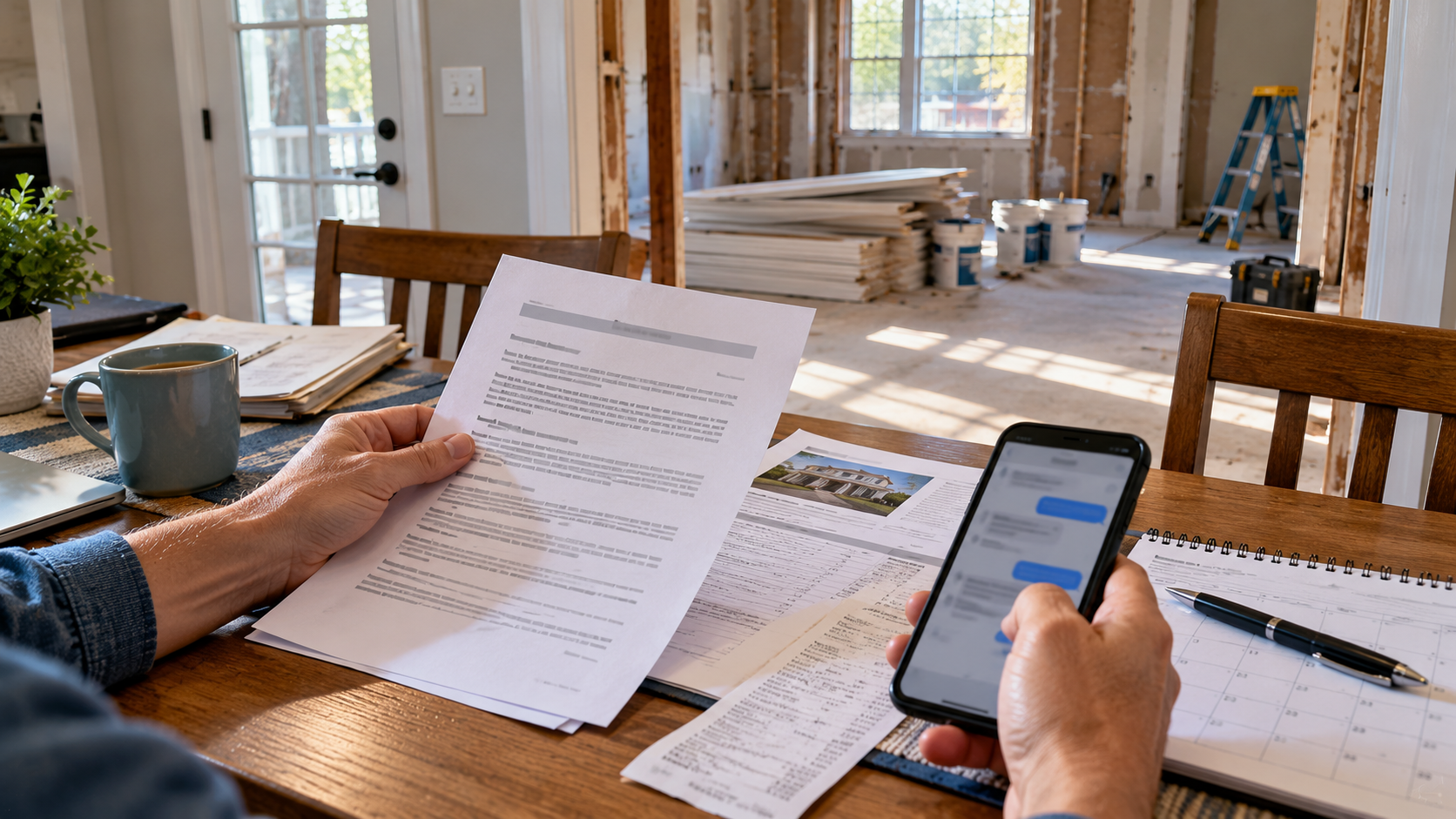
You paid a contractor a deposit for a roof, kitchen, bathroom or other home project. The agreed start date came and went, and now the contractor is making excuses, promising another date or no longer responding. You may be entitled to recover some or all of the deposit, but the quickest route depends on how you paid, what the agreement says and where the property is located.
Get DealyPlanet by email Practical help with insurance claims, expensive repairs and consumer problems.
Start by preserving the contract and payment records, then establish in writing what the contractor actually did with your money. If you paid by credit card, contact the issuer promptly rather than waiting through repeated promises: important dispute deadlines can run while the contractor delays. For checks, transfers and cash, a documented refund demand followed by the appropriate licensing, bond or court process is often more realistic.
Establish what the contractor owes before demanding it back
Find the signed contract, proposal or text exchange that identifies the work, start date, payment schedule and cancellation terms. Save the deposit receipt, canceled check, card statement or transfer confirmation, along with messages about delays. Photograph the untouched job site and keep a dated record of missed appointments. If the contract allows weather, permitting or supply-related delays, determine whether those conditions actually apply and whether a required notice-and-cure period must pass before termination.
A contractor who has done no work may still assert that money was spent on permits, plans or custom-ordered materials. Ask for invoices, proof of payment, descriptions of materials and their location, and whether the materials can be returned or transferred to you. An unsupported claim that a deposit is “nonrefundable” doesn’t automatically settle the matter, but neither does a missed start date automatically guarantee a full refund under every contract and state law.
Consider a hypothetical $12,000 renovation with a $4,000 deposit and no work started. If the contractor can prove $600 was legitimately spent on nonreturnable materials under an enforceable contract, the amount in dispute may differ from a case where no materials were purchased at all. That $600 is an illustrative claim, not an automatic deduction: the contract, applicable deposit restrictions, ownership of materials and evidence of actual expense determine whether anything can properly be retained.
Use the payment method before its recovery window closes
| How you paid | First recovery step | Important limitation |
|---|---|---|
| Credit card | Ask issuer about a dispute for services not provided; preserve the written billing-error deadline. | A dispute is investigated, not automatically granted. |
| Debit card | Contact your bank immediately and ask about its card-network dispute process. | Protections and deadlines can differ from credit cards. |
| Check | Ask your bank whether payment cleared; pursue the contractor if it has. | A routine stop-payment request generally cannot undo a cleared check. |
| Wire, payment app or cash | Contact the provider immediately, then focus on a written demand and recovery through other channels. | Authorized payments are often difficult to reverse. |
For credit cards, the Consumer Financial Protection Bureau says a written billing-error notice generally must reach the issuer within 60 calendar days after the charge first appeared on your statement. A charge for goods or services not delivered as agreed may qualify, depending on the circumstances. Call the issuer immediately and follow its instructions for a formal written notice; an online dispute or phone call alone may not preserve every federal billing-error right.
If work was supposed to start several months after the deposit, tell the issuer the promised performance date and supply the contract and the contractor’s messages. Card-network procedures may provide routes outside the statutory billing-error window, but those rights and deadlines differ. The Federal Trade Commission explains why a credit-card billing dispute and a debit-card dispute should not be treated as identical.
Send a refund demand the contractor can actually answer
After checking the contract’s notice provisions, send a factual demand by email and by any delivery method the agreement specifies; tracked mail can help establish receipt. Identify the contractor’s legal business name, the property, amount paid, contractual start date, missed commitments and what you are requesting. Set a reasonable response date, such as ten calendar days if no law or contract requires a different period, and keep copies of everything you send.
On [date], I paid [amount] under our agreement for [description of work] at [address]. The agreed start date was [date], and as of [date] the work has not begun. Please return [amount] by [date], or provide a written itemization with supporting invoices for any amount you contend you may retain. I reserve my rights under the contract and applicable law.
Use that as an ordinary request, not as a substitute for a legally required notice. In Massachusetts, for example, a consumer pursuing a claim under Chapter 93A generally must send a formal 30-day demand letter before filing suit under that statute. Avoid falsely describing the situation as theft or fraud; an ordinary contract dispute and deliberate deception are different allegations.
Three states, three different ways deposits are protected
Massachusetts: For covered home-improvement contracts, the permitted deposit before work starts generally cannot exceed the greater of one-third of the contract price or the actual cost of necessary special-order or custom-made materials or equipment. The state’s contract guidance explains the rule. Homeowners may have access to the state arbitration program, and eligible owners with an unpaid court judgment or arbitration award can seek up to $25,000 in actual losses through the Home Improvement Contractor Guaranty Fund.
The Massachusetts Guaranty Fund is a last resort, not a direct deposit-refund service. Eligibility generally requires a registered contractor at contract signing, work on the owner’s primary one-to-four-family residence, the contractor rather than the homeowner obtaining required permits, and reasonable efforts to collect an unpaid award or judgment. A rental property or a job outside the covered residential scope may not qualify.
New York: For covered home-improvement work, the contractor must generally put advance payments into a New York escrow account within five business days, or provide an allowable bond or comparable protection. The law restricts withdrawals and ties progress payments to work and costs under the contract. The New York Attorney General’s fact sheet explains these protections; homeowners can ask where the money was held and request the contractor’s documentation rather than simply accepting that the deposit has been spent.
California: The standard down payment for covered home-improvement work generally cannot exceed $1,000 or 10% of the contract price, whichever is less, and progress payments ordinarily cannot exceed the value of completed work or delivered materials. The Contractors State License Board describes the rule and its limited exceptions, including a special blanket performance-and-payment bond arrangement. The board accepts complaints about abandonment and improper payments, and some consumers may also make claims against the contractor’s license bond through the surety company.
These three regimes cannot be applied interchangeably. A $4,000 advance on a $12,000 project is at the ordinary one-third limit for a covered Massachusetts job; it is far above California’s usual $1,000 limit. New York’s focus includes how the advance was safeguarded and used, rather than imposing the same universal percentage cap. The correct rule depends on the job, the property and the applicable statutory exceptions.
Complaints can create pressure; collecting money is a separate job
Search the relevant state or local contractor registry for the exact legal entity and license or registration number. File a documented complaint with the licensing board or consumer-protection office if the contractor abandoned the project, misused the deposit or violated payment rules. In New York, the Attorney General offers a consumer complaint route; California accepts complaints through the CSLB.
Do not mistake an investigation for a refund order. California’s board expressly warns that its enforcement process does not guarantee restitution, even when it finds a violation. A surety bond claim may offer a separate path in an eligible California case; the CSLB explains how to identify the surety that covered the contractor when the agreement was signed.
If the contractor won’t pay, assess small claims court against the amount involved, your state’s monetary limit, any arbitration clause and the cost of collecting a judgment. Winning in court may establish the debt without producing payment if the contractor has no reachable assets. Where the amount is substantial or the contract has complex termination, lien or custom-material provisions, a local consumer or construction attorney may be worth consulting before you hire a replacement.
Don’t let a missed start date turn into a second loss
A homeowner often needs the project finished regardless of the deposit dispute. Before authorizing a replacement contractor, document the existing conditions, preserve any partially delivered materials and check whether the original agreement requires notice or an opportunity to cure. Keep separate records of any extra amount charged to finish the work, since those costs may affect a later damages claim but are not automatically recoverable.
If the project concerns an insurance-funded roof repair, a second complication may arise: the insurer may hold back recoverable depreciation until covered work is completed and documented. Our guide to recoverable depreciation on roof claims explains why losing a contractor deposit can also disrupt the timing of the insurance payment. Ask the insurer about proof and deadlines before making commitments to a new roofer.
For any future contractor, verify registration and insurance, get a dated written contract, confirm who obtains permits and avoid paying ahead of the work beyond what the law allows. The most useful document in a deposit dispute is often the one created before it: a contract that says what must happen, when, and what each payment buys.
Write a Reply or Comment