
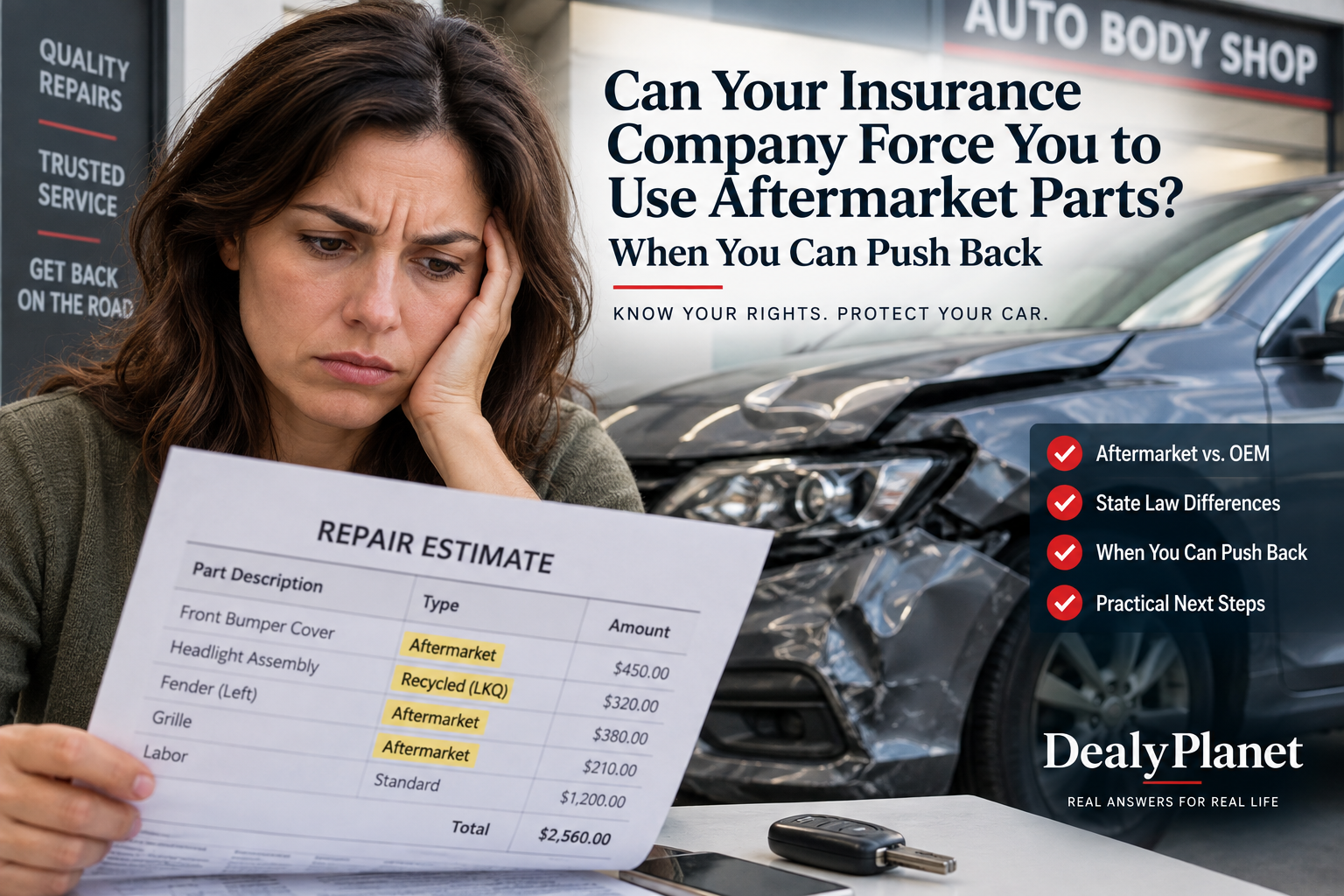
If you’re reading this because your car was just damaged, you’re probably already dealing with enough.
Get DealyPlanet by email Practical help with insurance claims, expensive repairs and consumer problems.
There is the accident itself, the repair shop, the adjuster, the rental car and the disruption of not having your vehicle. Then you open the insurance estimate and discover that the damaged factory bumper, headlight or fender is not being replaced with a new factory part.
The estimate says aftermarket. Or recycled. Or LKQ.
It is reasonable to be unhappy about that. You had an original part on the car before somebody hit it. Now the insurance company appears to be offering you something cheaper.
But this is also an area where the rules are more complicated than either side often makes them sound.
In many states and under many auto policies, insurers can base collision repairs on appropriate aftermarket, recycled or reconditioned parts rather than brand-new OEM parts. That does not give them unlimited discretion to specify whatever is cheapest. The replacement still has to satisfy the applicable repair standard, and state law, vehicle age, safety considerations, your policy and the particular component can all change the answer.
There is also an important distinction worth understanding from the beginning: the insurance company decides what it believes it owes under the claim. You decide what repairs you authorize on your car.
If those numbers do not match, you may have a legitimate basis to push the insurer higher. In other cases, you may ultimately have to decide whether an OEM part is worth paying something extra yourself.
First: Don’t Assume the First Estimate Is the Final Answer
This is probably the most useful thing to know if you have just received an estimate you don’t like.
Collision estimates change constantly.
Body shops discover hidden damage after taking vehicles apart. Parts turn out to be unavailable. An aftermarket panel arrives and doesn’t fit correctly. A repair procedure requires additional work. An insurer approves a supplement.
So if the estimate lists a part that concerns you, you do not necessarily need to decide immediately between accepting it and writing a large check for OEM.
Start by asking the body shop whether the proposed part is actually acceptable for the repair.
Aftermarket, Used and OEM Are Not the Same Thing
Insurance estimates use several terms that can sound alarming when you first see them.
- New OEM: A new part made by or for the vehicle’s original manufacturer.
- Aftermarket or non-OEM: A new replacement part manufactured by another company.
- Recycled or LKQ: An original factory part removed from another vehicle, often one that was totaled because of damage somewhere else.
- Reconditioned or remanufactured: A previously used component that has been repaired or restored for reuse.
A recycled Toyota door, for example, was originally manufactured by Toyota. It simply isn’t new. A brand-new fender made by an independent manufacturer is aftermarket even though it has never been on another vehicle.
That distinction matters because your objection should address the actual part being proposed rather than treating every alternative part as the same thing.
Can the Insurance Company Force You to Use Aftermarket Parts?
Usually, not in the literal sense.
The insurer is generally saying that it believes an aftermarket, recycled or reconditioned component is sufficient to satisfy its obligation under the policy or liability claim. You can normally instruct the shop to use a new OEM part instead.
The disagreement is over who pays the difference.
Some states expressly tell consumers that an insurer may use appropriate alternative parts in an estimate and that a vehicle owner who insists on new OEM parts may have to pay the additional cost.
But “we don’t pay for OEM” should not automatically end the conversation.
The better question is:
Does this particular replacement part properly restore this particular vehicle?
State Law Can Make a Big Difference
There is no single nationwide rule requiring insurers to use OEM parts.
Massachusetts, for example, has unusually specific rules. The state’s Division of Insurance says an insurer must pay for an OEM part when accident damage affects the safe operation of the vehicle. For non-safety parts, insurers generally must pay for OEM during the vehicle’s first 20,000 miles. Once the vehicle exceeds 20,000 miles, used, reconditioned and aftermarket parts can generally be used for non-safety repairs, although the owner can choose to pay the difference for OEM.
You can read the Massachusetts Division of Insurance guidance here.
California permits insurers to specify non-OEM crash parts, but those parts must be comparable to OEM parts in kind, quality, safety, fit and performance. The insurer specifying the part also has warranty obligations relating to those standards.
The California Department of Insurance explains those requirements here.
Other states have their own disclosure, quality, warranty and consent requirements.
So if an adjuster says, “We’re allowed to use aftermarket parts,” that may be generally true while still leaving an important question unanswered: Does the part on this estimate satisfy the rules that apply to your repair?
If You’re Upset About the Estimate, Focus on the Strongest Argument
It is understandable to look at a damaged car and think, “I had a factory part before the accident. Why should I accept something else now?”
Unfortunately, that argument alone may not require the insurer to pay the higher OEM price.
You will usually have more leverage if you turn your objection into a specific repair issue:
- The proposed part does not fit properly.
- The part isn’t actually available.
- The component does not meet an applicable safety or repair requirement.
- The replacement interferes with required sensors or calibration.
- The manufacturer’s repair procedure calls for something different.
- The proposed part is not comparable in quality or performance.
- Your policy specifically includes OEM-parts coverage.
- Your state’s rules require OEM in the circumstances.
Those are much harder for an insurer to dismiss than a general preference for factory parts.
Ask the Body Shop Whether It Actually Objects to the Part
Your repair shop can be extremely helpful here, but ask a precise question.
“Do you think this part will properly repair the car, or are you recommending OEM simply because you prefer OEM?”
If the shop says the alternative part is perfectly acceptable but it routinely recommends factory parts when customers are willing to pay more, you may have a preference dispute rather than an insurance dispute.
If the technician says the proposed part will not fit correctly, does not satisfy a repair procedure, creates a problem with sensors or has already been tried unsuccessfully, ask the shop to document that and send a supplement to the insurer.
You should not have to become an automotive engineer to argue the claim yourself. Let the repairer make the technical case when there is one.
What to Say to the Adjuster
You do not need to begin by accusing the insurance company of trying to cheapen the repair. A more productive request is:
“I see that the estimate specifies a non-OEM part. Can you tell me the manufacturer and part number, and explain why you believe it is equivalent to the part being replaced? If the repair shop determines that it does not fit or meet the required repair procedure, what is the process for submitting a supplement for the OEM part?”
That does several useful things at once. It requires the insurer to identify the actual part, establishes that you are not simply refusing aftermarket parts categorically, and makes clear that you expect the estimate to change if the proposed repair proves inadequate.
Modern Cars Make Some Parts More Complicated
The traditional OEM-versus-aftermarket debate often focused on sheet metal: hoods, doors, fenders and bumper covers.
Modern vehicles can make an apparently simple part much more important.
A bumper may be associated with radar sensors. A windshield can interact with camera-based driver-assistance systems. Headlights may contain sophisticated electronics. Repairs can require scanning, aiming and recalibration.
That does not mean every part near a sensor automatically must be OEM. It does mean the shop should evaluate the complete repair rather than treating the component as an interchangeable piece of plastic or metal.
If the repairer says the manufacturer’s procedure requires a particular component or repair method, ask for that documentation and have the shop submit it to the insurer.
Aftermarket Does Not Automatically Mean Bad
It is also worth resisting the assumption that every non-OEM part is inferior.
Quality varies.
The Certified Automotive Parts Association, or CAPA, independently certifies certain replacement crash parts for factors that include materials, fit, function and performance. A CAPA-certified part has gone through a defined third-party certification process.
If an insurer specifies an aftermarket component, ask exactly what it is. Who manufactured it? Is it certified? Is the shop comfortable using it?
“Aftermarket” is a category, not a quality grade.
A Recycled OEM Part Can Sometimes Be a Very Good Repair
A used factory component can initially sound worse than a new aftermarket one. That isn’t always the case.
An undamaged original door, fender or other component removed from a same-generation vehicle may fit exactly as the original one did because it is an original part.
The age, condition and history of the component still matter, and not every type of part is equally suitable for reuse. But “used” by itself does not mean unsuitable.
This becomes particularly relevant on older vehicles. Replacing an eight-year-old original component with another undamaged original component of similar age can be difficult to characterize as inherently inadequate simply because it isn’t new.
An Aftermarket Part Does Not Automatically Void Your Warranty
This is another claim that can add unnecessary anxiety to an already frustrating repair.
The Federal Trade Commission explains that using aftermarket or recycled parts does not automatically void the vehicle’s factory warranty. A manufacturer can deny warranty coverage for a problem actually caused by an improper or defective aftermarket component, but it cannot simply declare the entire vehicle warranty invalid because a non-OEM part was installed.
The FTC has more detail in its guidance on auto warranties.
If a particular replacement part creates a later failure, responsibility for that failure can still become disputed. But the broad claim that “aftermarket parts void your warranty” is misleading.
A Nearly New Car Is Different From an Older One
If your car was almost new before the accident, it is understandable to be especially concerned about alternative parts.
Some states explicitly recognize vehicle age or mileage in their rules, as Massachusetts does with its 20,000-mile threshold for many non-safety parts.
Even where the law does not automatically require OEM, I would examine the estimate for a late-model or low-mileage vehicle much more closely. Also check whether you purchased an OEM-parts endorsement or similar optional coverage.
If you paid extra for OEM replacement coverage, make sure the adjuster is handling the claim under the coverage you actually bought.
If the Part Isn’t Available, the Estimate Needs to Deal With Reality
An insurance estimate may list a specific alternative part from a specific supplier at a specific price.
That part has to exist.
If the repair shop calls and discovers that the component is out of stock, discontinued, damaged or simply not suitable for your exact vehicle, ask the shop to document the sourcing attempt and submit a supplement.
You should not be expected to leave your vehicle sitting indefinitely because the insurer’s estimate is based on a theoretical part that nobody can actually deliver.
If the Part Doesn’t Fit, That Is Important Evidence
Suppose the insurer specifies an aftermarket bumper or fender. The shop orders it, attempts to use it and concludes that the fit is unacceptable.
At that point, the conversation should change.
The cheaper alternative has been tested and failed. The shop should document what happened and ask the insurer to revise the estimate.
If the insurer chose the alternative part, you should not automatically assume that you are responsible for the extra cost when that part proves unsuitable.
“OEM Required” Can Mean Three Different Things
When someone tells you that OEM is required, find out who is requiring it and why.
You require it. You prefer factory parts. That is a legitimate preference, but it may not obligate the insurer to pay the difference.
The body shop requires it. Some repairers have strong OEM preferences or business policies. Those do not necessarily determine insurance coverage.
The repair requires it. There is a specific technical, safety, fit or manufacturer-procedure reason why the proposed alternative cannot properly restore the car.
The third argument is generally the strongest one to bring back to the insurer.
What If the Other Driver’s Insurance Company Is Paying?
There can be a meaningful distinction between using your own collision coverage and making a property-damage claim against the at-fault driver’s insurer.
With your own insurer, your policy language is a starting point. If the policy permits appropriate like-kind-and-quality replacement parts and you did not purchase OEM coverage, the insurer has a contractual basis for using qualifying alternatives.
A third-party claim arises from the other driver’s liability for damaging your vehicle. But that still does not necessarily entitle you to the most expensive repair available. The liability carrier will usually argue that it owes the reasonable cost necessary to restore the car to its pre-loss condition.
In either situation, evidence that a proposed replacement is actually inadequate is more persuasive than insisting on OEM as a matter of principle.
If the Car Is Leased, Check the Lease Before Approving Repairs
A leased vehicle adds another party to the dispute.
Your leasing company may impose repair or parts requirements that are stricter than what the insurer agrees to cover. If the lease requires a particular repair standard and your policy does not, you could be left responsible for the difference.
Resolve that before repairs are completed rather than discovering the problem during the lease-return inspection.
What About Resale Value?
It is reasonable to worry that an accident repair could affect the value of the car, particularly when the vehicle is new, expensive or unusual.
Whether an aftermarket component creates a meaningful additional loss in value depends heavily on the vehicle and the part. A buyer of a nearly new luxury car may care about non-OEM visible components. A buyer of a ten-year-old commuter car may not care at all about a certified aftermarket bumper cover.
If you are pursuing the at-fault driver’s insurer and believe the accident itself has reduced the vehicle’s market value even after a proper repair, that may raise a separate diminished-value claim. State rules vary.
Diminished value and OEM-parts coverage are related concerns, but they are not the same claim.
How to Push Back Without Getting Stuck in an Argument
If you are frustrated, it is tempting to spend the next hour telling the adjuster why it is unfair to put a cheaper part on a car you did not damage.
You will probably get farther by making the disagreement concrete.
- Read the estimate. Identify every aftermarket, recycled, reconditioned and OEM component.
- Ask the shop whether it has a real objection. Is there a technical problem or simply an OEM preference?
- Identify the proposed part. Ask for the manufacturer, part number, supplier and any certification.
- Check your policy. Look for OEM-parts coverage and the language governing replacement parts.
- Check your state’s rules. Vehicle age, safety components and disclosure requirements can change the result.
- Have the shop document problems. Fit, availability, calibration and manufacturer repair procedures are much stronger evidence than general objections.
- Ask for a supplement. Initial estimates are revised constantly.
- Escalate when the evidence supports you. Ask for a supervisor or claims appraiser rather than repeatedly making the same argument to the first adjuster.
- Consider a state insurance complaint when appropriate. A complaint is much stronger when you can identify a specific regulation, policy provision or documented repair deficiency.
You Don’t Have to Decide Everything Today
If the accident was recent, there can be a strong urge to resolve every dispute immediately just to get the car back.
Unless there is some urgent reason to authorize the repair, it is reasonable to ask questions first.
Have the shop explain the estimate. Ask the adjuster to identify the proposed part. Check the applicable rules. Find out whether a supplement is likely.
A day spent getting the repair scope right can be preferable to discovering after the car is assembled that you agreed to something you are unhappy with.
Sometimes Paying the Difference Is Still Reasonable
There are cases where the insurer’s position is legitimate and you still prefer OEM.
Suppose the carrier will pay $450 for a certified aftermarket fender. Your repairer says it fits properly and is appropriate for the vehicle. A new factory fender costs $725.
If the car is nearly new and you intend to keep it for many years, paying the additional $275 may be worthwhile to you.
That does not necessarily mean the insurer mishandled the claim. It may simply mean that your preferred repair exceeds what your coverage requires.
The important thing is to reach that point after determining whether the insurer really has a legitimate basis for refusing the OEM part—not simply because the first adjuster told you no.
You Are Allowed to Ask the Insurer to Justify the Repair
Being upset about this situation does not make you unreasonable.
Your vehicle was damaged, you want it restored properly, and the estimate may contain unfamiliar terms that make it look as though the repair is being downgraded to save somebody else money.
At the same time, not every aftermarket or recycled part represents an inferior repair.
The most productive approach is to get past the label and examine the actual component. Is it appropriate? Is it available? Does it fit? Is it certified? Does it comply with the required repair procedure? Does your policy or state law require something different?
If the answer supports the insurer’s part, you can make an informed decision about whether OEM is worth paying extra for. If it does not, you have something concrete to push back on.
The First Estimate Is Not the Last Word
An insurance estimate is a starting point based on the damage the adjuster can see, the parts believed to be available and the repair method the insurer expects to work.
Cars are taken apart. Additional damage appears. Parts fail to fit. Suppliers run out of inventory. Repair procedures change the scope. Shops submit supplements.
If the insurer’s proposed alternative part is appropriate, state law and your policy may allow it. If that part cannot actually restore the car properly, the repair should not remain frozen around a line item on the first estimate.
Ask questions, let the shop document legitimate problems and make the insurer address the repair that your vehicle actually needs.
If the way your current insurer is handling the claim has you thinking about changing companies once this is over, you can compare auto insurance options by calling (855) 467-0338.
And if the insurer decides the vehicle isn’t worth repairing at all, see our guide to what to do when a total-loss insurance offer is too low.
Write a Reply or Comment