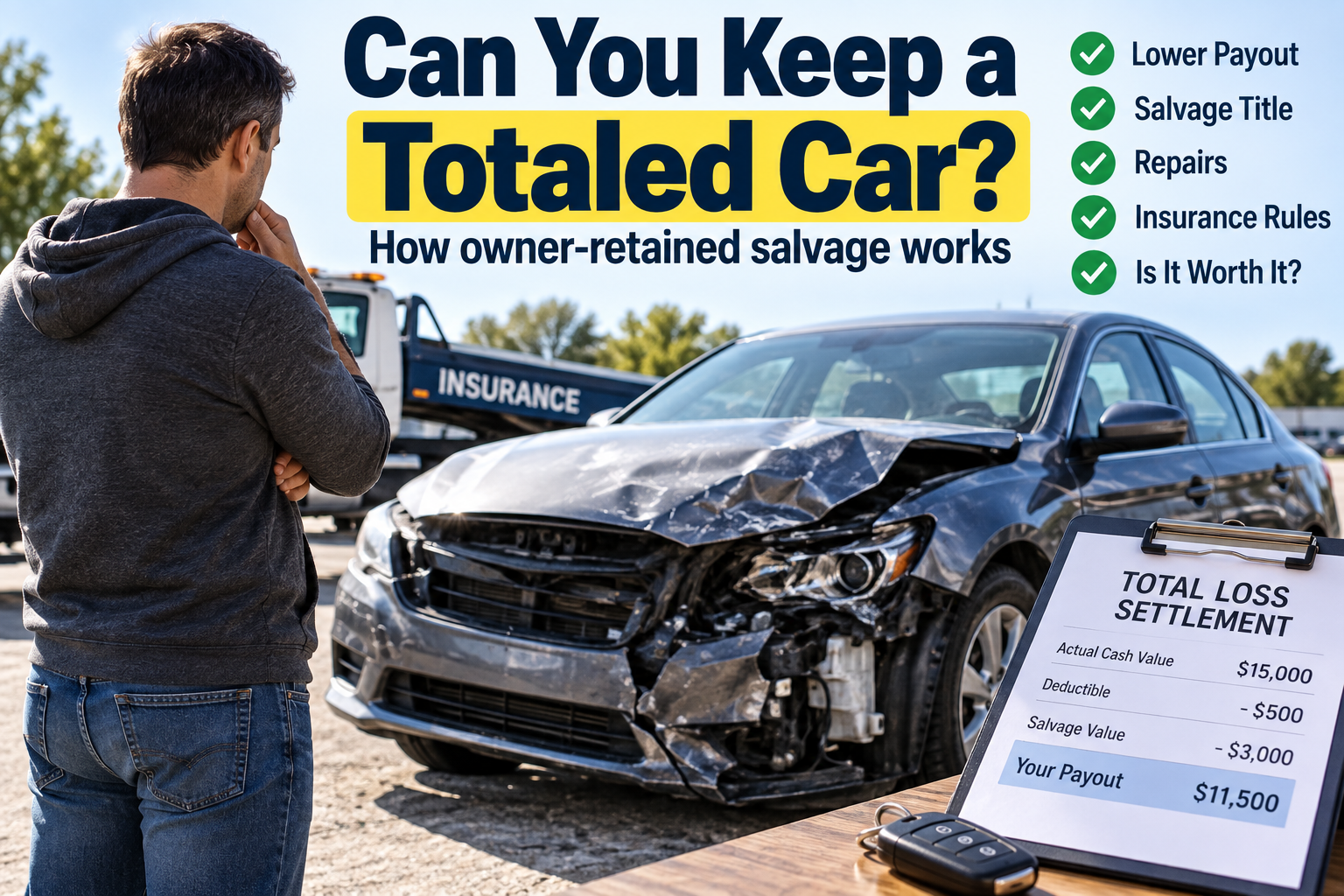
Your insurance company totals your car.
But there is a problem:
You actually want to keep it.
Maybe the damage is mostly cosmetic.
Maybe the car still runs well.
Maybe you know exactly how it has been maintained and would rather repair it than buy an unfamiliar used car.
Or perhaps the insurer has declared a perfectly usable older vehicle a total loss simply because the repair estimate is high relative to the car’s market value.
Can you take the insurance settlement and keep the car?
Often, yes.
This is generally known as owner-retained salvage.
But keeping a totaled car changes the settlement, can affect the title, may create inspection requirements and can make future insurance considerably more complicated.
Before telling the adjuster you want to keep it, understand what you are actually agreeing to.
Quick Answer: Can You Keep a Car After It Is Totaled?
In many states and claims, you may be able to keep possession of a vehicle after the insurance company declares it a total loss.
The insurer generally will not pay you the full total-loss settlement and then let you keep the damaged vehicle for free.
The car still has value as salvage.
If you retain it, the insurer will normally reduce your settlement to account for that salvage value.
You may then face state-specific requirements involving:
- a salvage or owner-retained title;
- vehicle inspections;
- repairs;
- registration;
- and future insurance coverage.
The exact process varies substantially by state.
Why Does the Insurance Company Want the Totaled Car?
When an insurer pays a normal total-loss settlement, it usually obtains the damaged vehicle.
That vehicle may be wrecked, but it is rarely worthless.
The insurer can sell it through a salvage auction.
A buyer may:
- repair and rebuild it;
- export it;
- use it for parts;
- or recycle the remaining materials.
That expected sale price is the vehicle’s salvage value.
If you keep the car instead, the insurer gives up that salvage value.
That is why your settlement is reduced.
How Much Money Do You Lose If You Keep the Totaled Car?
Imagine your insurer determines that your car was worth $15,000 immediately before the accident.
Your collision deductible is $500.
The insurer believes the damaged car can be sold for $3,000 as salvage.
A normal settlement might look roughly like this:
| Item | Amount |
|---|---|
| Actual cash value | $15,000 |
| Less deductible | -$500 |
| Estimated settlement | $14,500 |
If the insurer takes the car, it can then recover whatever it receives when the salvage vehicle is sold.
If you keep the car and the agreed salvage value is $3,000, the calculation might instead look like:
| Item | Amount |
|---|---|
| Actual cash value | $15,000 |
| Less deductible | -$500 |
| Less salvage value | -$3,000 |
| Estimated owner-retained settlement | $11,500 |
You would receive less cash, but you would still own the damaged car.
The actual calculation depends on your claim, state rules and policy.
You Can Negotiate the Salvage Value Too
This is worth remembering.
People often focus entirely on the insurer’s valuation of the car before the accident.
But if you are retaining the vehicle, the salvage deduction also affects how much money you receive.
Ask the adjuster:
- What salvage value are you using?
- Where did that number come from?
- Was it based on an actual salvage bid?
- Can I see the documentation?
If the insurer says the wreck is worth $4,500 and you have reason to think comparable salvage vehicles are worth much less, that difference matters.
Massachusetts insurance regulators, for example, explicitly state that an insurer is entitled to the salvage value of a totaled car and that an owner who wants to keep it can negotiate to retain the vehicle for the agreed salvage value.
Negotiate the Car’s Value Before You Negotiate Keeping It
Do not let the owner-retention discussion distract you from the larger number.
If the insurer undervalues your car by $3,000, arguing over a few hundred dollars of salvage value will not solve the real problem.
First make sure the insurer’s pre-loss valuation is accurate.
Check:
- year;
- make and model;
- trim level;
- mileage;
- options;
- condition;
- comparable vehicles;
- and every adjustment applied to those comparables.
If the offer looks low, see our guide to negotiating a low total-loss offer from your car insurance company.
A Totaled Car Does Not Necessarily Mean a Destroyed Car
This is one reason owner retention can sometimes make sense.
A car is usually declared a total loss because the economics of repairing it no longer work for the insurer.
That can happen even when the car is capable of being repaired.
Imagine an older vehicle worth $7,000.
A collision damages:
- a bumper;
- headlight;
- fender;
- hood;
- paint;
- and several sensors.
The professional repair estimate might approach the car’s value surprisingly quickly.
That does not mean the engine stopped running or that the vehicle has been crushed beyond recognition.
On the other hand, a car can also be totaled because it cannot be repaired safely.
Those are very different situations.
When Keeping a Totaled Car Can Make Sense
I would at least consider owner retention when:
- the damage is mostly cosmetic;
- the car remains mechanically sound;
- you can repair it inexpensively;
- you can do some work yourself;
- you have access to inexpensive used parts;
- the vehicle has unusual personal value;
- you know its maintenance history and would rather keep it than buy another used car;
- or the insurer totaled an older vehicle over damage that you are comfortable living with.
There can be real value in knowing the history of a car you already own.
A $6,000 used replacement may look better on paper but come with its own mechanical surprises.
When Keeping It Is Probably a Bad Idea
I would be much more cautious when:
- the vehicle has structural damage;
- airbags deployed;
- there is flood damage;
- high-voltage EV components were damaged;
- the car requires extensive electronic calibration;
- repair costs are uncertain;
- your state makes returning a salvage vehicle to the road difficult;
- your lender will not permit owner retention;
- or you need comprehensive and collision coverage that will be difficult to obtain afterward.
A cheap repair can stop being cheap very quickly if hidden damage appears after you accept the settlement.
What Happens to the Title?
This is where state law becomes critical.
A total-loss declaration may result in the vehicle receiving some form of:
- salvage title;
- owner-retained title;
- rebuilt or reconstructed title;
- or other permanent title brand.
The terminology and procedure vary by state.
Do not assume that because the car is still physically sitting in your driveway, you can simply continue driving it exactly as before.
Some States Treat Owner-Retained Cars Differently
Massachusetts provides a useful example of how specific the rules can become.
The Massachusetts Registry of Motor Vehicles has an owner-retained title process for certain vehicles that an insurance company declares a total loss while the owner keeps possession.
To qualify for that particular process, the vehicle must meet the state’s requirements, including being legally and safely operable at the time of loss.
Other totaled vehicles may instead fall into the state’s ordinary salvage-title system and face different rules.
Your state may handle this very differently.
Before agreeing to owner retention, check your DMV or motor-vehicle agency’s current rules.
Can You Drive a Car With a Salvage Title?
Often not immediately.
In many states, a vehicle carrying an ordinary salvage title cannot simply be registered and driven until it has been repaired and passed whatever inspection the state requires.
After meeting the requirements, it may receive a rebuilt or reconstructed title.
But again, the rules vary.
Massachusetts is a good example of why generic advice can be dangerous: its special owner-retained title process differs from its ordinary salvage-repairable process.
Find out which category your particular car will fall into before accepting the settlement.
A Salvage Brand Can Be Permanent
Repairing the car does not generally erase its history.
A rebuilt vehicle may legally return to the road, but its title history can continue to show that it was previously declared a total loss.
That can reduce resale value substantially.
Future buyers may hesitate even if the repair was excellent.
So if you are thinking:
“I’ll fix it and sell it for normal market value.”
Do not assume that.
Can You Insure a Totaled Car You Keep?
Possibly, but this can be one of the biggest drawbacks.
An insurer may be willing to provide liability coverage after the vehicle meets your state’s requirements.
Getting comprehensive and collision coverage can be harder.
Some companies may decline physical-damage coverage entirely on a vehicle with salvage or rebuilt history.
Others may insure it but handle valuation differently.
This is worth investigating before you decide to keep the car.
Call your insurer and ask:
- Will you continue insuring this vehicle?
- Will you provide liability coverage?
- Will you provide comprehensive coverage?
- Will you provide collision coverage?
- How will you value the car if it is damaged again?
- Do you require a rebuilt title or inspection first?
Shopping for Insurance After a Total Loss?
A total-loss claim is also a reasonable time to compare insurers, particularly if your current company will not provide the coverage you want on an owner-retained or rebuilt vehicle.
Call (855) 467-0338 to compare car insurance options.
Explain that the vehicle has been declared a total loss and whether it currently has—or is expected to receive—a salvage, rebuilt or owner-retained title.
Do not hide the title history to get through an online quote.
What If You Still Have a Loan?
This can make owner retention much harder.
If a lender has a lien on the vehicle, the insurer generally cannot treat you as though you own the car free and clear.
The lender has a financial interest in the vehicle and typically receives the insurance proceeds first.
If the total-loss settlement is less than the loan balance, you may still owe money after the car has been totaled.
Gap coverage may help in some cases, depending on the policy and loan.
But gap insurance should not be assumed to finance your desire to keep a wrecked vehicle.
Talk with:
- the insurance company;
- the lienholder;
- and, if applicable, the gap provider
before agreeing to retain the car.
What If the Car Is Leased?
A leased vehicle belongs to the leasing company.
That generally means you cannot simply decide to keep it after a total loss.
The leasing company controls the vehicle and settlement rights under the lease.
If you are driving a leased vehicle that has been totaled, talk with the leasing company and insurer rather than assuming owner-retained salvage is available to you.
Can You Repair the Car Yourself?
Potentially.
Whether that makes financial sense is another question.
DIY repair may be attractive for:
- cosmetic body damage;
- bolt-on panels;
- older vehicles;
- or cars where inexpensive used parts are readily available.
It is much less attractive when repairs involve:
- structural straightening;
- airbag systems;
- seat-belt pretensioners;
- ADAS sensors;
- camera calibration;
- high-voltage EV systems;
- or other safety-critical components.
A vehicle being technically repairable does not mean every repair should become a driveway project.
Get a Repair Estimate Before Saying Yes
If you are seriously considering keeping the car, get as much information as possible before accepting the settlement.
I would want:
- the insurer’s complete damage estimate;
- at least one independent repair estimate;
- the proposed salvage deduction;
- the title consequences in my state;
- the inspection requirements;
- and confirmation that I can obtain acceptable insurance afterward.
Then calculate the real cost.
Example: When Keeping the Car Might Work
Suppose:
- Pre-loss value: $8,000
- Deductible: $500
- Salvage value: $1,200
- Owner-retained settlement: about $6,300
- Your repair cost: $2,000
If the car can legally and safely return to the road and you are comfortable keeping a branded-title vehicle, the economics could be attractive.
You would still have the vehicle plus some of the settlement money.
Example: When It Can Go Badly
Now imagine:
- Pre-loss value: $18,000
- Salvage deduction: $5,000
- Initial repair estimate: $8,000
- Hidden structural damage discovered later: another $5,000
- Insurer refuses collision coverage afterward
You may end up investing a large amount of money into a car that:
- has a permanently branded history;
- is worth much less at resale;
- and is harder to insure.
That is a very different proposition.
What Happens If the Car Is Totaled Again?
This is another reason to ask about insurance valuation.
A vehicle with prior total-loss or rebuilt history may be worth substantially less than an equivalent clean-title vehicle.
If it suffers another covered loss, the settlement may reflect that lower market value.
Do not assume the insurer will value your repaired salvage vehicle as though the first accident never happened.
Can You Sell a Totaled Car You Kept?
Generally you can sell a vehicle once you comply with the applicable title rules, but you must accurately disclose and transfer the branded title as required by your state.
The salvage or rebuilt history can significantly affect:
- buyer interest;
- financing;
- insurance;
- trade-in value;
- and resale price.
That reduced future value belongs in your calculation when deciding whether owner retention makes sense.
Questions to Ask Before Keeping a Totaled Car
Before telling the adjuster you want the vehicle, I would ask:
- What is the car’s actual cash value?
- What salvage value will you deduct?
- How was that salvage value calculated?
- What will my final settlement be if I keep the car?
- What title will the vehicle receive in my state?
- Can I legally drive it immediately?
- Does it need a salvage or rebuilt inspection?
- Will my insurance company continue covering it?
- Can I still get comprehensive and collision coverage?
- What will it realistically cost to repair?
- Is there hidden structural or safety-system damage?
- Does a lender or leasing company have to approve the arrangement?
Frequently Asked Questions
Can I keep my car if the insurance company totals it?
Often yes, depending on the state, insurer and ownership situation. This is commonly called owner-retained salvage. Your settlement will generally be reduced by the car’s salvage value.
How much does the insurance company deduct if I keep a totaled car?
The insurer generally deducts the vehicle’s salvage value from the amount it otherwise would pay. Ask how the salvage value was determined and request documentation.
Can I negotiate the salvage value?
You can ask the insurer to explain and support the salvage deduction and can challenge it if you have evidence that the figure is unreasonable.
Will my car get a salvage title if I keep it?
It may. Title rules differ by state, and some states have special owner-retained classifications. Check your state’s motor-vehicle agency before agreeing to keep the vehicle.
Can I drive a totaled car?
That depends on the title status and state rules. A vehicle with an ordinary salvage title may need repairs and an inspection before it can be registered and driven. Some states have different rules for certain owner-retained vehicles.
Can you get full coverage on a rebuilt-title car?
Sometimes, but insurers vary. Some companies may offer liability coverage while limiting or refusing comprehensive and collision coverage. Ask before retaining the car.
Is it worth keeping a totaled car?
It can be when the damage is limited, the salvage deduction is reasonable and the car can be repaired cheaply and safely. It is much less attractive when repairs are extensive, title rules are burdensome or future insurance and resale value will be major problems.
Can I keep a totaled car if I still owe money on it?
Possibly, but the lender has a financial interest in the car and insurance payment. Owner retention can be much more complicated when a loan remains outstanding.
Can I keep a totaled leased car?
Usually the decision belongs to the leasing company because it owns the vehicle. Review the lease and speak with both the insurer and lessor.
Keeping the Car Can Work—But Run the Numbers First
A totaled car does not automatically belong in a junkyard.
Sometimes an older, well-maintained car with repairable damage is worth keeping.
But the decision should be based on more than:
“It still drives.”
You need to know:
- what the insurer is paying;
- what it is deducting for salvage;
- what repairs will really cost;
- what title the car will carry;
- what your state requires;
- how you will insure it afterward;
- and what it will be worth once repaired.
If the insurer’s valuation itself looks too low, deal with that first. Read our guide to negotiating a low total-loss offer before accepting the settlement.
And if keeping the car will require changing insurers or shopping for coverage on a rebuilt vehicle, call (855) 467-0338 to compare car insurance options and explain the title situation before buying a policy.
Write a Reply or Comment