
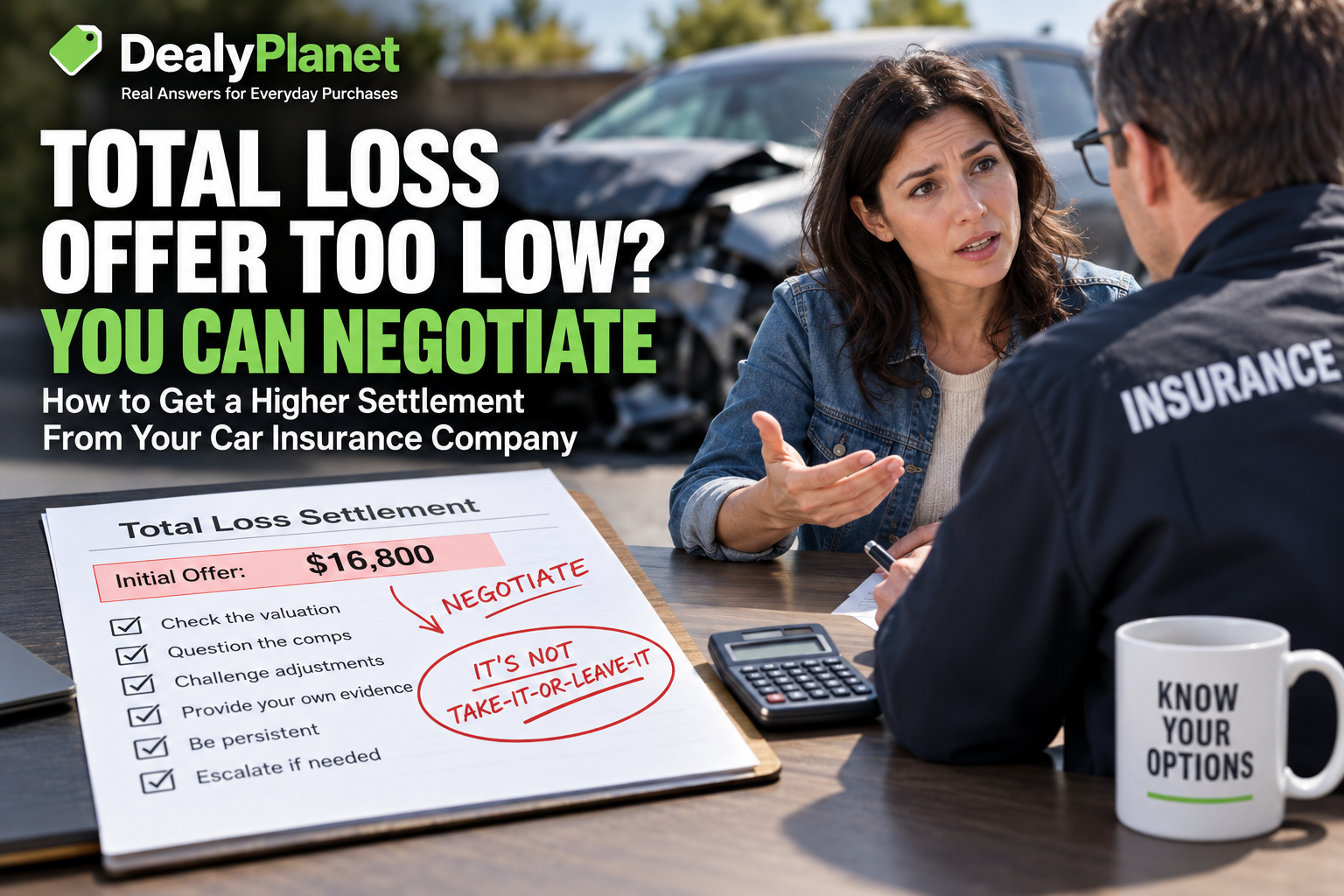
Your car insurance company has declared your car a total loss and sent you an offer.
Get DealyPlanet by email Practical help with insurance claims, expensive repairs and consumer problems.
Most people assume that is the number.
They assume the car insurance company calculated the value, the adjuster told them what the car is worth, and their only real choice is to accept the check.
That is a mistake.
If there is one thing to take away from this article, it is this:
Treat your car insurance company’s first total-loss offer as if it is never its best offer.
Do not assume the first number is final. Do not assume the valuation report is correct because it looks official. And do not assume you have to accept a number simply because a car insurance adjuster presented it to you.
You can negotiate.
You can challenge the comparable vehicles.
You can challenge the condition adjustments.
You can point out missing equipment and incorrect mileage.
You can provide better comparable vehicles.
You can ask the car insurance company to rerun the valuation.
You can keep following up.
And if the adjuster handling the claim will not engage with your evidence, you can escalate.
The most important strategy is simple:
- Make the car insurance company justify everything.
- Question anything that does not make sense.
- Provide evidence when you disagree.
- Be persistent.
- Escalate when necessary.
You may eventually conclude that the car insurance company’s valuation is reasonable.
But you should reach that conclusion after making the company defend the number—not because you mistakenly thought the first offer was take-it-or-leave-it.
Yes, You Can Negotiate With Your Car Insurance Company
This surprises people.
Car insurance companies generally do not send a total-loss offer with a note saying:
“This is our opening number. Feel free to negotiate.”
Instead, you receive a detailed valuation report filled with vehicle descriptions, comparable cars, adjustments and precise dollar amounts.
It looks final.
It is easy to assume that some sophisticated system has objectively determined exactly what your car was worth.
That is not how you should approach it.
The car insurance company has produced its valuation of your car.
If you think that valuation is wrong, challenge it.
The auto insurer may have used:
- the wrong trim;
- incorrect mileage;
- missing equipment;
- poor comparable vehicles;
- distant comparable vehicles;
- questionable condition deductions;
- or assumptions that deserve an explanation.
Even if there are no obvious factual errors, you can still ask why particular comparable vehicles or adjustments were used.
Your job is to make the car insurance company justify the valuation.
Assume the First Offer Can Be Improved
I would never look at a car insurance company’s first total-loss offer and immediately assume it is the best number the company is willing to pay.
There is no reason to give away your negotiating position before you have even examined the valuation.
The first offer reflects the car insurance company’s initial calculation using the information and methodology in its system.
Once you point out errors, produce better comparables, challenge unsupported adjustments or escalate the claim, that number can change.
Sometimes it changes a little.
Sometimes it changes considerably.
But if you simply accept the first number, you will never know.
So use a simple rule:
Never accept the first total-loss offer until you have reviewed the valuation and made the car insurance company explain how it reached the number.
Start by Asking for the Full Valuation Report
Do not negotiate against a single dollar figure.
Ask the car insurance company for the complete total-loss valuation report.
You want to see everything it used to calculate the value, including:
- year;
- make;
- model;
- trim;
- engine;
- drivetrain;
- mileage;
- options and packages;
- condition rating;
- comparable vehicles;
- adjustments applied to those vehicles;
- and the final calculation.
If the adjuster sends only a summary, ask for the underlying valuation report.
If something is unclear, ask what it means.
If an adjustment is listed without an explanation, ask how it was calculated.
The principle throughout this process is:
Do not let unexplained numbers pass simply because they came from the car insurance company.
Make the Car Insurance Company Justify Every Adjustment
This is one of the most important parts of negotiating a total-loss claim.
You may see something like:
Condition adjustment: -$1,609
A precise number has a way of looking authoritative.
Ask where it came from.
Ask:
- What specifically was wrong with my vehicle?
- Who made that determination?
- Was the vehicle actually inspected?
- What photographs support the conclusion?
- How was the dollar deduction calculated?
- Was ordinary wear for a vehicle of this age treated as a defect?
- Is the same difference being accounted for elsewhere in the valuation?
If you do not get a satisfactory answer, ask again.
If the adjuster cannot explain it, ask for the adjustment to be reviewed.
If necessary, ask for a supervisor.
The same approach applies to mileage, equipment and comparable-vehicle adjustments.
Make the car insurance company defend every dollar it is subtracting from your car’s value.
1. Make Sure They Valued the Right Car
This sounds obvious.
Check anyway.
Cars with the same model name can vary dramatically in equipment and value.
A valuation may be wrong if it treats your vehicle as a lower trim or fails to include equipment such as:
- all-wheel drive;
- a larger engine;
- premium trim;
- leather;
- panoramic roof;
- advanced safety equipment;
- premium audio;
- navigation;
- power-folding seats;
- tow package;
- third-row seating;
- or factory entertainment equipment.
Use your VIN, window sticker, purchase paperwork, manufacturer’s build information or photographs to verify the configuration.
If the car insurance company has the wrong information, do not merely point it out.
Ask it to correct the vehicle information and rerun the valuation.
2. Look Up Every Comparable Vehicle
Do not accept the word comparable without checking.
Look up every vehicle the car insurance company used.
Compare:
- year;
- trim;
- mileage;
- drivetrain;
- engine;
- major options;
- location;
- and advertised price.
A lower trim with 30,000 more miles may technically be the same model, but that does not make it a good comparison.
If a comp is weak, ask:
“Why is this vehicle an appropriate comparable for mine?”
Do not argue in generalities.
Make the car insurance company explain the specific choice.
3. Find Better Comparable Vehicles Yourself
This is often the most useful negotiating tool you have.
Search dealer listings for vehicles that match yours as closely as possible.
Try to match:
- year;
- make;
- model;
- trim;
- drivetrain;
- engine;
- equipment;
- mileage;
- and geographic market.
Do not find one absurdly expensive listing and claim it proves your case.
Find several good ones.
Save screenshots or PDFs because used-car listings disappear quickly.
Record:
- dealer;
- location;
- VIN;
- mileage;
- trim;
- equipment;
- price;
- and the date you found it.
If the car insurance company says your vehicle was worth $19,500 but you can show several genuinely comparable cars at $24,000 to $26,000, submit them.
Then ask:
“Please explain why these vehicles are not appropriate evidence of the market value of my car.”
Make the company respond to the evidence.
4. Don’t Let “That’s What the System Says” End the Conversation
You may hear:
- “That’s what our valuation company calculated.”
- “Those aren’t the comps the system selected.”
- “We don’t use that retailer.”
- “The report is automated.”
- “That’s the value.”
Ask why.
If your comparable vehicle is rejected, ask for the reason.
If a retailer is excluded, ask why.
If the automated report contains incorrect information, ask the car insurance company to correct the information.
An algorithm does not get the last word simply because it produced a PDF.
5. Persistence Is Part of Negotiating With a Car Insurance Company
This may be the most underappreciated part of a total-loss claim.
The car insurance company’s first response to your challenge may simply be:
“Our valuation remains unchanged.”
That is not an explanation.
If you supplied three comparable cars, ask:
“Why was each of the three comparables I supplied rejected?”
If you challenged a condition deduction, ask:
“What evidence supports the condition adjustment?”
If equipment is missing, ask:
“Has the valuation been corrected to include this equipment?”
If you do not receive an answer, follow up.
If you still do not receive an answer, follow up again.
You do not have to become obnoxious.
You do have to be persistent.
Car insurance claims departments handle large volumes of claims. A customer who quietly stops responding makes the claim easier to close.
Do not disappear if thousands of dollars are still in dispute.
6. Put the Important Issues in Writing
Phone calls are useful.
Written communication is better for creating a record.
After a substantive discussion, send an email listing the unresolved issues.
For example:
- The valuation uses the wrong trim.
- Two comparable vehicles lack equipment installed on mine.
- One comparable has 31,000 more miles.
- The factory safety package is missing.
- The $1,609 condition adjustment has not been explained.
- I provided three closer comparable vehicles at $24,900, $25,400 and $25,995.
Then say:
“Please revise the valuation or explain in writing why each of these items does not affect the value.”
That is far harder to brush aside than a vague complaint that the car insurance company’s offer is too low.
7. Escalate the Claim
This is where many people stop too early.
The car insurance adjuster assigned to your claim may not have unlimited authority.
If the adjuster will not meaningfully address your evidence, say:
“I don’t believe the valuation issues I’ve raised have been resolved. Please escalate this claim for supervisory review.”
Ask for:
- a supervisor;
- a total-loss specialist;
- a valuation specialist;
- or whoever has authority to review the settlement.
You are not being unreasonable.
You are asking the car insurance company to review a disputed valuation involving your property.
And if the next person simply repeats the same number, use the same method again:
Ask them to justify it.
8. Check the Mileage
Verify that your mileage is correct.
Then compare it with the mileage of the car insurance company’s comparable vehicles.
If your car had substantially fewer miles, make sure the valuation gives proper credit for that difference.
If you do not understand the mileage adjustment, ask how it was calculated.
9. Challenge Unsupported Condition Deductions
Condition can legitimately affect value.
But it should not be a black box that automatically subtracts hundreds or thousands of dollars.
Ask:
- What condition was assigned?
- What defects caused that rating?
- What evidence supports it?
- What photographs were used?
- How was the deduction calculated?
If you have photos or service records supporting better condition, provide them.
10. Maintenance Records Can Help
New tires or brakes generally do not increase the car’s value dollar for dollar.
But records can demonstrate that the car was well maintained and can rebut a poor condition rating.
They can be especially useful for documenting:
- a replacement engine or transmission;
- major recent repairs;
- significant equipment;
- or unusually good condition.
11. Check Taxes and Fees
Do not look only at the vehicle value.
Depending on your state and the claim, the car insurance settlement may also include items such as:
- sales tax;
- title fees;
- registration fees;
- or transfer fees.
Then check all deductions.
Again, ask the car insurance company to explain every addition and subtraction.
12. Your Loan Balance Is a Separate Issue
If the car insurance company values your vehicle at $22,000 and you owe $27,000, the vehicle does not become worth $27,000 because of the loan.
The loan balance and vehicle value are separate.
GAP coverage may help with the difference.
What If the Car Insurance Company Rejects Dealer Asking Prices?
A dealer asking price is not necessarily the final sale price.
That is true.
But dealer listings still provide evidence of the market.
Provide several genuinely comparable listings rather than relying on one.
If the car insurance company refuses to consider them, ask why.
What About Carvana, CarMax and Other Online Retailers?
Online sellers can become another point of disagreement in a total-loss valuation.
If an online retailer will sell a comparable vehicle to consumers in your market, the listing can still provide useful evidence of what a replacement vehicle is being offered for.
If the car insurance company says it will not consider that vehicle, ask:
“Why?”
There may be a legitimate reason under its methodology or your state’s valuation rules.
Make the company state the reason rather than accepting the exclusion automatically.
Ask the Car Insurance Company to Rerun the Valuation
If you identify factual errors, insist on a corrected report.
Ask the company to:
- correct the trim;
- add missing equipment;
- correct the mileage;
- revise unsupported condition adjustments;
- and reconsider poor comparable vehicles.
Then ask for a new valuation.
Do not settle for:
“We’ll make a note of that.”
You want to know whether the correction actually changed the valuation.
If Negotiation With the Car Insurance Company Still Goes Nowhere
You may have additional options.
Use the Appraisal Provision
If you are making the total-loss claim under your own auto insurance policy, check whether the policy includes an appraisal provision for disputes about the amount of loss.
The process often involves you hiring an appraiser, the car insurance company hiring an appraiser and potentially using an umpire if the two cannot agree.
Read the actual policy language.
Contact Your State Insurance Department
If you believe the car insurance company is not following required valuation or claims-handling procedures, contact your state insurance regulator.
The regulator may not decide exactly what your car is worth, but it may be able to address whether the auto insurer followed applicable rules.
Keep Everything
Save:
- valuation reports;
- emails;
- screenshots;
- dealer listings;
- vehicle build information;
- photographs;
- maintenance records;
- and notes from phone calls.
First-Party and Third-Party Car Insurance Claims Can Be Different
Pay attention to which car insurance company is handling the loss.
If your own collision or comprehensive coverage is paying, your policy terms may govern parts of the dispute, including a possible appraisal procedure.
If another driver’s car insurance company is paying under liability coverage, you do not have the same contractual relationship with that insurer.
State rules can also treat the two types of claims differently.
Can You Keep the Totaled Car?
Often you can, although the exact rules depend on your state.
If you retain the vehicle, the car insurance company generally deducts its salvage value from the settlement.
For example:
- Agreed vehicle value: $20,000
- Salvage value: $4,000
- Owner-retained amount before other adjustments: $16,000
But a retained total-loss vehicle may be subject to salvage-title, inspection, registration and insurance requirements.
Its resale value will also generally be lower.
Actual Cash Value Is Not Necessarily Replacement Cost
You may discover that cars like yours are expensive to replace.
The key argument is still the vehicle’s pre-loss market value.
Instead of saying:
“I need $26,000 to buy another car.”
A stronger argument is:
“These comparable vehicles show that a vehicle of the same year, trim, equipment and mileage was worth approximately $26,000 immediately before my loss.”
That keeps the negotiation focused on valuation evidence.
A Total-Loss Negotiation Checklist
- Assume the car insurance company’s first offer can be improved.
- Do not accept it immediately.
- Get the complete valuation report.
- Verify every detail about your car.
- Look up every comparable vehicle.
- Make the company justify every adjustment.
- Find better comparable vehicles yourself.
- Put your objections in writing.
- Ask for a revised valuation.
- Follow up.
- Follow up again.
- Escalate.
- Use appraisal or regulatory options if enough money remains at stake.
Frequently Asked Questions
Do I have to accept my car insurance company’s first total-loss offer?
No. You can challenge the valuation, ask how it was calculated, provide your own evidence and request a higher settlement.
Is the first total-loss offer usually the best offer?
You should never assume it is. Treat your car insurance company’s first offer as the starting point until you have reviewed the valuation, challenged questionable assumptions and asked the company to reconsider the number.
Can I really negotiate with my car insurance company?
Yes. Many people are surprised by this. A total-loss valuation can be challenged when you believe the car insurance company has undervalued your vehicle.
What should I say when my car insurance company’s total-loss offer is too low?
Do not simply say that your car was worth more. Identify specific problems in the valuation and ask the car insurance company to respond to each one.
What if the car insurance adjuster refuses to negotiate?
Ask the adjuster to explain why your evidence does not change the valuation. If you still cannot get a substantive response, ask for a supervisor, total-loss specialist or other person with authority to review the claim.
How persistent should I be with the car insurance company?
Persistent enough to receive actual answers. Repeating the original offer is not the same as explaining why your evidence is wrong.
What is the best evidence for negotiating a higher total-loss settlement?
Several current comparable vehicles matching your year, model, trim, equipment, mileage and market are particularly useful. Evidence correcting factual errors in the car insurance company’s own valuation report can be even stronger.
Can I challenge a condition adjustment?
Yes. Ask exactly what defects support the adjustment, what evidence was used and how the dollar amount was calculated.
Does the car insurance company have to pay what I owe on my loan?
Generally no. The amount owed on your loan does not determine the car’s market value. GAP coverage may help when the loan balance exceeds the total-loss settlement.
The Biggest Mistake Is Assuming You Have No Choice
Your car insurance company sends you a valuation.
It looks official.
The adjuster gives you a number.
It sounds final.
And a huge percentage of people assume they simply have to take it.
Don’t.
Treat the car insurance company’s first offer as the beginning of the process.
Make the company explain the valuation.
Make it justify the comparable vehicles.
Make it explain the adjustments.
Give the company better evidence.
Ask it to rerun the number.
Follow up when it doesn’t respond.
Escalate when necessary.
The car insurance company may ultimately convince you that its valuation is reasonable.
Or you may convince the car insurance company to pay considerably more.
But you should never leave money on the table simply because nobody told you the first offer was negotiable.
For more auto-insurance help, see our guides to why your car insurance is so expensive, how to lower your car insurance, and whether you can insure a car you don’t own.
Write a Reply or Comment