
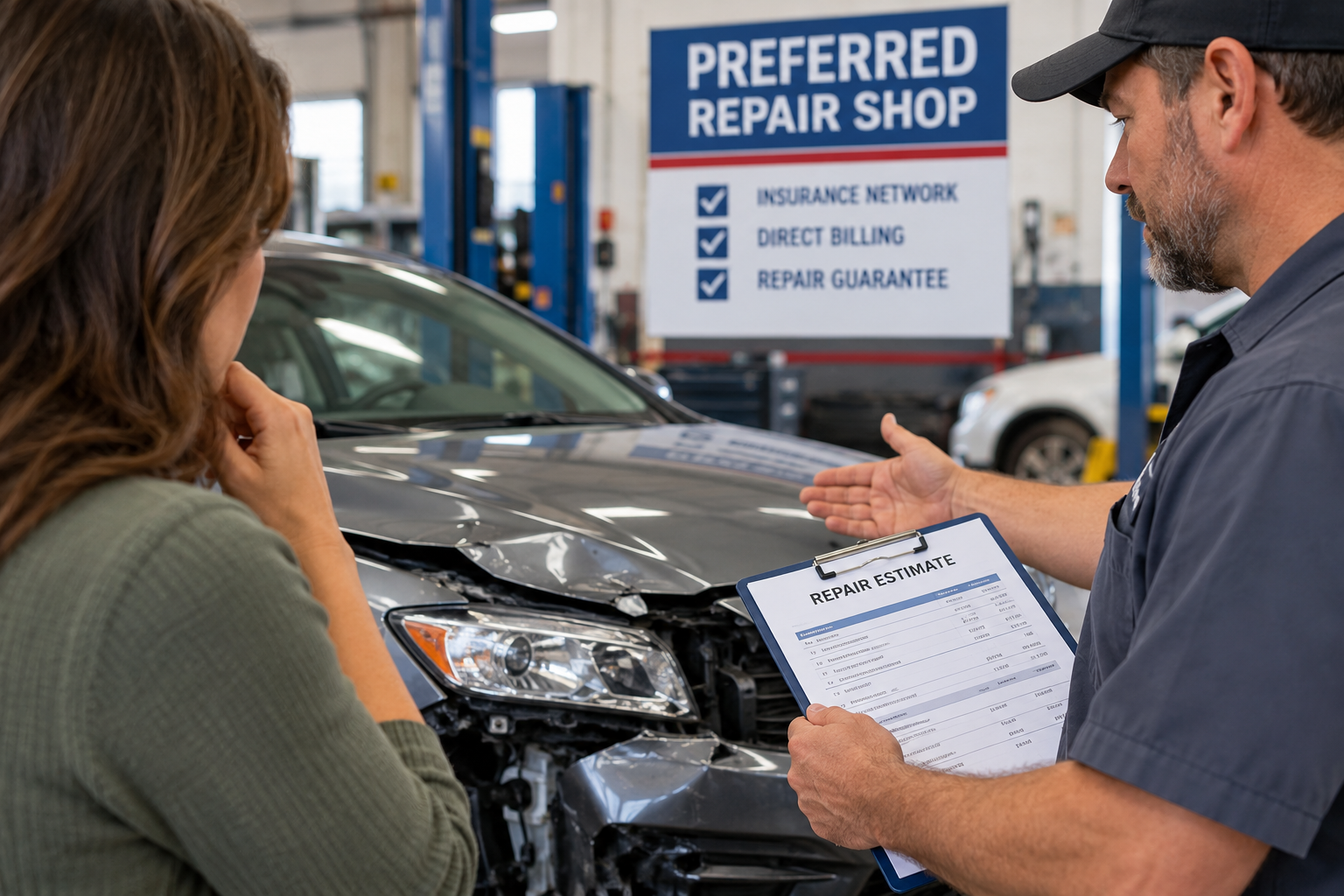
Your insurer gives you a list of “preferred” body shops after an accident. The adjuster may say those shops can start faster, bill the insurer directly, or guarantee the work. That can sound a lot like you are being told where the car has to go.
In many states, you can choose your own repair shop. But choosing the shop and deciding how much the insurer owes are separate issues. Your insurer may still dispute labor rates, repair procedures, parts, storage charges, or other costs at a shop outside its network.
First ask whether the shop is required or merely recommended
Do not argue about the repair before you know what the insurer is actually saying. Ask a very specific question: “Am I required to use one of these shops under my policy, or are you recommending them?” If the answer is that you are required, ask the adjuster to identify the policy provision or endorsement that creates the restriction.
State rules often protect your ability to choose a repairer. California’s Department of Insurance says an insurer cannot require a vehicle to be repaired at a specific shop, although it may recommend one under conditions set by state law. Texas tells consumers that an insurance company may provide a list of body shops, but the customer can take the vehicle to any shop. New York likewise says policyholders retain the right to choose the repair shop.
Massachusetts law goes even further for ordinary referral programs: an insurer or appraiser may not require repairs at a specific shop or list of shops. Massachusetts also allows a separate participating-repair-shop type of insurance plan in which an insured who agreed to the endorsement can face limits on benefits when using a nonparticipating shop. So the policy language still needs to be checked before assuming every claim works the same way.
Official state guidance: California Department of Insurance, Texas Department of Insurance, New York Department of Financial Services, and Massachusetts General Laws.
What a preferred body shop actually is
Insurers commonly have direct-repair or preferred-shop programs. The shop agrees to work within the insurer’s program, which can include negotiated labor rates, estimating procedures, electronic billing, reinspections, and rules for supplements. In return, the shop may receive a steady stream of referrals.
That arrangement can make a claim easier to administer. The insurer and shop already know how to exchange estimates and supplements, and some programs include an insurer-backed repair guarantee. Massachusetts, for example, requires an insurer referral shop to complete covered repairs for the insurer’s payment plus the applicable deductible, with disputes over the appraised amount handled between the insurer and referral shop.
A network relationship does not prove that the shop is better or worse than an independent shop. Treat “preferred” as a description of the shop’s relationship with the insurer, then evaluate the shop itself: reputation, certifications, experience with your vehicle, repair equipment, communication, warranty, and whether it follows the manufacturer’s repair procedures.
You can choose the shop and still have a payment dispute
This is where many drivers get surprised. The right to choose a shop does not necessarily mean the insurer must pay every amount that shop charges. Texas explicitly tells consumers they may choose the repair shop while also noting that the insurer is not required to pay more than a reasonable amount.
Suppose the insurer’s preferred shops accept $65 per labor hour while your chosen shop charges $90. Or your shop includes a repair operation the insurer says is unnecessary. You may be fully entitled to use that shop and still end up with a dispute over the difference.
Before authorizing repairs, ask your shop to compare its estimate with the insurer’s line by line. If there is a gap, determine whether it comes from hidden accident damage, labor rate, labor time, a repair procedure, replacement parts, storage, or something you personally requested. Our guide to what happens when the body shop estimate is higher than the insurance estimate explains how to separate those issues before agreeing to pay anything yourself.
If an adjuster tells you that the insurer “only works with” certain shops, ask what that means. It may mean the preferred shops have direct electronic access to the insurer’s estimating and supplement system or that the insurer backs repairs performed through its program. Neither statement necessarily means your own shop is prohibited.
Ask how the insurer handles estimates and supplements from a non-network shop. A competent independent collision shop deals with insurers every day and should be able to explain its process for documenting additional damage, requesting a reinspection, submitting supplements, and resolving repair-plan disagreements. Also ask both sides: “If I use this shop, other than my deductible, is there anything you currently expect me to pay out of pocket?”
Preferred-shop guarantees can have real value
There are legitimate reasons to use the insurer’s network. A preferred shop may be able to start the claim faster, avoid arguments over routine supplements, arrange a rental-car handoff, or provide a repair guarantee backed by the insurer. If the shop is reputable and experienced with your make and model, those conveniences can be valuable.
The guarantee deserves a closer look rather than a sales pitch. Ask who stands behind it, what it covers, how long it lasts, whether it follows the vehicle if you move, and what happens if you are dissatisfied with the repair. Compare that with the warranty offered by an independent shop you are considering.
Likewise, do not reject a preferred shop simply because the insurer suggested it. The goal is a proper repair with a clear path for resolving problems. A good network shop can provide that; a good independent shop can too.
Your own shop may be the better choice when the repair is complicated
An independent shop can be especially attractive if it specializes in your manufacturer, has the right structural or aluminum equipment, holds relevant OEM certifications, or has already earned your trust. Modern repairs can involve radar sensors, cameras, calibration, high-strength steel, aluminum, EV battery precautions, and manufacturer-specific procedures. A shop’s actual capabilities matter more than whether its name appears on an insurer’s list.
Parts can also become part of the dispute. If the insurer’s estimate specifies aftermarket, recycled, or reconditioned parts and your shop believes a different part is needed, ask the shop for the technical reason and have it document the issue. We cover that separately in Can Your Insurance Company Force You to Use Aftermarket Parts?
Watch storage and teardown charges before moving the car
Shop choice becomes more complicated after the damaged vehicle has already been towed somewhere. A shop may charge storage, teardown, administrative, or reassembly fees before releasing the car. Whether the insurer will pay all of those charges can depend on the claim, state law, reasonableness, and what was authorized.
If the insurer wants the vehicle moved from your chosen shop to a preferred shop, ask who will pay the existing charges and the second tow before agreeing. If you want to move it yourself, get the current bill and release requirements first. A repair-shop disagreement is much easier to solve before several days of additional storage accumulate.
First-party and third-party claims are not identical
If you are using your own collision coverage, your insurance policy is part of the analysis. Read any endorsement dealing with participating shops, repair methods, appraisal, or claim payment. Your deductible also generally applies to the covered repair.
If another driver caused the accident and you are making a property-damage claim against that driver’s insurer, you did not buy a policy from that company. The dispute is instead about what the at-fault party and insurer legally owe for the damage under the rules of your state. Either way, ask the insurer to put any claimed restriction or payment limitation in writing rather than relying on a vague statement over the phone.
What to say to the adjuster and the shop
You do not need to accuse the insurer of steering you. A precise request usually gets you further:
“I understand you have preferred repair shops. Am I required under my policy to use one of them, or is this a recommendation? If I choose my own licensed body shop, please tell me whether you expect any limitation on what the claim will pay and identify the reason for that limitation.”
Then ask your chosen shop a matching question:
“Have you reviewed the insurer’s estimate, and do you expect me to owe anything beyond my deductible? If you disagree with the insurer, please show me the specific labor, part, procedure, or other charge that is disputed before I authorize the work.”
Those two answers will tell you far more than simply asking whether you are “allowed” to use the shop.
Choose the shop deliberately
An insurer’s preferred network can be convenient, and the repair guarantee can be useful. Your own shop may have better experience with your vehicle or a stronger reputation locally. The choice should be based on the repair you need and the financial terms you are actually agreeing to.
Before the work begins, confirm whether the insurer’s shop is optional, check your policy for any genuine network restriction, compare the shop and insurance estimates, and identify any amount that somebody expects you to pay yourself. If the dispute grows because additional damage is discovered, deal with it through the supplement process rather than assuming the first estimate was the final amount the claim can pay.
Write a Reply or Comment