
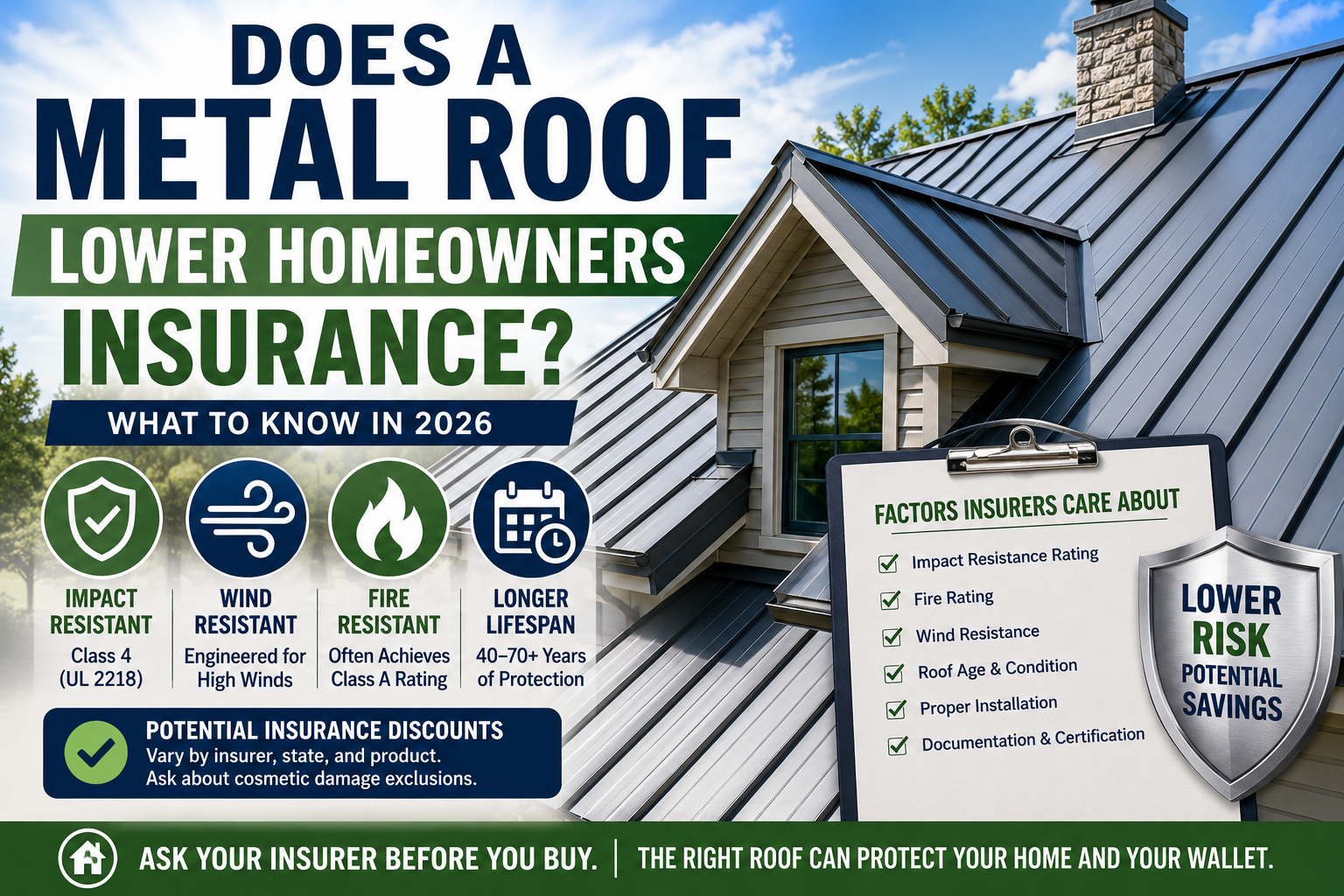
A metal roof may lower your homeowners insurance premium, but installing one does not automatically earn you a discount.
Get DealyPlanet by email Practical help with insurance claims, expensive repairs and consumer problems.
Insurance companies care less about the word metal than about what the roof can actually withstand. A qualifying impact-resistant roof may earn a premium credit from some insurers. Fire resistance, wind resistance, roof age and installation can matter too.
There is also a catch homeowners should understand before celebrating the savings: some insurers offer a metal-roof discount while excluding purely cosmetic hail damage. Your premium could go down while your coverage for dents goes down with it.
And because a high-quality metal roof can cost considerably more to replace than asphalt shingles, the effect on your total homeowners premium is not always as simple as “better roof = cheaper insurance.”
So, does a metal roof lower homeowners insurance? Sometimes. Here is what actually determines whether you save money, what to ask your insurer before replacing your roof, and why the biggest insurance benefit may not be the discount itself.
Quick Answer: Does a Metal Roof Lower Homeowners Insurance?
A metal roof can lower homeowners insurance premiums when the roof qualifies for an insurer’s discount for impact resistance, fire resistance, wind mitigation or a newer roof.
But there is no universal metal-roof discount.
Your savings can depend on:
- Your insurance company
- Your state
- The exact roofing product
- Its impact-resistance rating
- The roof assembly’s fire rating
- Wind-resistance specifications
- The roof’s age and condition
- How it was installed
- Whether you provide the required certification
- Whether you accept a cosmetic-damage exclusion
The Texas Department of Insurance put it plainly in August 2026: a metal roof could lower your premium, but not every insurer offers a discount and the savings vary.
Why Insurance Companies May Like Metal Roofs
A roof is one of the most exposed and expensive parts of a house.
Wind, hail, falling branches and fire can all turn it into an insurance claim. Damage to the roof can also allow water into the house and create a much larger claim involving ceilings, walls, insulation, flooring and personal property.
A roof that performs better against the hazards common in your area can therefore be attractive to an insurer.
Metal roofing has several potential advantages:
- Many products offer strong resistance to hail impact.
- Metal roof systems can be engineered for substantial wind-uplift resistance.
- Metal itself is noncombustible, and many properly designed metal roof assemblies can achieve a Class A fire rating.
- A quality metal roof can remain serviceable much longer than a typical asphalt-shingle roof.
That last point can become increasingly important as insurers pay more attention to roof age and condition.
As we explain in our guide to how long metal roofs last, a standing-seam metal roof may last 40 to 70 years or longer, while many asphalt roofs have much shorter replacement cycles.
But insurers do not necessarily reward all of those advantages equally.
Class 4 Impact Resistance May Matter More Than “Metal”
If you are replacing a roof partly to improve your insurance situation, one specification worth asking about is UL 2218 impact resistance.
UL 2218 is a testing standard used to classify roofing products according to their resistance to impact. Ratings range from Class 1 through Class 4, with Class 4 the highest classification.
Texas provides a particularly clear example of how this can work. The Texas Department of Insurance says qualifying roof coverings can include shingles, tiles, shakes, formed metal panels or sheets and other materials. Products that successfully meet the applicable testing requirements may qualify for insurance credits, with Class 4 receiving the highest credit under the Texas program.
But a metal roof is not automatically a Class 4 roof.
The particular product must have been tested and classified.
That means two contractors can both quote you a “metal roof” while offering products that your insurance company treats very differently.
Ask for the Product Certification Before You Buy the Roof
If an insurance discount is part of your calculation, do not wait until the roof is installed to find out whether the material qualifies.
Before signing a roofing contract, get:
- The manufacturer’s name
- The exact product or panel name
- The impact-resistance classification, if any
- The applicable UL or other testing documentation
- Fire-rating information for the proposed roof assembly
- Wind-uplift or wind-rating information if relevant in your area
- A description of how the roof will be installed
- Any certification form your insurance company requires
Then send that information to your insurance agent or company and ask a very specific question:
“If I install this exact roofing system on my house, what discount will I receive, and will accepting that discount change my coverage?”
That is much more useful than asking whether the company gives a generic metal-roof discount.
A Class 4 Roof Can Still Get Dented by Hail
This is one of the easiest parts of metal-roof insurance to misunderstand.
A Class 4 impact rating does not mean the roof is guaranteed to look untouched after a severe hailstorm.
UL 2218 evaluates whether roofing materials withstand specified impact testing. It does not mean that a metal panel cannot acquire a visible dent.
The Texas Department of Insurance notes that metal roofs can still be dented or scratched by hail, wind-blown debris and falling branches even when the damage does not interfere with the roof’s performance.
That leads directly to one of the most important insurance questions for anyone considering metal.
Watch for a Cosmetic Hail Damage Exclusion
Your insurer may distinguish between functional damage and cosmetic damage.
Imagine that a hailstorm leaves dozens of visible dents across your metal roof.
The roof still keeps water out. The seams remain intact. The panels still perform their job.
You may nevertheless hate the way your expensive new roof looks.
If your policy covers cosmetic hail damage, you may have a claim.
If you accepted an endorsement excluding cosmetic damage, you may not.
This is not a hypothetical concern.
The Texas Department of Insurance specifically warns that a metal-roof discount can come with an exclusion for cosmetic damage. State Farm likewise says that, for qualifying metal products, an exclusion for certain damage to metal roofing will be part of the policy in applicable programs.
So before taking a premium credit, ask:
- Does the discount require a cosmetic-damage waiver or exclusion?
- What exactly does the policy consider cosmetic damage?
- Would hail dents be covered if the roof still functions?
- What happens if damage affects both appearance and performance?
- Does declining the exclusion also mean losing the discount?
Saving $150 a year looks much less compelling if you are giving up coverage for a type of loss that could leave you with a badly dented $30,000 roof.
Does a Metal Roof Get a Fire-Resistance Discount?
Possibly, but once again the certification matters.
Metal is noncombustible, which makes it attractive in areas exposed to wildfire. But saying “metal roofs are Class A” is too broad.
Fire classifications apply to tested roof coverings or roof assemblies. FEMA recommends a Class A roof assembly for wildfire resistance and notes that many metal panels and shingles can achieve Class A when properly configured and tested.
The components below the visible metal can matter too.
If fire resistance is important where you live, ask the roofing manufacturer or contractor for the tested fire classification of the complete assembly being installed on your house.
Then ask your insurance company whether that classification changes your premium or eligibility.
What About Wind Resistance?
Metal roofs can perform extremely well in high winds when the roof system is designed and installed correctly.
But wind performance involves much more than choosing metal panels.
Fasteners, clips, panel attachment, roof decking, edge details, flashing and the particular tested assembly all contribute to wind-uplift resistance.
The Insurance Institute for Business & Home Safety notes that metal roof assemblies are tested as systems and that the appropriate design pressure depends on factors including roof height, pitch and local exposure.
In hurricane-prone areas, the insurance advantage may therefore come from meeting a recognized wind-mitigation or FORTIFIED standard rather than simply replacing shingles with metal.
If wind is your primary concern, ask the insurer what construction standard earns a discount before deciding which roof to buy.
Does Standing Seam Get a Bigger Insurance Discount Than Exposed-Fastener Metal?
Not automatically.
Standing-seam roofing is usually a more expensive system with concealed fasteners and a long expected service life. Exposed-fastener panels are generally cheaper and may require more maintenance over time.
Those differences matter when you compare the long-term cost of metal roofing and shingles.
But an insurer may care more about the tested performance of the particular roofing system than whether a contractor calls it standing seam or exposed fastener.
A documented qualifying impact-resistant system may earn a credit. A more expensive metal roof without the required certification may not.
Do not assume the most expensive roof automatically receives the largest insurance discount.
A New Roof May Help Even Without a Special Metal-Roof Discount
There is another reason replacing an old shingle roof with metal might improve your insurance situation.
The new roof is new.
Insurers increasingly consider roof age and condition when underwriting homes and deciding how damaged roofs will be covered.
The Texas Department of Insurance advises homeowners to tell their insurers when they replace a roof and notes that newer roofs can receive better rates than older roofs.
A deteriorating 25-year-old asphalt roof may create an underwriting problem even if the replacement metal roof earns no special “metal” credit.
A new roof may help through:
- A roof-age discount
- Better underwriting eligibility
- Improved wind or hail characteristics
- Restoration of broader roof coverage
- Reduced likelihood of an inspection-related problem at renewal
That can be more valuable than a small named discount.
Could a Metal Roof Actually Increase Your Insurance Premium?
Potentially.
This sounds strange after discussing all the reasons insurers may prefer metal, but your premium reflects more than the probability that the roof will be damaged.
The insurer also cares about how much it would cost to rebuild your house after a major covered loss.
A premium standing-seam metal roof can cost much more to replace than basic asphalt shingles. If installing it increases the estimated replacement cost of the home, your dwelling coverage may need to increase accordingly.
State Farm, for example, advises customers that improvements such as an impact-resistant roof may increase a home’s estimated replacement cost and says coverage should be reviewed after substantial improvements.
So two changes can happen at the same time:
- Your insurer may give you a credit because the new roof is more resistant to damage.
- Your home’s insured replacement cost may increase because the roof itself is more expensive to replace.
The final premium is the result of the entire rating calculation.
Do not assume a 10% roof credit means your total homeowners bill will drop 10%.
How Much Can a Metal Roof Save on Homeowners Insurance?
There is no responsible nationwide percentage to quote.
You will find roofing companies online promising savings of 10%, 20%, 30% or even more. Those numbers may be possible in particular programs, but they are not a universal metal-roof discount.
Insurance departments and major insurers are much more careful.
Texas says savings vary by company. State Farm says discount availability and eligibility vary by state. Each insurer determines its own rating rules and qualifying products.
For planning purposes, I would treat insurance savings as a potential bonus until your own insurer gives you an actual quote.
If insurance savings are important to the economics of your roof purchase, get the number in writing before you commit.
Example: Why a Discount Probably Won’t Pay for the Metal Roof
Suppose your homeowners premium is $2,500 per year.
Imagine your insurer gives you a 10% credit attributable to the new qualifying roof.
That would save:
$250 per year.
Over 20 years, ignoring future rate changes, that would be $5,000.
If a standing-seam metal roof costs $10,000 or $15,000 more than a comparable asphalt roof, the insurance discount alone does not recover the difference.
That does not mean metal is a bad investment.
Its financial case can also include:
- A much longer service life
- Avoiding a future roof replacement
- Lower maintenance
- Possible energy savings
- Better storm performance
- Potential resale value
- Insurance savings
Our metal roof vs. shingles cost comparison looks at that larger calculation.
Should You Choose Metal Just to Get an Insurance Discount?
Probably not.
A metal roof is too expensive and too long-lived a purchase to choose primarily for a modest annual premium reduction.
I would first decide whether metal makes sense for:
- Your climate
- Your expected time in the house
- Your budget
- The roof’s complexity
- Your tolerance for hail denting
- Local contractor expertise
- The expected life of the roofing system
Then include any verified insurance savings in the financial comparison.
The calculation can change, however, in areas where insurance availability itself is becoming difficult.
If your insurer strongly favors newer, impact-resistant, wind-resistant or wildfire-resistant roofs, upgrading the roof may help you maintain coverage or shop among more insurers. That can be worth considerably more than one small line-item discount.
What to Ask Your Insurance Company Before Installing a Metal Roof
I would make this call before signing the roofing contract.
Ask your agent or insurer:
- Do you offer a premium discount for a new metal roof?
- Do you offer a separate discount for UL 2218 Class 3 or Class 4 impact-resistant roofing?
- Does this specific product qualify? Provide the manufacturer and model.
- Do fire or wind ratings qualify for additional credits?
- What documentation will you need from the contractor?
- Does the discount require a cosmetic hail-damage exclusion?
- How will my roof be covered after installation—replacement cost or actual cash value?
- Will the new roof change my wind/hail deductible?
- Will installing a more expensive roof increase my dwelling replacement-cost estimate?
- What will my actual premium be after all of these changes?
The last question is the one that tells you whether you are really saving money.
After Installation, Keep the Paperwork
A qualifying roof does you little good for insurance purposes if you cannot prove what was installed.
Keep:
- Your roofing contract
- The final paid invoice
- Manufacturer and product information
- Impact-resistance certification
- Fire and wind documentation where applicable
- Warranty paperwork
- Installation photographs
- Permit and inspection records
- Any insurer-required certification form
Texas, for example, uses an Impact-Resistant Roofing Installation Form for certain credits and tells homeowners to keep the original and provide a copy to the insurer.
Your company may have its own requirements.
Don’t Forget to Tell Your Insurer You Replaced the Roof
If you install a new roof and never update your policy, the insurer may still have the old roof age and material in its records.
Contact the company after installation and confirm:
- Roof material
- Installation date
- Impact rating
- Any applicable mitigation credits
- Your resulting premium
- Any new endorsements or exclusions
Then check the declarations and renewal documents rather than assuming everything was entered correctly.
Frequently Asked Questions About Metal Roofs and Homeowners Insurance
Do all insurance companies give a discount for metal roofs?
No. Discounts vary by insurer and state. Some companies offer credits for qualifying impact-resistant or fire-resistant roofs rather than for metal roofing generally.
Does a Class 4 metal roof lower homeowners insurance?
It may. Class 4 is the highest UL 2218 impact-resistance classification, and some insurers offer premium credits for qualifying Class 4 products. The amount and eligibility requirements vary by company and state.
Is every metal roof Class 4?
No. A metal roof should not be assumed to have a Class 4 impact rating simply because it is made of metal. Check the certification for the exact product being installed.
Are metal roofs Class A fire rated?
Many metal roofing products and assemblies can achieve a Class A fire rating, but the entire roof assembly matters. Ask for the tested fire classification of the system being installed rather than assuming metal alone guarantees a particular rating.
Will homeowners insurance cover dents in a metal roof?
It depends on your policy. Some insurers distinguish cosmetic hail damage from functional damage and may exclude cosmetic dents, particularly when a homeowner receives an impact-resistant-roof discount.
Can a metal roof make insurance more expensive?
It is possible. A more durable roof may qualify for a discount while simultaneously increasing the home’s estimated replacement cost because premium metal roofing costs more to replace. The effect on the total premium depends on the insurer’s full rating calculation.
Does standing seam metal get a bigger insurance discount?
Not necessarily. Standing seam generally costs more and can have excellent longevity, but insurers may base roofing credits on tested impact, fire or wind performance rather than roof style alone.
Should I call my insurer before replacing my roof?
Yes. Ask which products qualify, what documentation is required, whether a cosmetic-damage exclusion applies and exactly how the proposed roof would change your premium and coverage.
Insurance Savings Are One Part of the Metal-Roof Decision
A metal roof can lower homeowners insurance. It can also make a home more attractive to an insurer because the roof is newer and potentially more resistant to hail, wind or fire.
But “metal” by itself is not the magic word.
The exact product, its tested ratings, your location, your insurer’s rules and the coverage you accept all affect the result.
Before buying a roof partly for the insurance savings, give your insurer the specifications and ask for an actual premium comparison. Also find out whether the discount requires you to give up cosmetic-damage coverage.
Then put that number into the larger ownership calculation.
A properly chosen metal roof may last decades longer than shingles. It may weather storms better. It may reduce maintenance and avoid another roof replacement. An insurance discount can improve those economics.
It probably should not be the reason you buy the roof in the first place.
Write a Reply or Comment