
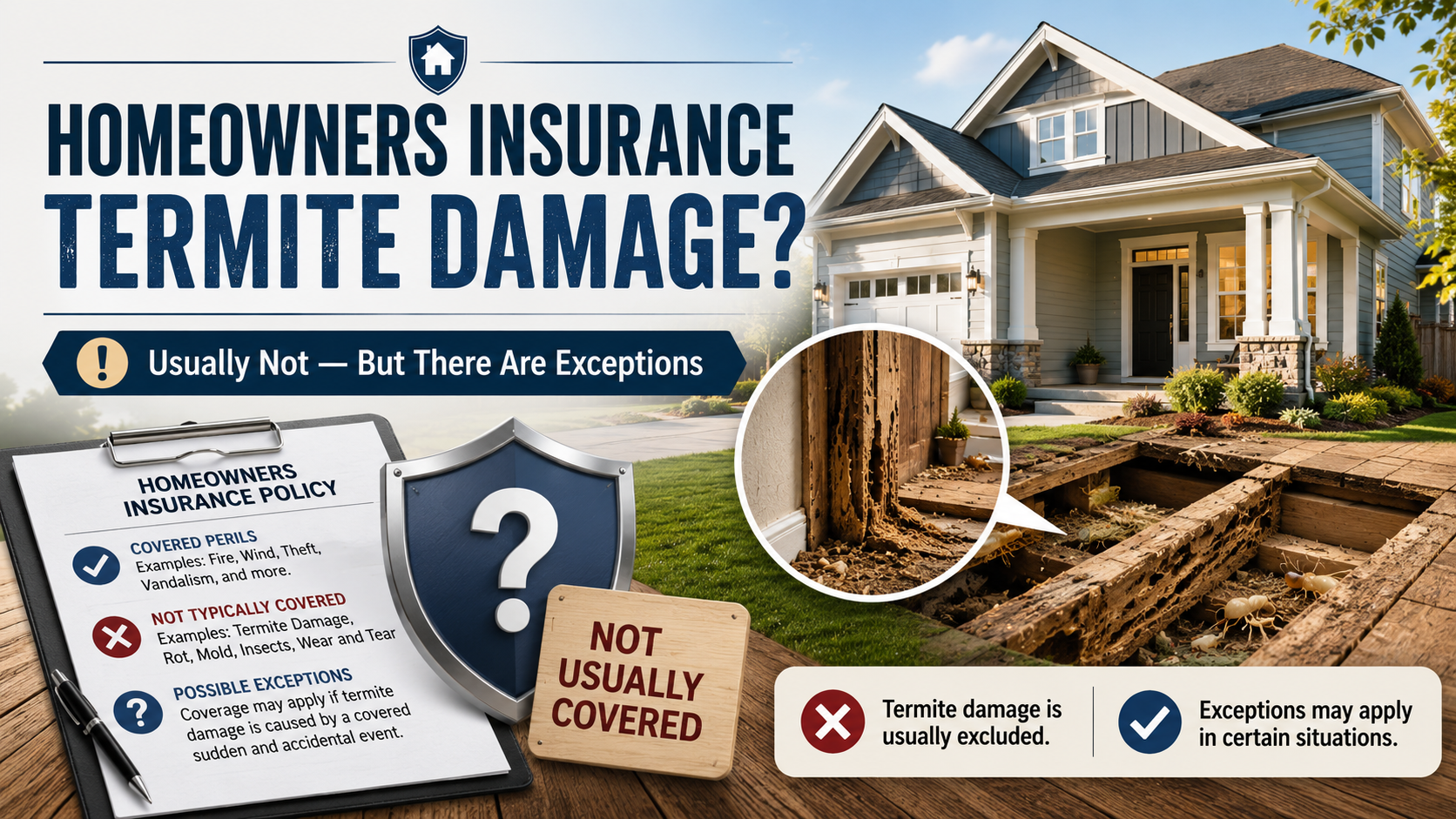
If termites have damaged your house, it is natural to wonder whether homeowners insurance will pay for the repairs.
Usually, the answer is no.
Most homeowners insurance policies treat termite infestations as a maintenance problem that develops gradually rather than a sudden, accidental loss. That generally leaves the homeowner responsible for both termite treatment and repairs to wood, flooring, walls, framing and other parts of the house.
There are, however, some important exceptions. A homeowners policy may cover a separate loss caused by termite damage—such as a fire—and some policies contain limited collapse coverage for hidden insect damage.
Those exceptions depend heavily on the exact policy language and what actually happened.
Quick Answer: Does Homeowners Insurance Cover Termite Damage?
Homeowners insurance usually does not cover termite treatment or ordinary termite damage.
Insurers generally consider termite infestations preventable through inspection, maintenance and pest control. Progressive, for example, states that termite damage and removal typically are not covered because an infestation is viewed as preventable.
But there are situations where insurance may still become relevant:
- Termites cause a separate event that is covered by your policy, such as a fire.
- Hidden termite damage causes an actual structural collapse and your policy includes applicable collapse coverage.
- Some of the damage is caused by a different covered peril rather than the termites themselves.
Do not assume one of those exceptions applies simply because you found extensive termite damage. Coverage depends on the wording of your own policy and the facts of the loss.
Why Doesn’t Homeowners Insurance Normally Cover Termites?
Homeowners insurance is primarily designed to protect against unexpected losses such as fire, wind, theft and certain types of sudden water damage.
Termites work very differently.
A colony can remain hidden while gradually eating structural wood for months or years. Insurers generally view inspection, pest prevention and maintenance as the homeowner’s responsibility.
That puts termite damage in the same general category as many other problems caused by deterioration, infestation or neglected maintenance.
Allstate’s current guidance says most homeowners policies do not cover termite damage or removal and identifies prevention as a homeowner responsibility. You can read Allstate’s explanation here.
Does Homeowners Insurance Pay for Termite Treatment?
Generally, no.
If you discover an active infestation and need an exterminator, the cost of killing the termites is normally your responsibility.
Depending on the home, termite species and treatment method, that can range from a relatively small localized treatment to a whole-house treatment costing thousands of dollars.
We break those costs down in our guide to termite treatment prices in 2026.
Homeowners insurance also normally will not pay for preventative termite inspections, bait stations or routine pest-control service.
Does Insurance Pay to Repair Wood Damaged by Termites?
Usually not if the termites themselves caused the damage.
That can leave you responsible for repairs to:
- Floor joists
- Sill plates
- Wall studs
- Roof framing
- Subflooring
- Hardwood flooring
- Window and door framing
- Trim and molding
- Deck or porch components
- Drywall or finishes removed to reach damaged wood
The size of that repair bill depends much more on where the termites have been feeding than on the number of termites you happen to see.
A small amount of damaged trim is very different from a compromised structural beam.
Exception #1: Termites Cause a Covered Loss
One important exception involves what insurers sometimes call an ensuing or resulting loss.
Imagine termites chew through electrical wiring inside a wall and the damaged wiring starts a fire.
Your policy may exclude the cost of repairing the termite infestation and the wood that the termites damaged, while still covering fire damage because fire itself is a covered peril.
Allstate specifically gives this example in its termite guidance: if termites damage wiring and cause a fire, the resulting fire damage may be covered.
Exactly how an insurer treats a combined loss depends on the exclusions and resulting-loss provisions in your policy.
The practical lesson is that you should not automatically abandon an insurance claim simply because termites were somewhere in the chain of events.
Exception #2: Hidden Termite Damage Causes a Collapse
This is the most interesting—and potentially confusing—exception.
Some homeowners policies contain additional coverage for a collapse caused by hidden insect or vermin damage.
That does not mean an insurer must replace a beam merely because termites have weakened it.
Collapse coverage is usually defined quite narrowly. Depending on the policy, the building or part of it may need to actually fall down or cave in. Sagging, cracking, leaning or a structure that is merely in danger of collapsing may not be enough.
Some policy forms also restrict coverage if the homeowner knew about the insect damage before the collapse occurred.
This is an area where exact wording matters enormously.
There have been insurance disputes and court cases over houses damaged by termites where policies specifically included collapse caused by hidden insect damage. The outcomes can turn on questions such as:
- Did an actual “collapse” occur under the policy definition?
- Was the termite damage hidden?
- Did the homeowner know about it?
- Was termite damage the cause of the collapse?
- Do other exclusions apply?
If termite damage has caused a floor, wall, roof or other part of the house to physically collapse, I would not assume the claim is excluded without reading the collapse section of the policy.
What If the Floor Is Sagging but Hasn’t Collapsed?
This is where many homeowners can be disappointed.
A floor may feel soft. A beam may have lost substantial structural strength. A wall may sag.
That can be a serious and expensive structural problem without satisfying the policy definition of “collapse.”
Some policy forms specifically say that settling, cracking, shrinking, bulging or expansion does not constitute collapse.
If the structure is still standing, a collapse provision may therefore provide little help even if a contractor says substantial reconstruction is necessary.
What If You Didn’t Know You Had Termites?
Unfortunately, simply being unaware of an infestation does not normally convert ordinary termite damage into a covered homeowners claim.
Termites are exceptionally good at remaining hidden.
You can have substantial activity behind walls, under flooring or inside structural wood before noticing anything obvious.
That is one reason homeowners insurance typically treats termite infestation differently from a sudden event such as a tree falling through the roof.
However, whether the damage was truly hidden can become relevant if your policy contains the collapse coverage discussed above.
What If You Just Bought the House?
If you discover termites shortly after buying a house, homeowners insurance still may not be the right source of recovery.
Other possibilities may be more relevant, depending on the facts:
- A termite inspection or wood-destroying-organism report
- A termite bond or warranty transferred with the house
- A pest-control company’s treatment guarantee
- Seller disclosure requirements
- A home inspector’s agreement
- Contract rights arising from the sale
Those issues are very fact- and state-specific. Finding termites after closing does not automatically mean someone else is liable, but it is worth locating every inspection report, disclosure, receipt, warranty and termite-treatment record associated with the property.
What Is a Termite Bond—and Is That Better Than Insurance?
A termite bond is very different from homeowners insurance.
It is typically an agreement with a pest-control company providing some combination of:
- Regular inspections
- Monitoring
- Retreatment if termites return
- In some cases, repair coverage for qualifying new termite damage
The last item is important because not every termite contract includes repairs.
A retreatment bond may promise to treat future termite activity without promising to repair the wood the termites damaged.
A repair bond may offer substantially more protection, but limits, exclusions, inspection requirements and transfer rules can apply.
If you are buying termite protection partly because you are worried about a future repair bill, read that part of the contract carefully.
How Much Can Termite Damage Cost to Repair?
There is no useful single average because termite repairs range from replacing a small section of trim to rebuilding structural portions of a house.
Our termite-treatment guide estimates that repairs can range from hundreds of dollars to $10,000 or more when framing, flooring or other substantial components are affected.
Treatment is a separate expense.
That is why discovering termites early is financially important even when insurance will not pay the bill.
What Should You Do If You Find Termites?
If you see termites or evidence of them, I would approach the problem in this order:
- Document what you found. Take photographs and video before tearing things apart.
- Do not destroy all the evidence. An inspector may learn something from the location and type of activity.
- Arrange a termite inspection. Determine whether the infestation is active and how extensive it appears to be.
- Separate treatment from repairs. First stop the active infestation; then determine which damaged materials actually need replacement.
- Read your homeowners policy. Look specifically for insect/vermin exclusions, collapse coverage and resulting-loss language.
- Check for a termite bond or warranty. Previous owners may have maintained one.
- Contact your insurer if there is a potentially covered event. Fire or an actual collapse deserves a closer look than ordinary chewed wood.
If the first thing you found was a narrow dirt-colored line running up your foundation or basement wall, see our guide to termite mud tubes and what they mean.
Should You File an Insurance Claim for Termite Damage?
If the only problem is an ordinary termite infestation and gradually damaged wood, your policy is likely to exclude it.
But I would look more closely before making that assumption if:
- Part of the building actually collapsed
- A fire occurred
- Another sudden event caused part of the loss
- The insurer’s policy specifically includes collapse caused by hidden insect damage
- You are unsure what caused the structural failure
You can call your agent or insurer and ask how the relevant provisions apply to the facts. For a very large disputed claim, an insurance professional or attorney familiar with property claims may also be appropriate.
Do not rely on a generic internet article—including this one—to tell you definitively whether a specific loss is covered. Your policy is the contract that controls.
How to Reduce the Chance of an Expensive Termite Problem
Termite prevention is not glamorous, but neither is paying to replace a sill plate.
Useful steps include:
- Keep soil and wood from making unnecessary contact with the house
- Repair plumbing and roof leaks
- Keep gutters and downspouts working properly
- Direct water away from the foundation
- Avoid stacking firewood against the house
- Watch for mud tubes around the foundation and crawlspace
- Investigate swarming termites or discarded wings
- Have suspicious activity inspected before damage becomes extensive
Allstate and Progressive both emphasize moisture control, inspection and keeping wood or landscaping conditions from encouraging termite activity.
Seeing Signs of Termites?
If you have found mud tubes, damaged wood, discarded wings or other signs of termites, finding out how extensive the problem is should come before arguing with an insurance company about who will pay for it.
Call a local pest control professional: (833) 770-0877
You can also see our full guide to termite treatment costs before getting estimates.
Frequently Asked Questions
Will homeowners insurance pay for termite extermination?
Usually no. Termite treatment is generally considered pest control and routine property maintenance rather than a covered homeowners insurance loss.
Does homeowners insurance cover structural damage from termites?
Ordinary structural damage caused gradually by termites is generally excluded. Some policies may provide limited coverage if hidden insect damage causes a qualifying collapse, so check your policy’s collapse provisions.
What if termites cause my house to collapse?
Some homeowners policies specifically provide collapse coverage when hidden insect damage causes the collapse. Definitions and exclusions vary, and simply having severe structural damage or sagging may not satisfy the policy’s definition of collapse.
What if termites chew wiring and cause a fire?
The termite damage itself may be excluded while the resulting fire damage may be covered. Allstate uses this as an example of a situation where homeowners insurance may respond even though termites started the sequence of events.
Does homeowners insurance cover termite damage if I didn’t know the termites were there?
Usually not for ordinary termite damage. Lack of knowledge alone does not normally make an infestation covered. Hidden damage can become important, however, under certain policy provisions dealing with collapse.
Does a termite bond cover damage?
It depends on the contract. Some bonds provide only inspections and retreatment, while others include limited repair protection. Read the repair coverage and exclusions rather than assuming every termite warranty pays for structural damage.
Write a Reply or Comment