
If you find a narrow line of dried mud running up your foundation, basement wall, crawlspace, or wood framing, it is worth paying attention.
It may just look like dirt. But it may also be one of the clearest warning signs of subterranean termites.
These lines are called termite mud tubes. Termites build them so they can travel between the soil and the wood in your home while staying moist and protected. If you see them, it does not automatically mean your house is falling apart. But it does mean you should stop guessing and take the sign seriously.
Quick Answer: What Are Termite Mud Tubes?
Termite mud tubes are narrow, dirt-colored tunnels that subterranean termites build from soil, saliva, and waste. They use these tubes to travel between the ground and wood while protecting themselves from dry air and predators. Mud tubes are often found on foundation walls, basement walls, crawlspaces, piers, sill plates, and other areas where termites may be entering a home.
If you find mud tubes, don’t panic: inspect. A mud tube may be active, abandoned, or old, but it should not be ignored.
What Do Termite Mud Tubes Look Like?
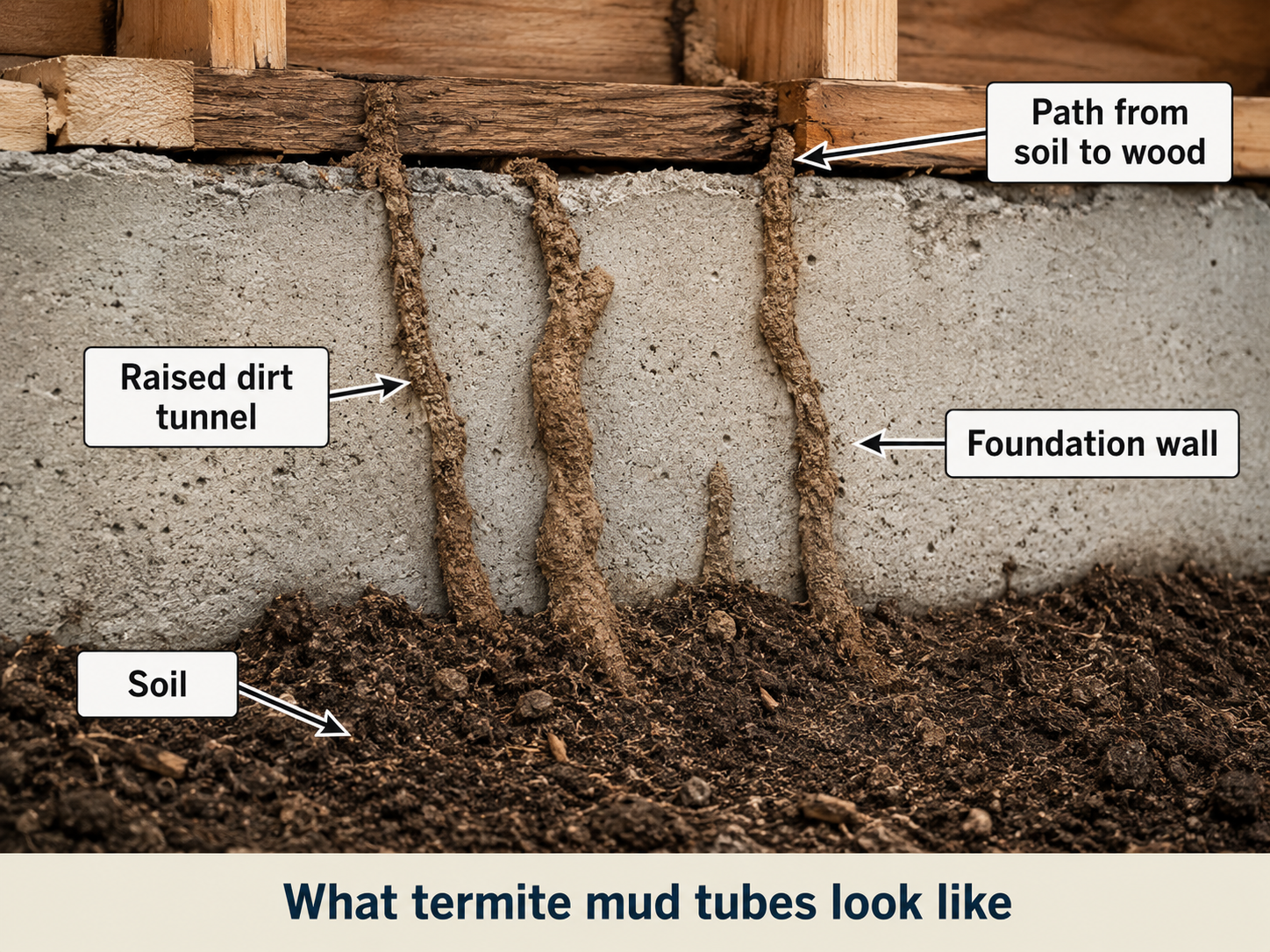
Termite mud tubes usually look like thin, raised dirt trails. They may be about the width of a pencil, though they can be smaller or wider depending on the infestation and location.
They often appear as:
- brown or tan dirt-like lines on concrete, brick, wood, or drywall
- narrow tubes running vertically up a foundation wall
- muddy trails in crawlspaces or basements
- dirt-like patches along cracks, seams, or joints
- small covered tunnels leading from soil to wood
They are easy to miss because they do not look dramatic. A homeowner may walk past them for months thinking they are just dirt, staining, or some odd bit of construction residue.
That is part of the problem. Termites do not announce themselves with a cartoon warning sign. Sometimes the first visible clue is a little brown line where there should not be one.
Why Do Termites Build Mud Tubes?
Subterranean termites need moisture. They usually live in the soil and travel to wood to feed. Open air can dry them out, so they build mud tubes as protected highways.
The tube lets them move between the colony and the food source without being exposed.
That is why mud tubes matter. You are not just seeing a random trail of dirt. You may be seeing the route termites are using to reach the structure of your home.
Where Are Termite Mud Tubes Usually Found?
Termite mud tubes are most often found where the ground meets the house or where termites can move from soil to wood.
Check these areas:
- foundation walls
- basement walls
- crawlspace piers
- sill plates
- floor joists
- garage walls
- utility penetrations
- expansion joints
- porch supports
- wood touching soil
Outside the home, look near places where moisture collects: downspouts, mulch beds, leaky hose bibs, decks, steps, and wood piles.
Inside the home, mud tubes may show up in basements, garages, closets, utility rooms, or along cracks where termites have found a path.
Are Mud Tubes Always a Sign of Active Termites?
No. Mud tubes are not always active at the moment you find them.
A mud tube may be:
- active, with termites still using it
- abandoned, if the colony moved or treatment worked
- old, especially in homes with past termite treatment
But here is the practical point: you usually cannot know that just by glancing at it.
An old mud tube is less urgent than an active one, but both deserve context. If the home has a termite treatment history, that matters. If there are new tubes, damaged wood, moisture problems, or no record of treatment, that matters too.
Should You Break Open a Termite Mud Tube?
You can break open a small section of a mud tube to see whether termites are inside, but do not treat that as a complete inspection.
If the tube is active, you may see small pale insects moving inside. If you do not see termites, that does not guarantee the problem is gone. Termites may be elsewhere, the tube may be temporarily unused, or the visible section may not show the whole route.
If you do break open a small section, check it again later. Active termites may repair the tube.
The bigger mistake is tearing out every visible sign before anyone can inspect it. If you are going to call a professional, leaving some evidence in place can help them understand what is going on.
Termite Mud Tubes vs Dirt, Cracks, or Other Insect Debris
Not every dirty line on a foundation is a termite tube.
Termite mud tubes can be confused with:
- mud splatter from rain
- old concrete or mortar residue
- cracks filled with dirt
- spider webs covered in dust
- ant activity
- moisture staining
The difference is that a termite mud tube usually has structure. It looks built. It may be raised from the surface, follow a path, cross over concrete or masonry, and connect soil to wood or a crack.
If you are not sure, take photos before disturbing it. Get close-up shots and wider shots showing where the tube is located. The location often tells as much as the tube itself.
What Should You Do If You Find Termite Mud Tubes?
Do not ignore them. Do not immediately panic. And do not assume the cheapest DIY spray at the hardware store has solved the problem.
Here is a sensible order of operations:
- Take photos. Get close-up and wide-angle photos before disturbing anything.
- Check nearby wood. Look for soft, hollow, blistered, or damaged wood.
- Look for moisture problems. Termites are often helped by leaks, poor drainage, or damp crawlspaces.
- Check whether the tube is active. You can break a small section and see if termites appear or rebuild it.
- Consider a professional inspection. Especially if tubes are near structural wood or inside the home.
Mud tubes are not the place for homeowner optimism. If you see them, the question is not whether you can explain them away. The question is whether you can confidently rule out termites.
How Serious Are Termite Mud Tubes?
Termite mud tubes can be serious because they may indicate termites are actively reaching the structure of your home.
The seriousness depends on:
- where the tubes are located
- whether they are active
- whether there is wood damage
- whether the home has been treated before
- whether moisture is attracting termites
- how long the tubes may have been there
A single old tube on an exterior foundation is not the same as multiple active tubes inside a crawlspace. But both are clues worth investigating.
Do Termite Mud Tubes Mean You Need Treatment?
Not always, but they often mean you need an inspection.
If the tubes are active, professional treatment may be needed. If they are old and the home has already been treated, the next step may be monitoring. If there is visible damage, the treatment question becomes more urgent.
Treatment cost depends on the type of termites, the size of the home, the treatment method, and whether repairs are needed. For a detailed price breakdown, see our guide to how much termite treatment costs.
Can You Treat Termite Mud Tubes Yourself?
You can knock down a mud tube. That does not mean you treated the termite problem.
That is an important distinction.
Destroying the visible tube may interrupt one route, but it does not eliminate the colony or seal every possible entry point. Termites can build new tubes, use hidden paths, or continue feeding somewhere else.
DIY treatment may be reasonable for some household pest problems. Termites are different because the expensive part is not seeing one insect. The expensive part is missing a hidden structural problem until it has grown.
When Should You Call Pest Control?
You should consider calling pest control if:
- you see mud tubes on your foundation or inside your home
- the tube appears active
- you find damaged or hollow-sounding wood
- mud tubes reappear after being broken
- you see discarded termite wings
- you have moisture problems near the foundation
- you are buying or selling a home
If you are still deciding whether the issue is serious enough, read our guide on when to call pest control.
Seeing Termite Mud Tubes?
If you found mud tubes, damaged wood, discarded wings, or signs of pests in your home, speaking with a pest control professional can help you understand your options before the problem gets worse.
(833) 770-0877
Related Pest Control Guides
- How Much Does Termite Treatment Cost?
- When to Call Pest Control
- Complete Pest Control Guide
- Animal Removal From Walls Cost
Frequently Asked Questions About Termite Mud Tubes
Are termite mud tubes always active?
No. Termite mud tubes may be active, abandoned, or old. But they should not be ignored because they can indicate that termites have found a path into or near the home.
Should you break open termite mud tubes?
You can break open a small section to look for active termites, but do not destroy all visible evidence before an inspection. Active termites may repair the tube later.
Where are termite mud tubes usually found?
Termite mud tubes are often found on foundation walls, basement walls, crawlspaces, piers, sill plates, garage walls, and places where soil, moisture, and wood are close together.
Can mud tubes appear inside a house?
Yes. Mud tubes can appear inside basements, crawlspaces, garages, utility rooms, or along walls if termites have found a hidden path indoors.
Do termite mud tubes mean you need treatment?
Not always, but they usually mean you should investigate further. Active tubes, damaged wood, or recurring tubes are strong reasons to consider a professional termite inspection.
Write a Reply or Comment