
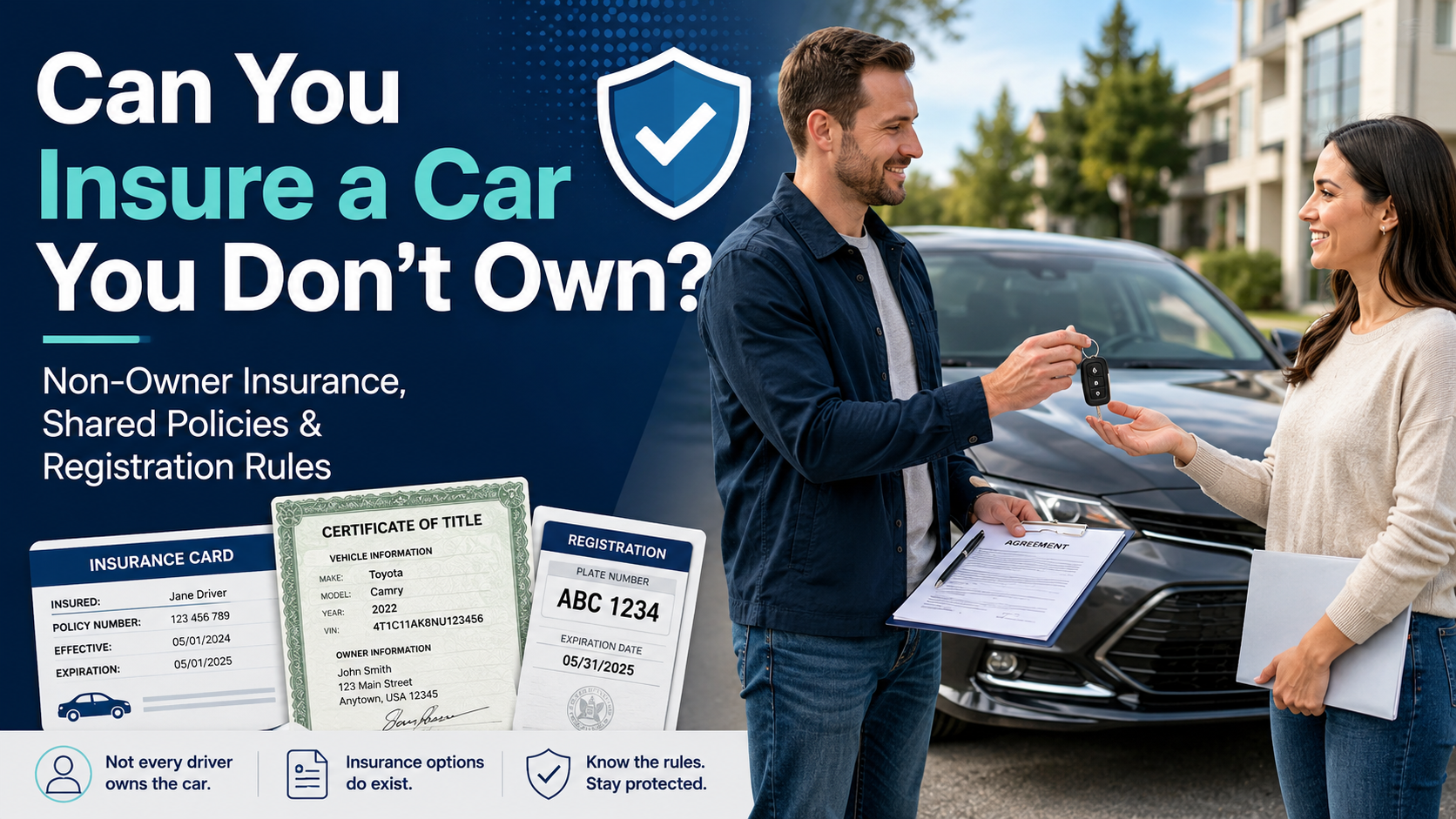
If you drive a car that is titled in someone else’s name, can you simply buy an insurance policy on it yourself?
Get DealyPlanet by email Practical help with insurance claims, expensive repairs and consumer problems.
Sometimes. But it depends on who owns the vehicle, where you live, whether you live with the owner, how often you drive the car, and what your insurance company is willing to insure.
There is also an important difference between insuring yourself while driving cars you don’t own and insuring a particular car against collision, theft, fire and other damage.
A non-owner car insurance policy can solve the first problem. It usually does not solve the second.
Quick Answer: Can You Insure a Car You Don’t Own?
You may be able to insure or be covered while driving a car you don’t own, but you cannot assume that you can simply put someone else’s vehicle on a standard policy in your own name.
The best solution depends on the situation:
| Situation | Usually the Best Approach |
|---|---|
| You occasionally borrow a friend’s car | The owner’s policy may cover permissive use; a non-owner policy can provide additional liability protection |
| You regularly drive a household member’s car | Usually be listed as a driver on the owner’s policy |
| Your spouse owns the car | A shared household policy may be possible even if only one spouse is on the title |
| You regularly rent or borrow different cars | Consider non-owner car insurance |
| You need an SR-22 but don’t own a car | A non-owner policy with an SR-22 filing may work |
| The car is titled to a parent or friend but is effectively your everyday car | Talk to the insurer; the owner may need to insure it and list you, or ownership/registration may need to change |
| You want collision and comprehensive coverage on someone else’s car | A non-owner policy usually will not provide it; the vehicle itself generally needs to be properly insured by an acceptable named insured |
State laws and insurance-company underwriting rules differ, so there is no single arrangement that works everywhere.
Why Does It Matter Who Owns the Car?
A standard auto insurance policy is built around both people and vehicles.
The insurer wants to know:
- Who owns the vehicle
- Who registered it
- Where it is normally kept
- Who drives it
- How it is used
- Whether anyone has a loan or lease interest in it
Putting a vehicle on an insurance policy does more than provide liability coverage when you drive. If you buy comprehensive and collision coverage, the insurer may be agreeing to pay for damage to the vehicle itself.
That makes ownership relevant.
An insurer may refuse to write a standard policy where the named insured has no acceptable ownership or financial relationship to the vehicle, even if state law does not expressly prohibit the arrangement.
What Is Non-Owner Car Insurance?
Non-owner car insurance is designed for people who drive but do not own a vehicle.
According to Progressive’s current guidance, a non-owner policy primarily provides liability coverage for injuries or property damage you cause while driving a vehicle you do not own.
It can make sense if you:
- Frequently rent cars
- Borrow cars from friends
- Use car-sharing services
- Want to maintain continuous insurance coverage between vehicles
- Need an SR-22 but do not own a car
Depending on the state and insurer, a non-owner policy may also offer coverages such as uninsured/underinsured motorist coverage, medical payments or personal injury protection.
What Non-Owner Insurance Does NOT Do
This is where the name can be misleading.
A non-owner policy generally does not insure the borrowed car itself.
It usually does not provide comprehensive or collision coverage for damage to the vehicle you are driving.
So if you borrow your friend’s $30,000 car and crash it, your non-owner liability policy is not the equivalent of buying “full coverage” on your friend’s car.
The vehicle owner’s collision coverage may respond to damage to the vehicle, subject to that policy’s terms and deductible.
Your non-owner policy is primarily there to protect you against liability for injuries or property damage you cause to other people.
What If You Borrow a Friend’s Car Occasionally?
You may not need to insure the car yourself at all.
Auto insurance often follows the vehicle when an owner gives someone permission to drive it.
GEICO’s current guidance says that a friend who has permission to drive a vehicle will generally be covered by the owner’s policy, assuming the driver is not excluded and the policy otherwise applies.
That is commonly called permissive use.
But there are limits.
Policies differ, and an occasional borrower is very different from someone who drives the vehicle every day.
If you regularly use the car, the insurer may expect you to be disclosed and listed as a driver.
What If You Drive Your Parent’s Car?
This depends heavily on where you live and how often you use it.
If You Live With Your Parents
If you live in the same household and regularly drive their car, you generally should be disclosed to the insurance company.
Progressive notes that many insurers require licensed household members to be listed on the policy, even if they do not regularly drive every vehicle.
A non-owner policy is generally not the obvious solution when you have regular access to a vehicle in your own household.
If You Live Somewhere Else
Suppose your parent owns a car but you take it to college, move into your own apartment, or use it every day in another state.
That needs to be discussed with the insurer.
The company needs the correct:
- Principal driver
- Garaging address
- Vehicle location
- Mileage
- Use of the vehicle
Leaving the policy written as though your parent is still the principal driver and the car still lives at your parents’ house can create serious problems if that is no longer true.
Depending on the insurer and state, the cleanest solution may eventually be transferring the vehicle into your name.
Can You Insure a Car Owned by Your Spouse?
This is often much easier.
Insurers routinely write household policies covering married couples and multiple household vehicles.
Progressive specifically notes that married couples living together may be able to put both vehicles on the same policy even when the cars are not jointly owned.
That does not mean every insurer handles ownership identically, but a car titled only to your spouse is very different from trying to insure a stranger’s vehicle.
If you marry, move in together or combine vehicles onto one policy, make sure the insurer knows who owns each vehicle and who drives it.
Can You Insure a Car Titled to Your Boyfriend or Girlfriend?
Possibly, particularly if you live together, but do not assume the rules will be identical to those for married spouses.
Some insurers may allow both people and their vehicles on a household policy. Others may have different ownership requirements.
If the car belongs to your partner and you drive it regularly, ask the insurer whether you should:
- Be listed as a driver on the owner’s policy
- Be added as a named insured
- Combine household vehicles onto one policy
- Change the registration or title
Trying to solve the issue by buying an unrelated policy without telling either insurer about the actual arrangement is a poor idea.
What If Someone Bought a Car for You but Kept the Title?
This is a common source of confusion.
Maybe a parent bought the vehicle. Maybe a relative gave you an old car but never transferred the title. Maybe you paid someone for a vehicle and never finished the paperwork.
If the car is effectively yours and you use it every day, clean ownership paperwork is usually preferable to building an insurance arrangement around an inaccurate title.
You may need to:
- Transfer the title
- Register the car in the correct name
- Buy a policy reflecting the actual owner, drivers and garaging location
Registration and insurance requirements vary by state.
For example, New York has unusually strict requirements. The New York DMV says the name on a vehicle’s insurance and registration must match exactly.
Other states may allow the registered owner and insured to differ, but an insurance company can still impose its own underwriting requirements.
Can the Registration and Insurance Be in Different Names?
Sometimes.
Progressive notes that most states allow insurance and registration to be in different names from a legal standpoint, but insurers may still decline to issue the policy that way.
And there are important exceptions.
New York requires the insurance and registration to have the same name.
So there are really two questions:
- Does your state permit the arrangement?
- Will your insurance company accept the arrangement?
You need a yes to both.
Trying to Insure a Car That’s Not in Your Name?
If ownership, household drivers or registration make your situation unusual, comparing insurers can be useful because underwriting rules differ.
Call (855) 467-0338 to compare car insurance options.
Explain who owns the vehicle, who drives it, where it is kept and whether there is a loan or lease. Do not try to make the situation look simpler than it really is just to get through an online quote.
Can Someone Else Insure Your Financed Car?
This can be more complicated because a lender has a financial interest in the vehicle.
If you finance a car, your lender normally requires you to maintain comprehensive and collision coverage and to list the lender appropriately on the policy.
Having a completely unrelated person insure your financed vehicle may not satisfy the lender or the insurance company’s requirements.
Progressive says it generally is not possible for someone who lives elsewhere to simply insure your financed car, although household situations can sometimes be handled differently.
If another person is making the insurance payments for you, that does not necessarily mean the policy itself has to be written in that person’s name. Someone can pay your premium without becoming the vehicle owner or named insured.
What About a Leased Car?
A leased car technically belongs to the leasing company.
Yet the person leasing the vehicle normally obtains the insurance.
That is not the same as randomly insuring someone else’s car.
Your lease gives you possession and contractual responsibility for the vehicle, and the leasing company requires insurance protecting its interest.
Lease agreements commonly require:
- Liability insurance
- Collision coverage
- Comprehensive coverage
- Specified coverage limits
- The leasing company to be properly listed on the policy
Always check the insurance requirements in your particular lease.
Can You Get Car Insurance If You Don’t Own Any Car?
Yes.
This is exactly what non-owner car insurance is designed for.
You do not need to own a vehicle to have an auto insurance policy.
This can be especially useful if you sold your car but still:
- Rent vehicles frequently
- Borrow friends’ cars
- Use car-sharing services
- Expect to buy another car soon
Keeping non-owner coverage can also help you avoid a long insurance-coverage gap, which may make shopping for insurance easier when you buy your next vehicle.
Can You Get an SR-22 Without Owning a Car?
Yes.
An SR-22 is not actually a type of insurance. It is a filing showing that you have insurance meeting required financial-responsibility limits.
If your state or a court requires an SR-22 and you do not own a vehicle, you may be able to buy a non-owner insurance policy with an SR-22 filing.
Both Progressive and GEICO currently describe non-owner SR-22 policies for drivers who need the filing but do not own a vehicle.
State rules differ, and not every insurer offers SR-22 filings.
Does Non-Owner Insurance Cover Rental Cars?
It can provide liability protection while you rent a vehicle, but there is an important gap.
A typical non-owner policy does not provide collision or comprehensive coverage for damage to the rental car itself.
You may need another source of physical-damage protection, such as:
- The rental company’s collision damage waiver
- Applicable credit-card rental protection
- Another policy that specifically provides the coverage
Check the terms carefully. Rental-car coverage is an area where people frequently assume they have protection that they do not actually have.
What If You Regularly Borrow the Same Car?
This is where a non-owner policy may stop being the clean solution.
Non-owner coverage is primarily designed around vehicles you do not own and do not have regular household access to.
If you drive the same person’s vehicle every day, especially if you live with that person, the insurer may expect you to be listed on the vehicle owner’s policy.
Progressive specifically recommends that a person regularly borrowing a household member’s car generally be added to that person’s policy instead of relying on non-owner coverage.
The insurer needs an accurate picture of who actually presents the driving risk.
Whose Insurance Pays When You Crash Someone Else’s Car?
There is no universal answer, but the vehicle owner’s insurance is commonly the first policy involved when the owner gave you permission to drive.
For example:
Damage to the owner’s car: The owner’s collision coverage may pay, subject to the policy and deductible.
Damage you cause to someone else: The owner’s liability coverage may apply first. Your own applicable coverage, including a non-owner policy, may potentially provide additional protection depending on the policies and state law.
Your injuries: Coverage can depend on your state and whether medical payments, PIP, uninsured motorist or other coverages apply.
Do not assume “insurance follows the car” answers every coverage question. It is a useful general rule, not a substitute for reading the policies involved.
Can You Add Yourself to the Owner’s Insurance?
Often, yes—and in many situations that is much cleaner than trying to insure the vehicle separately.
This is especially worth considering when:
- You live with the owner
- You are the owner’s spouse or partner
- You regularly drive the vehicle
- The car is owned by a parent
- You share vehicles within the household
Tell the insurer exactly how the car is used.
If you are actually the principal driver, do not describe yourself as an occasional driver merely because that produces a cheaper quote.
What Not to Do
Unusual ownership arrangements are manageable. Inaccurate insurance applications are much less so.
Avoid these shortcuts:
- Do not use the wrong garaging address. The insurer needs to know where the vehicle actually lives.
- Do not hide the regular driver. If someone drives the car every day, disclose that.
- Do not assume a non-owner policy provides collision coverage. It generally does not insure the borrowed vehicle itself.
- Do not ignore registration rules. States differ, and some require names to match.
- Do not assume paying for the policy makes you the insured owner. Payment and ownership are separate issues.
- Do not leave an old ownership arrangement in place indefinitely just because it is inconvenient to transfer the title.
Misstating ownership, vehicle location or regular drivers can create serious problems when you eventually need the insurance.
The Simplest Way to Think About It
Start by asking what you are actually trying to insure.
If you want liability coverage for yourself while occasionally driving cars you don’t own: look at non-owner insurance.
If you regularly drive a family or household vehicle: being added to the owner’s policy is usually worth discussing.
If you want comprehensive and collision coverage on a particular car: make sure the vehicle’s ownership, registration and policy structure are acceptable to both the state and the insurer.
If the car is effectively yours but still titled to someone else: fixing the title and registration may ultimately be cleaner than trying to engineer an insurance workaround.
Compare Car Insurance for an Unusual Ownership Situation
Different insurers can handle ownership and household situations differently.
If you are shopping for coverage, explain the arrangement accurately before buying the policy.
Call (855) 467-0338 to compare car insurance options.
Be ready to provide the vehicle owner, title and registration information, where the vehicle is kept, who drives it most often and whether it is financed or leased.
Frequently Asked Questions
Can I insure a car if the title isn’t in my name?
Possibly, depending on the state, insurance company and your relationship to the vehicle owner. Some insurers allow certain household or spouse-owned vehicles on a shared policy, while others may require the named insured to be an owner or registrant. State registration rules can also apply.
Can I insure my mom’s car in my name?
If your mother owns the car, the cleaner arrangement is often for her to insure the vehicle and list you as a driver if you use it regularly. If the vehicle has effectively become yours, consider whether ownership and registration should be transferred.
Can I insure my boyfriend’s or girlfriend’s car?
Some insurers may allow unmarried household members and their vehicles on the same policy, but rules vary. If you regularly drive your partner’s car, ask the insurer whether you should be a listed driver, named insured or part of a combined household policy.
Can I get insurance without owning a car?
Yes. Non-owner car insurance provides liability coverage for people who drive but do not own a vehicle. It is commonly used by people who frequently rent or borrow cars.
Does non-owner insurance cover damage to the car I’m driving?
Usually not. Non-owner insurance is primarily liability coverage. It generally does not provide comprehensive or collision coverage for the borrowed or rented vehicle itself.
Do insurance and registration have to be in the same name?
It depends on the state. Many states can allow different names, subject to the insurance company’s own underwriting rules. New York specifically requires the insurance and registration names to match.
Can someone else pay for my car insurance?
Generally, the person paying the bill does not necessarily have to be the vehicle owner. Paying a premium is different from being the named insured or owner. The policy itself still needs to accurately identify the owner, drivers, vehicle and garaging information.
Write a Reply or Comment