
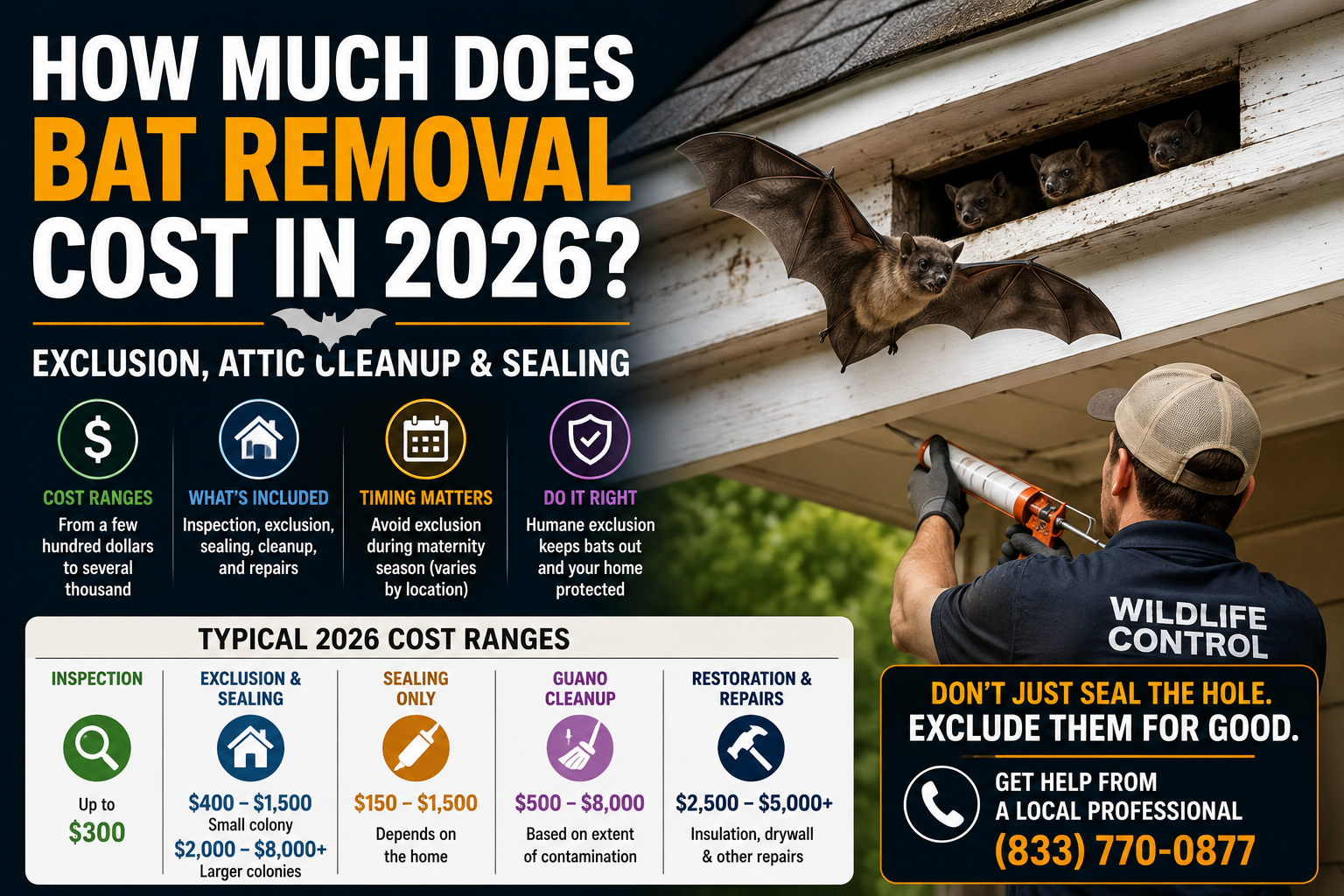
If you discover bats living in your eaves or attic, the actual cost of getting rid of them can range from a few hundred dollars to several thousand.
Get DealyPlanet by email Practical help with insurance claims, expensive repairs and consumer problems.
The reason for that enormous range is that “bat removal” can describe very different jobs.
Removing one bat that accidentally flew into a bedroom may cost a few hundred dollars. Excluding an established colony from an attic, sealing every usable opening around the roofline, removing accumulated guano and replacing contaminated insulation can become a much larger project.
In 2026, a reasonable starting point is about $232 to $754 for relatively straightforward professional bat removal. A proper small-colony exclusion commonly runs roughly $400 to $1,500, while large or complicated colony exclusions can cost $2,000 to $8,000 or more.
And exclusion may only be the beginning. Extensive guano cleanup and attic restoration can add thousands of dollars.
Here is what bat removal really costs in 2026, what you should expect a professional to do, and how to tell whether two wildly different quotes are actually pricing the same job.
Quick Answer: How Much Does Bat Removal Cost in 2026?
| Bat Removal Service | Typical 2026 Cost |
|---|---|
| Professional bat removal, typical simple job | $232–$754 |
| Bat inspection | Up to about $300; often included with treatment |
| Single bat capture/removal | Around $400, depending on access |
| Small colony exclusion and sealing | About $400–$1,500 |
| Larger colony exclusion | About $2,000–$8,000+ |
| Sealing entry points | About $150–$1,500 depending on the house |
| Guano cleanup | About $500–$8,000 |
| Major attic/drywall restoration | Potentially $2,500–$5,000+ |
These are planning ranges rather than quotes. Current 2026 cost data from Angi and HomeAdvisor shows just how quickly the price changes with colony size, accessibility, contamination and the amount of sealing required.
A homeowner with five bats using one obvious fascia gap is dealing with a very different project from someone with dozens of bats entering through several openings and years of guano accumulated across an attic.
Think You Have Bats in Your House?
A wildlife or pest-control professional can inspect the roofline, locate entry points and determine whether the job requires exclusion, sealing and cleanup.
Call a local pest control professional: (833) 770-0877
Bat Removal Usually Means Exclusion
A professional generally should not solve an established bat colony by killing the bats.
The normal approach is bat exclusion.
The basic process is:
- Find the openings bats are using.
- Seal secondary gaps they could use instead.
- Install one-way exclusion devices at active exits.
- Allow the bats to leave to feed.
- Prevent them from getting back inside.
- Remove the exclusion devices after the colony is out.
- Permanently seal the remaining entry points.
This is exactly why you should not simply discover a hole in your fascia and immediately fill it with caulk.
I learned that after discovering bats living in a surprisingly small opening in the eaves of a house. The droppings had been falling onto the deck below for years before we realized what was living overhead.
You can see the signs that led us to the problem in our guide to bats living in eaves and fascia gaps.
How Much Does Bat Exclusion Cost?
A small colony with straightforward access may cost roughly $400 to $1,500 to exclude and seal.
A larger colony can cost substantially more.
Current Angi estimates put exclusion and sealing for colonies of roughly 50 to 200 bats at about $2,000 to $8,000.
The number of bats matters, but the building can matter just as much.
A simple gable roof with one obvious entrance is relatively easy to inspect and seal.
A large older house may have potential openings around:
- Fascia
- Soffits
- Dormers
- Chimneys
- Roof intersections
- Ridge vents
- Gable vents
- Siding
- Flashing
- Utility penetrations
A technician may need ladders, lifts or roof access to reach all of them.
That labor can become a major part of the price.
A $300 Bat Quote and a $2,000 Bat Quote May Not Be for the Same Work
This is the part I would pay the most attention to when comparing estimates.
One company may quote $350 to install a one-way device over the obvious entrance.
Another may quote $1,800 to:
- Inspect the entire structure
- Identify every possible bat-sized opening
- Seal secondary gaps
- Install exclusion devices
- Return to remove those devices
- Permanently seal the original exits
- Provide a warranty against reentry
Those are not equivalent jobs.
If the cheap quote gets the bats out through one opening but leaves another usable gap ten feet away, you may discover the same colony has simply moved its entrance.
How Small an Opening Can a Bat Use?
Smaller than many homeowners expect.
The CDC says bats can enter through openings as small as about 1/4 inch.
That is why a thorough exclusion job can involve much more exterior sealing than the single hole where you happen to see bats emerging.
The technician should identify both:
- Active entry points the bats are currently using
- Potential entry points they could use after the active entrance is blocked
A good estimate should tell you how much sealing is included.
How Much Does It Cost to Seal a House Against Bats?
Current national estimates put bat-related sealing work at roughly $150 to $1,500, depending on the number and accessibility of the openings.
That number can go higher on large or complicated houses.
A wildlife professional may handle minor sealing directly. Significant fascia, soffit, siding or roof damage may also require a roofer, carpenter or other contractor.
The goal is not merely to cover an obvious hole.
The house needs to remain weather-tight and properly ventilated while eliminating openings bats can use.
How Much Does It Cost to Remove One Bat From a House?
A single bat flying around your living room is not necessarily evidence of an established colony.
Current estimates put professional capture of a single bat at roughly $400 on average, although local prices vary substantially.
The company may also inspect the house for likely entry points.
But there is an important health issue before anyone simply releases that bat outside.
If a Bat Was Inside the Living Space, Think About Rabies Before Releasing It
If there is any possibility that a person had direct contact with the bat, contact your local health department or medical provider.
Bat bites can be difficult to see.
The CDC advises people to seek medical guidance after possible bat contact and to talk with public-health authorities before releasing a bat that may need to be tested for rabies.
This becomes particularly important when a bat is found:
- In a room with someone who was sleeping
- Near an unattended young child
- Near someone unable to reliably report whether contact occurred
- After a known bite or scratch
- After contact with a pet
If there may have been an exposure, do not automatically let the bat fly away before asking the health department what to do.
Finding Bats in an Attic Is Different From Finding One in a Bedroom
A colony living in an attic or eaves does not automatically mean everyone in the house has been exposed to rabies.
The concern changes when bats enter occupied living or sleeping spaces or someone has direct contact with one.
If the bats remain separated from people inside an attic, the building problem is primarily one of exclusion, cleanup and preventing future interior access.
If one appears inside a bedroom, treat the rabies question separately from the structural exclusion job.
Bat Removal Timing Matters
There are times when immediately excluding a colony can create a worse problem.
Female bats often form maternity colonies in buildings and give birth to pups that cannot initially fly.
If adults are excluded while those young bats are still trapped inside, the pups may die in the building or crawl into living areas looking for another way out.
The U.S. Fish and Wildlife Service advises against exclusion during maternity season, generally identifying May 15 through August 15 as a period to avoid, while also telling homeowners to check state-specific requirements.
Timing varies by location and bat species.
New York Homeowners Should Be Especially Careful in Summer
New York State health guidance says the common house bats found in buildings often use maternity roosts from roughly early June through late August while females give birth and raise young bats until they can fly.
That means someone discovering bats in a New York attic in July may receive a very different treatment schedule from someone discovering the same problem in September.
The professional may be able to perform inspection and preliminary sealing while waiting to complete the active exclusion at an appropriate time.
Local wildlife rules vary, so a qualified nuisance-wildlife operator should know what is permitted where you live.
Do Not Seal Active Bats Inside the House
This is one of the easiest DIY mistakes to make.
You see bats leaving through a gap.
You wait until daytime.
You fill the hole.
Problem solved?
Possibly not.
Bats may still be inside the attic, wall or soffit.
Now they cannot use their normal exit.
They may die inside the structure or search for another path—which can lead directly into the living space.
Proper exclusion allows active bats to leave before the final opening is sealed.
How Much Does Bat Guano Cleanup Cost?
This is where an inexpensive bat problem can become an expensive one.
Current 2026 estimates put professional guano cleanup anywhere from roughly $500 to $8,000.
That range reflects radically different levels of contamination.
A few droppings below a small eave roost are one thing.
Years of accumulated guano across attic insulation are another.
The cleanup may involve:
- Removing droppings
- Removing contaminated insulation
- HEPA vacuuming
- Controlling dust
- Cleaning affected surfaces
- Odor remediation
- Disposal of contaminated material
- Replacing insulation
Why Large Guano Cleanup Is Not a Shop-Vac Job
Bat droppings can be associated with Histoplasma, a fungus that can cause histoplasmosis when spores become airborne and are inhaled.
The risk is particularly associated with disturbing larger accumulations of bird or bat droppings.
The CDC recommends that large accumulations of droppings be handled by professional companies experienced with the work.
Its occupational guidance also specifically advises against simply sweeping or shoveling dry contaminated material because that can send dust into the air.
This does not mean every isolated bat dropping on a porch is a hazmat emergency.
It does mean I would treat an attic containing years of accumulated guano differently from a few pellets beneath the eaves.
How Much Can Attic Restoration Add?
After the bats are gone and contaminated material is removed, the attic may need repair.
Current estimates put substantial bat-related drywall, insulation and attic restoration around $2,500 to $5,000 in affected cases.
Severe contamination can cost more.
This is why the total bill for a long-established colony can become several times the price of the initial exclusion.
Example: What a Real Bat Job Could Cost
Consider a house where a colony has been using the attic for several years.
A hypothetical project might include:
| Work | Example Cost |
|---|---|
| Inspection | $200 |
| Exclusion and exterior sealing | $1,500 |
| Guano and contaminated insulation removal | $2,000 |
| Replacement insulation/repairs | $2,000 |
| Total | $5,700 |
Those numbers are only an illustration.
But they explain why asking “How much does it cost to remove bats?” can produce answers ranging from $300 to $6,000 without either quote necessarily being absurd.
What Makes Bat Removal More Expensive?
A Large Colony
More bats generally mean a more established roost, more contamination and potentially more active openings.
A Complicated Roof
Dormers, multiple rooflines, chimneys, high peaks and inaccessible soffits make inspection and sealing harder.
Multiple Entry Points
A bat house needs to be sealed comprehensively enough that the animals cannot simply choose another opening.
Bats Inside Walls
Wildlife hidden in walls or ceilings can be harder to locate and exclude than animals using an accessible attic.
If you are hearing movement but cannot identify the animal, our guide to identifying animals living inside walls and ceilings can help narrow down the possibilities.
Guano Accumulation
Cleanup can easily become one of the largest parts of the bill.
Contaminated Insulation
Removal and replacement adds material and labor costs beyond wildlife exclusion.
Height and Access
A technician working 35 feet above the ground may need equipment that someone working from an attic ladder does not.
Repairs
Damaged fascia, soffits, vents, siding or roofing may require additional trades.
Do Repellents Get Rid of Bats More Cheaply?
I would not build a bat-removal plan around ultrasonic gadgets, mothballs or other supposed miracle repellents.
CDC/NIOSH guidance specifically says ultrasonic devices and chemical repellents are not effective for eliminating bats from a roost.
The long-term solution is physical exclusion: get the bats out at the proper time and eliminate the openings they are using.
That costs more than plugging in a $30 gadget.
It also addresses the actual reason bats are inside the structure.
Does a Bat House Solve the Problem?
A bat house can provide alternate roosting habitat, but it does not seal your attic.
If bats can still enter the house, hanging a bat house in the yard does not guarantee they will voluntarily move into it.
A bat house can be part of a wildlife-friendly plan after exclusion, especially if you would like the bats to remain nearby eating insects.
I would treat it as optional habitat rather than the primary removal method.
Will Homeowners Insurance Pay for Bat Removal?
Usually, I would expect to pay the exclusion bill myself.
Progressive explicitly says its homeowners coverage does not pay for removal of bats from an attic and that cleanup is the homeowner’s responsibility.
Other insurers and policy forms may use different language.
The treatment of resulting property damage can also be more complicated than the cost of removing the bats themselves.
Your policy may distinguish among:
- Wildlife removal
- Infestation
- Animal waste
- Gradual damage
- Damage to the structure
- A separate covered event caused by animal damage
If the damage is substantial, read your actual policy and ask the insurer specifically what is and is not covered before assuming the entire project is excluded.
I would not base the decision to hire a bat-removal company on expecting an insurance reimbursement.
What Should Be Included in a Bat Removal Quote?
I would want the estimate to answer these questions:
- Where are the bats entering?
- How many active entrances did you find?
- What other gaps will you seal?
- What exclusion devices will you install?
- When will the devices be removed?
- Is permanent sealing included?
- Is cleanup included?
- Is contaminated insulation removal included?
- Are repairs included or handled by another contractor?
- Is a return inspection included?
- What warranty do you provide against bats reentering?
- What happens if another entry point becomes active?
The total price means much more after you know exactly what the company is promising to do.
Ask About the Warranty
A wildlife-exclusion warranty can be valuable.
But read what it actually covers.
Ask:
- How long does the warranty last?
- Does it cover the whole roofline or only the openings the company sealed?
- Are annual inspections required?
- Does roof work by another contractor void it?
- Does the company charge for return visits?
A five-year warranty on one particular hole is much less useful than it initially sounds if the bats return through an adjacent soffit gap.
Should You Get More Than One Bat Removal Quote?
For anything beyond a simple single-bat capture, I would.
The scope of wildlife-exclusion proposals can vary dramatically.
Ask each company to identify the work in enough detail that you can compare:
- Inspection
- Exclusion
- Sealing
- Follow-up
- Cleanup
- Repairs
- Warranty
The cheapest quote can be the best quote.
It can also be cheap because it leaves half the job for you to solve later.
For general hiring advice, see our guide to choosing a pest control company.
Can You Remove Bats Yourself?
A knowledgeable homeowner can perform exclusion work in some circumstances.
I would be cautious.
You need to understand:
- Where every active opening is
- Whether young bats are present
- When exclusion is legal and appropriate locally
- How to install a one-way exclusion without trapping bats
- How to safely reach the roofline
- How to seal the structure without creating moisture or ventilation problems
- How to handle contaminated material safely
There is also a big difference between sealing a small accessible fascia gap and working high on a steep roof around a chimney.
When animals are living inside a structure rather than merely visiting the yard, this is one of the situations where professional help often makes sense. See our guide to when to stop DIY pest control and call a professional.
How Can You Save Money on Bat Removal?
Address the Problem Before the Colony Grows
A small, recently established roost can be much cheaper to exclude than a long-term attic colony with contaminated insulation.
Get Multiple Detailed Estimates
Compare scope rather than only price.
Separate Exclusion From Restoration
A wildlife company may be excellent at exclusion but expensive for insulation replacement. You may be able to have restoration work quoted separately after the bats are gone.
Do Basic Exterior Maintenance Before Bats Move In
Repairing loose fascia or screening an unused vent before animals occupy it is much cheaper than removing a colony later.
Do Not Spend Money on Products That Do Not Solve the Entry Problem
Repellents do not repair a gap in a soffit.
What If You Rent the House?
Notify the landlord or property manager promptly and in writing.
Responsibility can depend on state law, local housing rules and the lease.
A tenant generally should not hire someone to make permanent alterations to the roofline without first involving the property owner.
If a bat has entered the occupied portion of the apartment and there may have been human exposure, handle the public-health question immediately rather than waiting for the landlord dispute to be resolved.
How Long Does Bat Removal Take?
The hands-on work can be relatively quick.
The whole process may take longer.
A typical exclusion can involve:
- Inspection
- Initial sealing
- Installation of exclusion devices
- Waiting for bats to leave
- Confirming activity has stopped
- Removing exclusion devices
- Final sealing
- Cleanup and restoration if needed
Seasonal restrictions can delay active exclusion much longer if a maternity colony is present.
That is why someone who discovers bats in midsummer may be told to wait before the final exclusion even though the company can begin planning and preventive work.
Frequently Asked Questions About Bat Removal Cost
How much does it cost to get bats out of an attic?
A relatively simple professional bat-removal job may cost a few hundred dollars, while colony exclusion and sealing commonly reaches $400 to $1,500 and can rise into the thousands for large colonies or complicated homes. Guano cleanup and attic restoration are additional costs.
How much does it cost to remove a bat colony?
Current 2026 estimates put a small colony exclusion around $400 to $1,500. Larger colonies can cost $2,000 to $8,000 or more when extensive sealing is required.
How much does bat guano cleanup cost?
Professional cleanup can range from roughly $500 to $8,000 depending on the amount of contamination, size of the attic and whether insulation or other materials need to be removed.
Can an exterminator kill bats?
Professional bat control usually relies on humane exclusion rather than extermination. Legal protections and removal rules vary by state and species, and exclusion may be restricted during maternity season.
What time of year should bats be removed?
Timing depends on location and species. The U.S. Fish and Wildlife Service advises against exclusion during the typical maternity period, generally May 15 through August 15, and recommends checking state-specific rules. New York health guidance says building-roosting house bats often raise young from early June through late August.
Should I seal a bat hole during the day?
Not simply because the bats appear to be outside. Some bats or flightless young may remain inside. Proper exclusion lets the colony leave before the final active opening is permanently sealed.
Does homeowners insurance cover bat removal?
Usually not. Bat exclusion and cleanup are commonly treated as maintenance or infestation expenses. Coverage for resulting structural damage depends on the policy and circumstances, so check your actual policy if damages are substantial.
Does bat guano cause histoplasmosis?
Histoplasmosis comes from inhaling spores of the Histoplasma fungus. The fungus can grow in environments containing significant accumulations of bat or bird droppings, and disturbing contaminated material can send spores into the air. Large accumulations should be handled carefully and may warrant professional cleanup.
What should I do if I wake up with a bat in my bedroom?
Do not simply release it and forget about the incident. Contact your local health department or healthcare provider to determine whether there may have been a rabies exposure and whether the bat should be captured for testing.
Is one bat in the house evidence of an infestation?
Not necessarily. One bat can enter accidentally. Repeated indoor bats, droppings beneath the roofline, noises in the attic or seeing multiple bats leave the same opening at dusk are much stronger signs of an established roost.
The Removal Price Is Only Part of the Bat Problem
A homeowner who catches the problem early may spend a few hundred dollars.
A long-established attic colony can produce a bill several thousand dollars larger because the project now involves exclusion, whole-house sealing, contaminated insulation and restoration.
That is why I would ask for a detailed scope rather than focusing only on a headline “bat removal” price.
You want to know whether the quote gets one bat out tonight or solves the structural problem that allowed a colony to live there in the first place.
If bats are actively using your attic, soffits or eaves, identifying the entry points early can prevent a relatively small wildlife problem from becoming an attic-remediation project.
Need Help With Bats?
If you are seeing bats emerge from your roofline, finding guano, or hearing activity inside the attic or walls, you can speak with a local pest or wildlife-control professional about inspection and exclusion.
Call a local pest control professional: (833) 770-0877
Write a Reply or Comment