
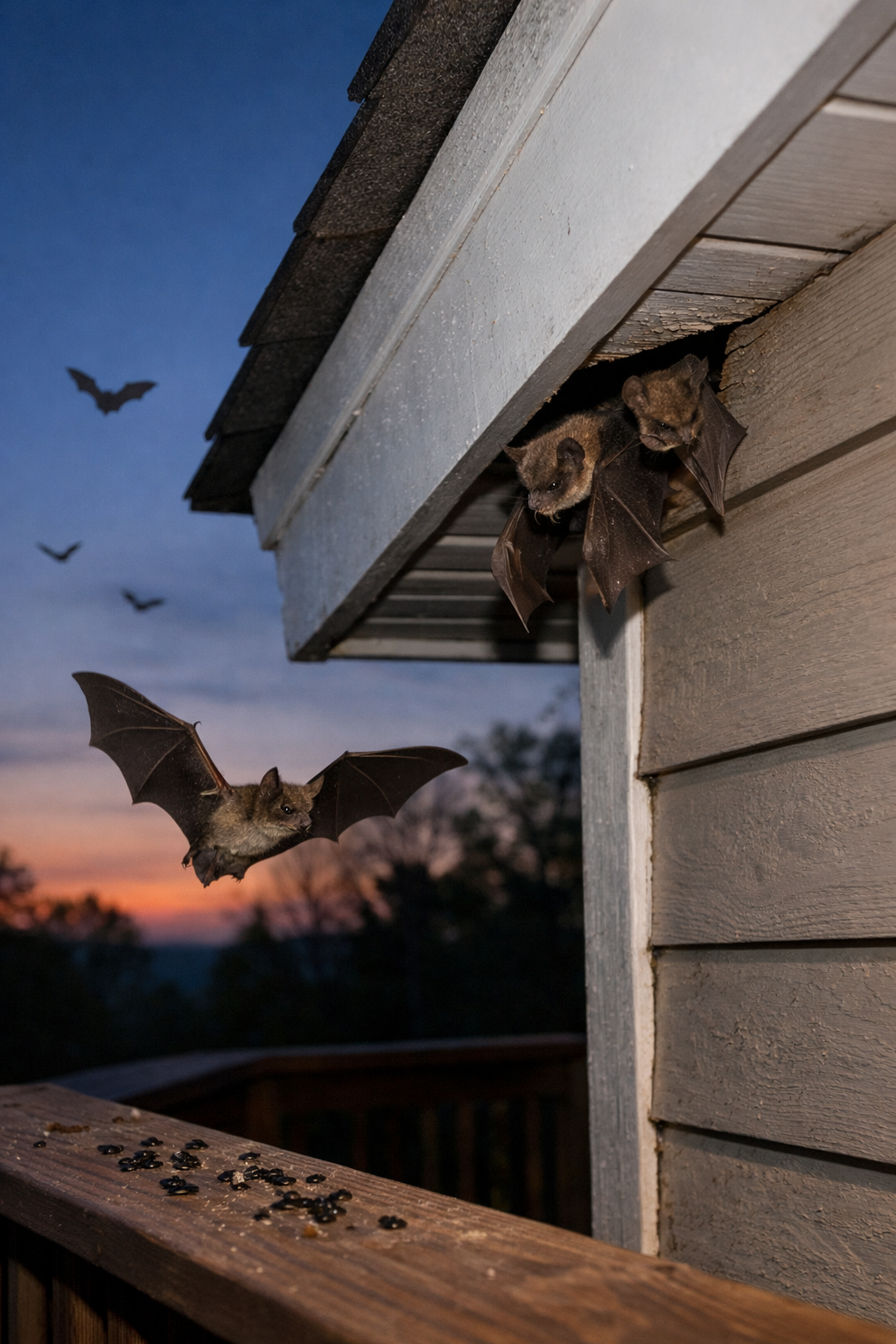
For several years, I kept noticing what looked like mouse droppings appearing on the same corner of my wraparound deck.
It was easy to assume mice were the problem. The droppings were small, dark, and kept showing up in the same area. But the pattern never fully made sense. I was not seeing clear signs of mice elsewhere on the deck, and yet the mess kept coming back.
Then my daughter heard rustling in the ceiling.
That was the clue that finally pushed us to look more carefully at the outside of the house. What we discovered was that bats had made a home in a tiny gap between the fascia and the side of the house in the eaves.
The droppings on the deck were not from mice at all. They were falling from the roofline above.
What Finally Solved the Mystery
Once we knew to stop focusing on the deck and start looking up, the situation became much easier to understand.
There was a small opening where the fascia met the side of the house. It did not look like much from the ground, but it was apparently large enough for bats to slip into and use as a roosting spot. That tiny gap had likely been the source of the problem for years.
This is one reason bat problems can be easy to miss at first. Homeowners often expect obvious attic access or a large hole, but bats can get into surprisingly small openings around eaves, soffits, fascia boards, vents, and roof intersections.
If you’re not sure whether you’re dealing with bats or another animal, this guide can help identify what may be living in your walls or eaves.
Why Bat Droppings Can Be Mistaken for Mouse Droppings
If droppings are showing up on a deck, patio, porch, or walkway, many people will assume mice, and that is exactly what I did.
Bat guano can look similar at first glance, especially when you only see a small amount of it and do not yet know there is activity overhead. But there are clues that point in a different direction.
- The droppings may appear directly below a roofline or eave.
- They often keep reappearing in the exact same outdoor spot.
- You may hear rustling or light movement at night.
- The problem may be seasonal or more noticeable in warmer months.
In hindsight, the location should have told me more. If droppings keep appearing in one area below your roof, it is worth asking whether something is living above that spot rather than below it.
Signs You May Have Bats in Your Eaves
If you are trying to figure out whether bats may be using your eaves or roofline, here are some of the more common signs:
- Droppings below the same section of roof: Repeated accumulation in one spot is a major clue.
- Rustling, scratching, or fluttering sounds: These may be more noticeable at dusk, overnight, or just before dawn.
- Visible movement near the roofline at sunset: Bats often emerge around dusk to feed.
- A small hidden gap in fascia, soffit, or siding: The opening may be much smaller than you expect.
- Staining near an entry point: Over time, some openings develop dark marks from repeated animal traffic.
Why Bats Like Gaps in Fascia and Eaves
Eaves offer shelter, elevation, darkness, and protection from many predators. A narrow gap between fascia and siding can function like a ready-made hiding place.
That makes these areas especially attractive to bats looking for a quiet roost.
Homeowners tend to notice obvious openings, but small construction gaps, separated trim, aging caulk, or slight movement in exterior materials can create enough space for wildlife to get in. Once bats find a reliable roost, they may return to it repeatedly.
Why You Should Take It Seriously
Bats are useful animals outdoors, but they are not something you want living in your house structure.
The longer they remain, the more droppings can accumulate. Over time that can create odor, staining, and contamination issues. If the colony is large enough or remains in place long enough, cleanup can become much more difficult.
There is also a practical issue: as long as the opening remains, the problem may continue year after year.
What Homeowners Should Do If They Find Bats in the Eaves
The most important point is this: do not simply seal the gap immediately if bats are actively using it.
Bat removal is usually handled through a process called exclusion. That means allowing bats to leave while preventing them from getting back in, and then sealing the entry point permanently once the roost is empty.
Because bats are protected in many areas and removal can be complex, this is often a situation where professional pest control is necessary.
Think You Have Bats in Your Eaves?
If you are hearing movement near the roofline, finding droppings below the eaves, or seeing bats emerge from the house at dusk, a pest or wildlife professional can help identify the entry point and determine the appropriate exclusion approach.
Call A Local Pest Control Professional: (833) 770-0877
In general, the right sequence is:
- Confirm the entry point.
- Determine whether bats are actively using it.
- Use proper exclusion methods at the appropriate time.
- Seal the gap permanently once the bats are out.
What you do not want is to trap animals inside walls, ceilings, or enclosed spaces by closing the hole too soon.
If bats are inside the structure, removal can sometimes require opening parts of the home. Here’s what it typically costs to remove animals from walls.
The Lesson I Took From This
For years, I thought I was dealing with a minor mouse issue on my deck.
Instead, the real issue was above me the whole time: a tiny hidden gap in the eaves that had become a bat entry point.
If you keep finding droppings in the same place outside your house, especially below the roofline, do not just look at the ground. Look up at the fascia, soffits, and eaves too.
Sometimes the real source of the problem is not where the mess lands. It is where it starts.
Small openings in homes can attract all kinds of animals and insects. In another case we dealt with, a colony of bees actually built a hive inside a bathroom exhaust fan vent, which caused hundreds of dead bees to appear inside the house each morning.
Quick Answer
If droppings keep appearing on a deck below your roofline, could bats be the cause?
Yes. If droppings consistently appear in the same outdoor spot beneath eaves or fascia, bats may be roosting in a small gap above. Rustling sounds in the ceiling or roof area can be another clue.
FAQ
Can bats get into a very small gap in the eaves?
Yes. Bats can use surprisingly small openings around fascia, soffits, vents, and rooflines.
Do bat droppings look like mouse droppings?
They can look similar at first glance, which is why outdoor droppings are sometimes misidentified at first.
Why would bats choose the eaves of a house?
Eaves provide shelter, darkness, warmth, and narrow protected gaps that can work well as roosting spots.
Should I seal the gap as soon as I find it?
Not if bats are actively using it. Sealing an active entry point too soon can trap animals inside. Proper exclusion first, sealing second, is usually the safer approach.
When should I call a professional?
If you suspect active bat activity in your eaves, attic, soffits, or ceiling, a wildlife exclusion professional is often the safest choice.
Write a Reply or Comment