
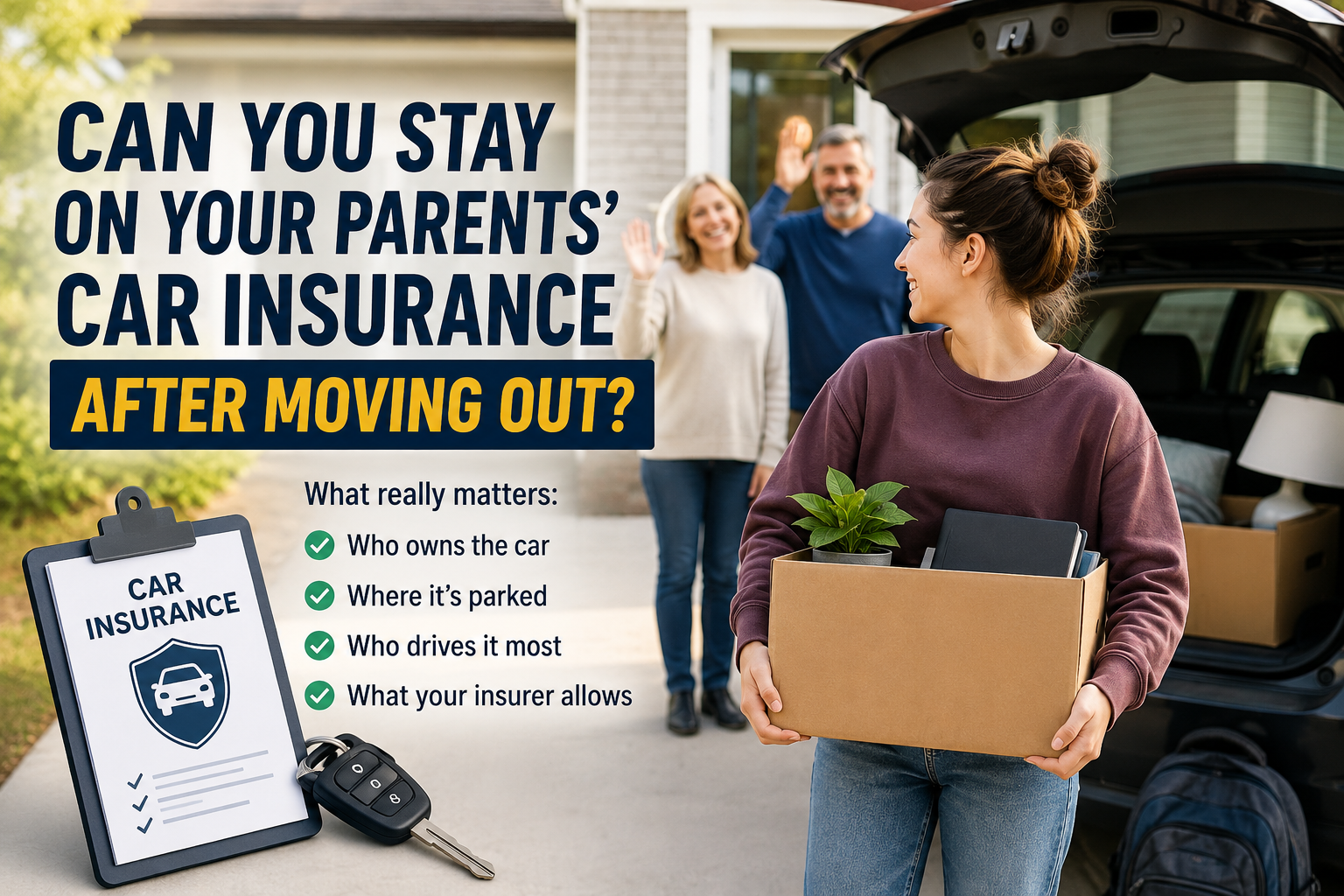
Moving out does not automatically mean you have to leave your parents’ car insurance.
But your insurer needs accurate information about the car.
That means the company should know where the car is usually parked, who owns it, who drives it most, and whether the driver still lives in the household.
If the car is still connected to your parents’ household, staying on the family policy may be fine. If the car now lives at your apartment, is titled to you, or is mainly driven by you, the cheaper family policy may no longer be the right fit.
Moved out, bought a car, or unsure whether the family policy still fits?
Compare your options before you cancel, renew, or guess.
Call (855) 467-0338 to compare car insurance options.
Can You Stay On Your Parents’ Car Insurance After Moving Out?
Sometimes, yes.
There usually is no automatic age cutoff for staying on a parent’s car insurance policy. Auto insurance is mostly about the car, the drivers, the address, and the insurer’s rules.
A college student who is away at school may still be treated as part of the family household. A young adult who has moved into an apartment, bought a car, registered it in their own name, and parks it somewhere else every night may need a separate policy.
The details matter:
- Who owns the car?
- Where is the car usually parked?
- Who drives it most?
- Are you still part of your parents’ household?
- Has the insurance company approved the setup?
Those questions matter more than your age.
When A Family Policy Still Works
A parent’s car insurance policy may still work when the car is genuinely part of the family household.
That may be the case if:
- Your parent owns the car.
- The car is kept at your parents’ home most of the time.
- You are away at college but still use your parents’ address as your permanent home.
- You only drive the car when you are home on breaks or visiting.
- The insurance company knows the arrangement and allows it.
This is why college students often get a different answer than young adults who have fully moved out. A student may be temporarily away. Someone with their own apartment, job, car, registration, and parking address may be in a different situation.
The cleanest answer always comes from the insurer. Describe the setup and ask how the policy should be written.
When You Probably Need Your Own Car Insurance
You are more likely to need your own policy when your driving life has separated from your parents’ household.
That may be true if:
- You moved out permanently.
- The car is titled or registered in your name.
- The car is parked at your apartment or house most nights.
- You moved to another state.
- You are the primary driver.
- Your parent no longer has an ownership connection to the car.
- Your insurer says the car cannot stay on the family policy.
The most common issue is the garaging address. That is insurance language for where the car is usually kept.
If your car sleeps at your apartment most nights, your insurer generally needs to know that. A different ZIP code can affect the price. A different state can create bigger complications because insurance and registration rules vary.
The Five Details To Check Before You Decide
1. Who owns the car?
If your parent owns the car, keeping it on a family policy may be easier.
If you own the car, especially if it is titled and registered in your name, you may need your own policy. Insurers usually want the person buying the policy to have a real ownership or financial connection to the vehicle.
2. Where is the car parked most nights?
This is where many people get into gray areas.
Your license may still show your parents’ address. Your mail may still go there. You may visit all the time.
But if the car is parked five or six nights a week at your apartment, the insurer may treat that apartment as the car’s real location.
3. Who drives the car most?
Borrowing your parents’ car once in a while is different from taking the car with you and using it every day.
If you are the primary driver, the policy should reflect that. Listing a parent as the main driver when the adult child actually drives the car every day can create problems.
4. Are you still part of the household?
Insurers may treat household members differently from non-household drivers.
A student away at school may still be part of the family household. A financially independent adult with a separate residence may not be.
The insurer decides how it handles that distinction, so ask directly.
5. Did you tell the insurer what changed?
Some family-policy arrangements are fine when disclosed.
The risk comes from leaving old information on the policy after life has changed. Moving out, changing where the car is parked, buying your own car, or becoming the main driver are all worth a call to the insurer.
Common Moving-Out Scenarios
| Situation | What It Usually Means | What To Do |
|---|---|---|
| You are away at college | You may still be part of the family household, depending on the insurer and where the car is kept. | Ask whether you can stay listed and whether student discounts apply. |
| You moved to an apartment nearby | The car may now have a different garaging address. | Update the insurer and ask whether the family policy still works. |
| You bought your own car | Ownership and registration may point toward a separate policy. | Compare your own policy against any family-policy option the insurer allows. |
| You moved to another state | State insurance and registration rules may require new coverage. | Contact the insurer before or soon after the move. |
| You only borrow a parent’s car when visiting | You may not need your own policy for that car, but the household driver list should be accurate. | Make sure your parents’ insurer knows who has regular access to the car. |
Why Staying On The Family Policy Can Backfire
People want to stay on a parent’s policy because it can be cheaper.
That makes sense. A family policy may have multi-car discounts, longer insurance history, better payment history, and lower pricing than a brand-new policy for a younger driver.
But the cheapest setup can become expensive if the policy information is stale.
Problems can come up when:
- The policy lists your parents’ address, but the car is kept at your apartment.
- The policy lists your parent as the main driver, but you drive the car every day.
- The car is registered in one state but insured as if it lives in another.
- The car is titled to you, but insured as if it still belongs to a parent.
- A regular driver was never added to the policy.
Insurance claims depend on the policy, the facts, and state law. A mistake does not automatically mean a claim will be denied. Still, you do not want the first serious conversation about your living situation to happen after an accident.
How To Move Off A Parent’s Policy Without A Coverage Gap
If you need your own policy, do not cancel first and shop later.
A gap in coverage can make car insurance more expensive later. It can also leave you exposed if something happens between policies.
Use this order instead:
- Get the current policy details from your parents.
- Gather your car title, registration, driver’s license, and current address.
- Compare quotes for your own policy.
- Choose the new policy and start date.
- Make sure the new policy is active.
- Then remove yourself or the car from the family policy, if appropriate.
The handoff matters. The new policy should start before the old coverage ends.
Leaving a parent’s policy?
Get quotes before you make the switch so you do not create a coverage gap or overpay for your first policy.
Call (855) 467-0338 to compare car insurance quotes.
How To Keep Your Own Policy From Being Painfully Expensive
Your first solo car insurance quote may be higher than you expected.
Do not assume the first number is the number.
To keep the cost down:
- Compare multiple insurers. Young drivers can see very different prices from different companies.
- Ask about discounts. Good student, defensive driving, paperless billing, autopay, telematics, and bundling discounts may help.
- Choose the car carefully. Some vehicles are much more expensive to insure than others.
- Be careful with the deductible. A higher deductible can lower the premium, but only choose one you could afford after a claim.
- Do not choose minimum coverage by reflex. The cheapest legal policy may not be enough after a serious accident.
- Keep continuous coverage. A lapse can make the next policy more expensive.
For a broader savings plan, see our guide to how to lower car insurance.
What If Your Parents Want You Off Their Policy?
That happens.
Adding a young driver can raise the family premium. Tickets, accidents, a long commute, or a more expensive car can make the increase worse.
If your parents want you to get your own policy, handle it as a transition.
Get quotes. Pick a start date. Make sure your new policy is active. Then have your parents remove you or the car from their policy if that is what the insurer recommends.
The goal is to avoid a gap, not to win an insurance argument at the kitchen table.
What If You Moved Out But Do Not Own A Car?
If you moved out and do not own a car, you may not need a standard auto insurance policy.
But think about how often you drive.
If you borrow cars often, rent cars, use car-sharing services, or want to avoid a gap in insurance history, ask about non-owner car insurance.
A non-owner policy is not the same as insuring a specific car. It usually provides liability coverage for a driver who does not own a vehicle. It generally does not cover damage to a borrowed car. For some drivers, it can be a useful bridge between leaving a family policy and owning a car later.
Questions To Ask Before You Stay On The Family Policy
Before you rely on a parent’s policy after moving out, ask the insurer or agent these questions:
- Can I stay on this policy if I no longer live at the same address?
- Does it matter who owns or titles the car?
- What address should be listed as the garaging address?
- Who should be listed as the primary driver?
- Can this policy cover a car registered in another state?
- Would this setup create any claim problems?
- Would a separate policy be required or cleaner?
Vague answers are not very useful here. Ask how the policy should be written for your actual situation.
Related DealyPlanet Guides
- Car Insurance for Gen Z: How to Buy Your First Real Policy Without Overpaying
- How to Lower Car Insurance
- Why Is My Car Insurance So High?
- Cheapest Cars to Insure
- When Is The Best Time To Shop For Car Insurance?
- A Quick Guide To Different Types Of Auto Insurance Coverage
FAQ
Can I stay on my parents’ car insurance if I move out?
Maybe. Moving out does not automatically remove you from a parent’s car insurance policy. The insurer needs accurate information about where the car is kept, who owns it, who drives it, and whether you are still considered part of the household.
Is there an age limit for staying on parents’ car insurance?
Usually, there is no simple age limit like there is with health insurance. Auto insurance depends more on the car, address, ownership, drivers, and insurer rules.
Can I stay on my parents’ insurance if the car is in my name?
It may be harder. If the car is titled and registered to you, especially at a different address, you may need your own policy. Ask the insurer before assuming a parent can keep insuring the car.
Can I stay on my parents’ policy while away at college?
Often, yes, especially if your permanent address is still your parents’ home and the insurer knows you are away at school. If you take the car with you, make sure the insurer knows where it is kept.
Do I need new car insurance if I move to another state?
Very possibly. State insurance and registration rules vary. If you move to another state, contact your insurer quickly and ask whether you need a new policy.
Is it cheaper to stay on my parents’ car insurance?
It often is cheaper, especially for younger drivers. The savings only help if the policy is written correctly. A cheap policy with the wrong address, owner, or primary driver can create problems.
What happens if my car insurance has the wrong address?
The insurer may need to correct and reprice the policy. A wrong address can also create questions during a claim, especially if the car was regularly kept somewhere different from the address on the policy.
What To Do Next
If you recently moved out, start with the practical details.
Who owns the car? Where is it parked most nights? Who drives it most? Is the car registered in the same state where it is insured?
If your parent owns the car, the car is still part of the household, and the insurer knows where it is usually kept, staying on the family policy may be fine.
If you own the car, park it somewhere else, drive it every day, or moved to another state, get quotes for your own policy before renewal.
The goal is to have insurance that fits the situation you are actually in.
Not sure whether the family policy still fits?
Compare your options before you renew, cancel, or move the car to a new address.
Call (855) 467-0338 to compare car insurance options.
Write a Reply or Comment