
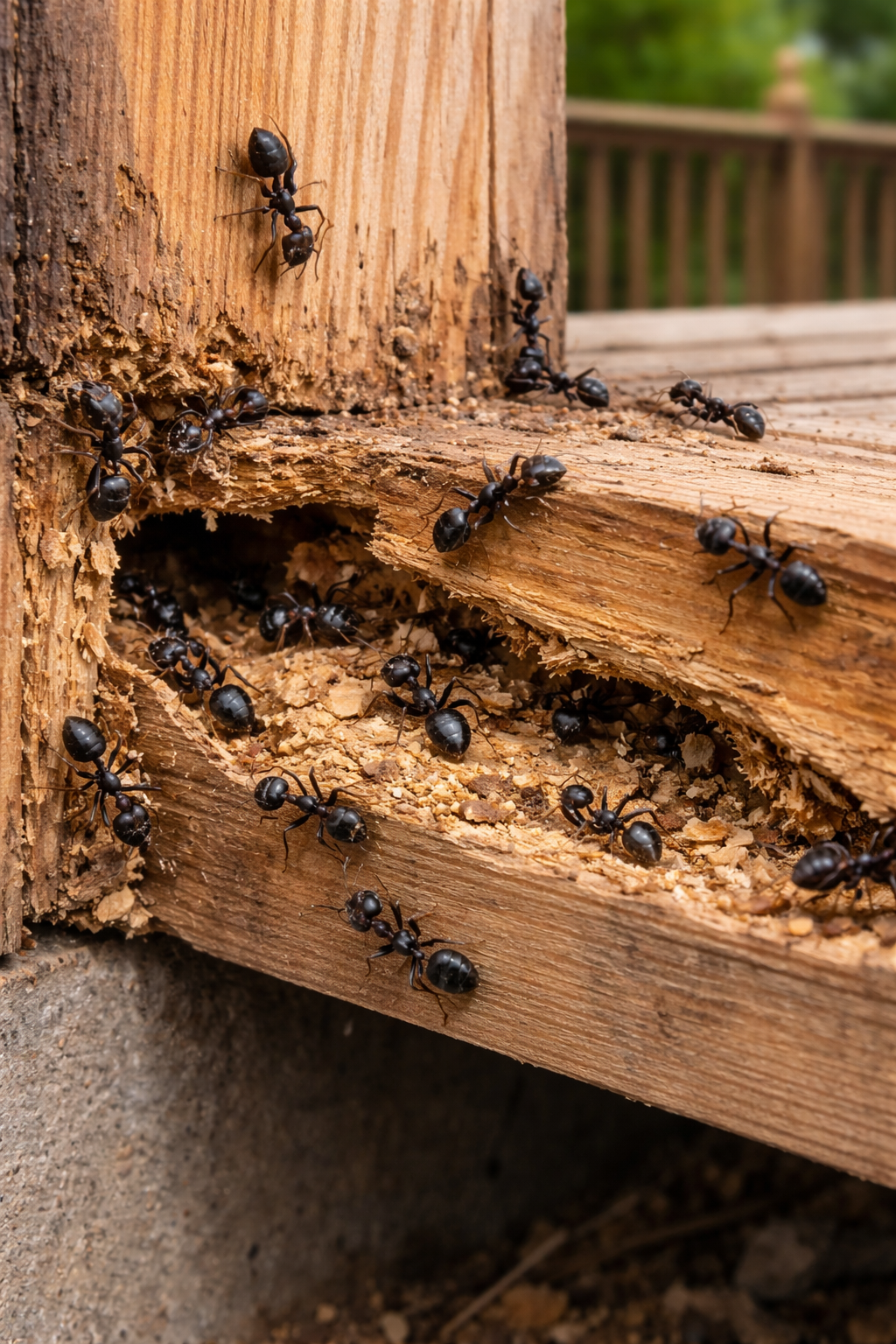
For the first few years after we purchased our home, we had a persistent carpenter ant problem.
Every summer they would show up again in the same areas of the house, particularly the living room and kitchen.
We hired an exterminator and treated the house repeatedly, but the activity never fully went away. Each year the ants would disappear during the winter and then return once warm weather arrived.
It felt like we were managing the symptoms without ever solving the actual problem.
We had no idea how right that assumption was.
The Discovery That Explained Everything
A few years after moving in, we decided to replace the 30-year-old deck attached to the house.
Not long after demolition began, our contractor called and said something you never want to hear during a home renovation:
“We have a problem.”
Once the deck had been removed, the source of our carpenter ant problem became immediately obvious.
There was a massive colony of carpenter ants living inside the house structure itself.
Not dozens. Not hundreds.
Tens of thousands.
The Real Cause: Missing Chimney Flashing
After investigating further, the contractor discovered the root cause of the infestation.
When the house had originally been built, flashing had never been installed around the chimney where it met the structure.
That missing flashing allowed water to slowly penetrate the structure for years.
Moist wood is exactly what carpenter ants are looking for.
The water intrusion created the perfect environment for a large colony to establish itself inside the home’s box beam — a major structural component that helped support the house on the foundation.
By the time the problem was discovered, the ants had caused significant damage inside the beam.
Why Carpenter Ants Love Water-Damaged Wood
Unlike termites, carpenter ants do not eat wood. Instead, they excavate it to create tunnels and chambers for their nests.
They strongly prefer wood that is already weakened by moisture, rot, or fungal damage.
Common places where carpenter ants establish nests include:
- Deck beams and joists
- Window and door framing
- Roofline structures
- Chimney framing
- Areas affected by long-term water intrusion
Because the nest is often hidden inside structural wood, homeowners may only see the worker ants traveling through the house while the main colony remains concealed.
Why Our Exterminator Could Never Solve the Problem
Our exterminator was treating the ants we could see.
But the main colony — containing thousands of ants — was hidden inside the structure of the house.
As long as that nest remained intact, the ants would continue sending workers into the house each year.
Once the deck was removed and the colony exposed, everything suddenly made sense.
How the Problem Was Finally Fixed
Fixing the problem required addressing both the ants and the structural issues that allowed them to thrive.
- The carpenter ant colony was removed.
- The damaged box beam was repaired.
- Proper chimney flashing was installed to stop the water intrusion, and the box around the chimney was rebuilt
- The deck was rebuilt with the corrected structure.
Once those repairs were completed, the carpenter ant problem disappeared.
We have not seen carpenter ants in the house since.
The Lesson From Our Carpenter Ant Problem
When carpenter ants keep returning year after year, the real issue may not be the insects themselves.
The underlying problem is often hidden moisture or structural damage that has created a perfect nesting environment inside the house.
Until that underlying issue is fixed, pest treatments alone may only provide temporary relief.
In our case, the ants were the warning sign that something deeper in the structure needed attention.
Sometimes pests are not just a nuisance — they are telling you that something in the house needs repair.
Related Home Pest Stories
Hidden spaces in homes can attract many different types of pests.
For example, we once discovered that a tiny gap in our roofline allowed bats to move into the eaves of the house, which only became obvious after droppings started appearing on the deck below.
In another case, a colony of bees built a hive inside a bathroom exhaust fan vent, causing hundreds of dead bees to appear inside the house each morning.
Quick Answer
Why do carpenter ants keep coming back every year?
Persistent carpenter ant activity often indicates a hidden nest inside structural wood, usually in areas affected by moisture or water damage.
FAQ
What attracts carpenter ants to a house?
Carpenter ants are attracted to damp or decaying wood, which is easier for them to excavate when building nests.
Can carpenter ants damage structural beams?
Yes. Large colonies can tunnel extensively inside structural wood, which can weaken beams, joists, or framing over time.
Why do carpenter ants appear more in summer?
Worker ants become more active in warmer months as colonies expand and search for food.
How do you permanently get rid of carpenter ants?
The most effective solution is to locate and remove the nest while fixing any moisture or structural problems that attracted the ants in the first place.
Write a Reply or Comment