
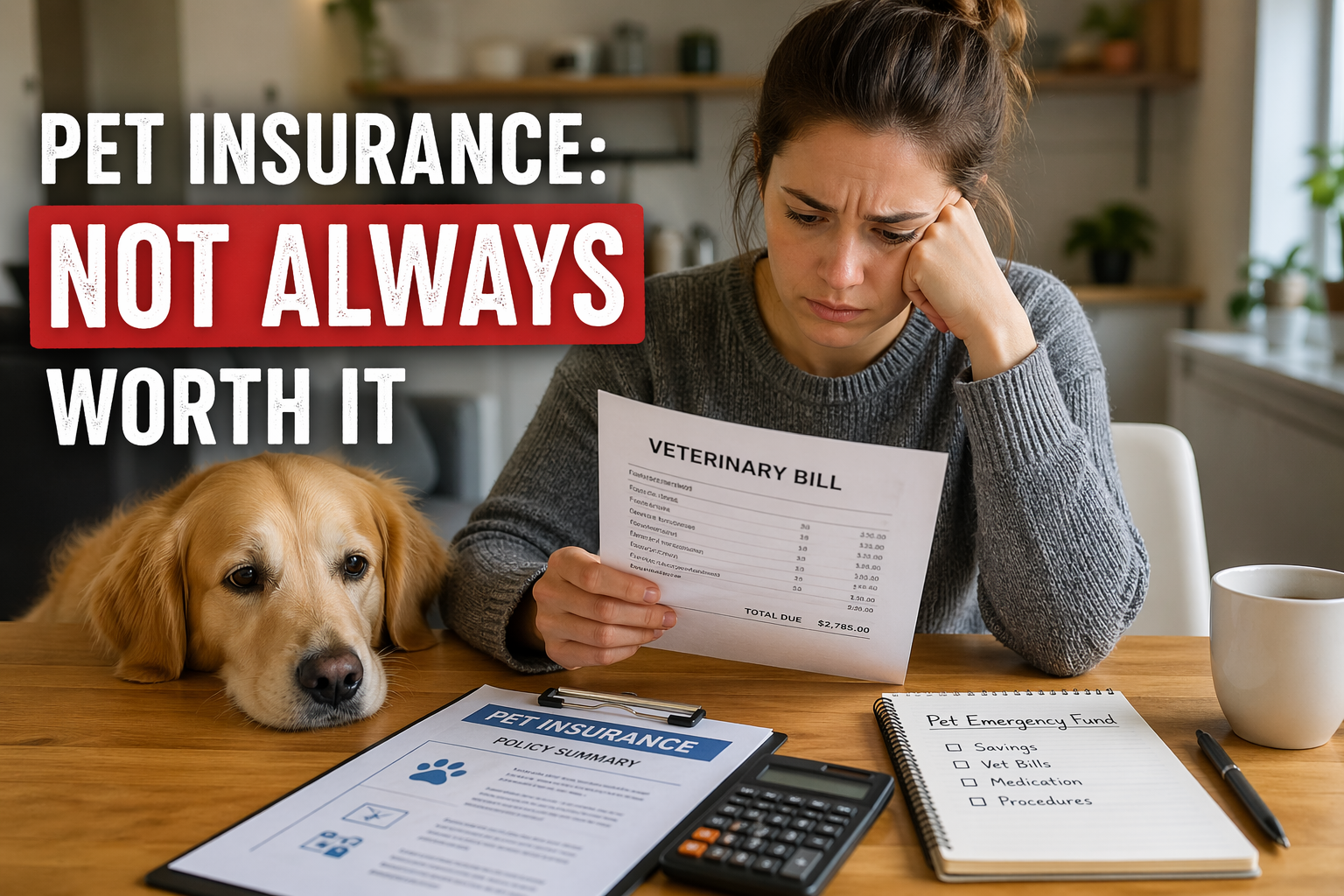
Pet insurance is often presented as an easy yes for responsible pet owners. The pitch is simple: pay a monthly premium now so you are protected from a much larger vet bill later.
And sometimes, that is absolutely the right move.
But there is another side to the story that does not get talked about nearly enough: pet insurance is not always worth it.
Depending on your pet, your finances, and the kind of policy you are considering, you may wind up paying a lot in premiums for coverage that does not help very much when you actually need it.
That does not mean pet insurance is bad. It means you should look at it with clear eyes before signing up. If you are still looking for a general overview, you may want to start with our pet insurance overview, our guide to protecting your furry friend with pet insurance, our earlier look at why many owners consider pet insurance a must-have, and our rundown of what every fur parent should know about pet insurance.
Here are the most common situations where pet insurance may not be worth the money.
Quick Answer: When Is Pet Insurance Not Worth It?
Pet insurance is often not worth it if your pet already has pre-existing conditions, if your pet is older and premiums are very high, or if you can comfortably cover a major vet bill on your own. It can also be a poor value if you expect it to cover routine care, or if the policy has exclusions and waiting periods that make reimbursement less useful than it appears.
1. Your Pet Already Has Pre-Existing Conditions
This is one of the biggest reasons pet insurance may not make sense.
Most pet insurance policies do not cover pre-existing conditions. That means if your dog or cat already has an issue on the medical record, the insurer may refuse to pay for treatment related to that issue going forward.
Examples can include:
- chronic ear infections
- allergies
- joint problems
- diabetes
- recurring digestive issues
If your pet already has a meaningful medical history, you could end up paying premiums for a policy that excludes exactly the problem you are most worried about. That is why broad advice about why pet insurance can be valuable does not always apply equally to every pet owner.
In this situation, building your own pet emergency fund may be more useful than paying for limited insurance coverage.
2. Your Pet Is Older and Premiums Are Expensive
Pet insurance usually gets much more expensive as pets age. That should not be surprising. Older pets are more likely to need care, so the insurer charges more to take on that risk.
The problem is that once premiums climb high enough, the math may stop making sense.
If you are paying a substantial amount every month for a policy with a deductible, reimbursement caps, and exclusions, you may discover that you are still on the hook for a large portion of any major bill.
For older pets, ask yourself a blunt question: am I paying for meaningful protection, or am I mostly paying for the feeling of having protection?
If you are just starting to explore the category, our article on how pet insurance can protect your pet when it matters most gives the more traditional case for coverage, but age and pricing can change that calculation dramatically.
3. You Can Afford a Major Emergency Bill Yourself
Insurance is most valuable when it protects you from a financial hit you cannot easily absorb.
If you already have a healthy emergency fund, strong monthly cash flow, or enough liquid savings to handle a surprise vet bill, pet insurance may be less compelling.
That does not mean you should never buy it. Some people prefer the predictability of a monthly premium even when they can self-insure.
But if you can comfortably pay a $2,000 to $5,000 bill without financial strain, you may be better off keeping that money under your own control instead of sending it to an insurance company every month.
4. You Think It Covers Everything
This is where many pet owners get disappointed.
Pet insurance often sounds broader than it really is. Many policies do not automatically cover routine care, vaccinations, dental cleanings, wellness visits, or preventive treatment. Some offer those benefits only through optional add-ons. Others keep tight limits on what they reimburse.
Even when something is covered, you may still have to deal with:
- annual deductibles
- reimbursement percentages of 70%, 80%, or 90%
- annual or lifetime payout limits
- condition-specific exclusions
If you are buying pet insurance because you think it will make vet care essentially free, you are likely to be disappointed. In that case, it may not be worth it because your expectations do not match how the product works. That is also why many of the basic benefits discussed in articles like these things every fur parent should know about pet insurance need to be weighed against the fine print.
5. The Waiting Period Makes the Policy Less Useful
Most pet insurance plans come with waiting periods.
That means you cannot sign up today and expect coverage to begin immediately for every condition. Accidents may be covered sooner, but illnesses and orthopedic issues often have longer waiting periods.
This matters because many pet owners start shopping for insurance only after they become worried about something.
If your pet has already started showing symptoms, there is a real chance the insurer will treat the issue as pre-existing or otherwise outside the coverage window.
In other words, the policy may not help with the exact problem that pushed you to buy it in the first place.
6. You Rarely Use Veterinary Care Beyond Routine Visits
Some pets simply do not generate many medical expenses beyond basic preventive care for years at a time.
If your pet is healthy, low-risk, and not especially accident-prone, you may go a long time without filing a meaningful claim.
That does not automatically mean insurance is a bad idea. Insurance is protection against the unexpected, not a subscription designed to guarantee you come out ahead every year.
Still, if your premiums are high and your claims are minimal, the long-term value may be poor. Some owners would be better off putting the same monthly amount into savings and leaving it there for future care.
7. You Do Not Like Reimbursement-Based Systems
Another overlooked issue is how pet insurance usually works in practice.
In many cases, you still pay the vet bill up front. Then you submit documentation and wait for reimbursement from the insurer.
That means pet insurance may not solve a cash flow problem if you do not have the money available at the moment treatment is needed.
Some owners are fine with that. Others find it frustrating and much less helpful than they expected. If you are still deciding whether the overall category makes sense for your household, our piece on why pet insurance can help protect your furry friend gives the upside case, but the reimbursement model is one of the most important downsides to understand.
8. You Are Better Off Self-Insuring
For some households, the best alternative to pet insurance is not doing nothing. It is self-insuring.
That means setting aside a dedicated amount every month in a pet emergency fund and only using it for veterinary expenses.
This approach can make more sense if:
- your pet is older
- your pet has exclusions that make insurance less useful
- you are disciplined about saving
- you want full control over how the money is used
Self-insuring does require consistency. It also leaves you exposed if a large expense hits before the fund has grown. But in the right situation, it can be more efficient than paying premiums for years.
When Pet Insurance May Still Be Worth It
To be clear, there are situations where pet insurance can be a smart move.
It is often more attractive when:
- your pet is young and healthy
- you enroll before problems develop
- you would struggle with a large emergency vet bill
- the policy terms are actually good
That is why this is not really a yes-or-no product. It is a fit question.
The issue is not whether pet insurance is universally good or bad. The issue is whether it is a good fit for your pet and your finances. If you want the broader pro-insurance case before making up your mind, the best starting point is still our general pet insurance guide.
What to Ask Before You Buy
If you are on the fence, ask yourself these questions before committing:
- What exactly does this policy exclude?
- What counts as a pre-existing condition?
- How long are the waiting periods?
- What is the deductible?
- What percentage will actually be reimbursed?
- Would I rather keep this money in savings instead?
If you cannot answer those clearly, you should not buy the policy yet.
The Bottom Line
Pet insurance is not automatically a waste of money, but it is also not automatically a smart buy.
It may not be worth it if your pet already has pre-existing conditions, if your pet is older and premiums are high, if you can comfortably pay large vet bills yourself, or if the policy has enough exclusions and delays to make reimbursement less useful than it seems.
For some pet owners, the better strategy is to skip the policy, save aggressively, and keep control of the money.
For others, especially those with younger pets and limited financial flexibility, pet insurance may still provide valuable peace of mind.
The key is not to assume it is always worth it just because it sounds responsible. Sometimes the responsible move is deciding that it is not the right fit.
Related Pet Insurance Guides
- Pet Insurance Waiting Periods Explained
- Pre-Existing Conditions in Pet Insurance
- Pet Insurance Overview
Frequently Asked Questions
Is pet insurance worth it for an older dog?
It depends on the premium, exclusions, and the dog’s medical history. In many cases, older dogs face higher premiums and more limited value, which can make pet insurance less attractive.
Does pet insurance cover pre-existing conditions?
Usually not. Most pet insurance companies exclude pre-existing conditions, which is one of the main reasons a policy may not be worth it for some owners.
Is it better to save money instead of buying pet insurance?
For some households, yes. If you are financially disciplined and can handle a large unexpected vet bill, self-insuring through savings may be a better fit.
What is the biggest downside of pet insurance?
The biggest downside is often the gap between expectations and reality. Many plans have waiting periods, exclusions, deductibles, and reimbursement limits that reduce the value of the coverage.
Write a Reply or Comment