I recently sat down to read The Secret of Life by Howard Markel, a fascinating history of the scientific race to understand the structure of DNA and unlock the genetic code.
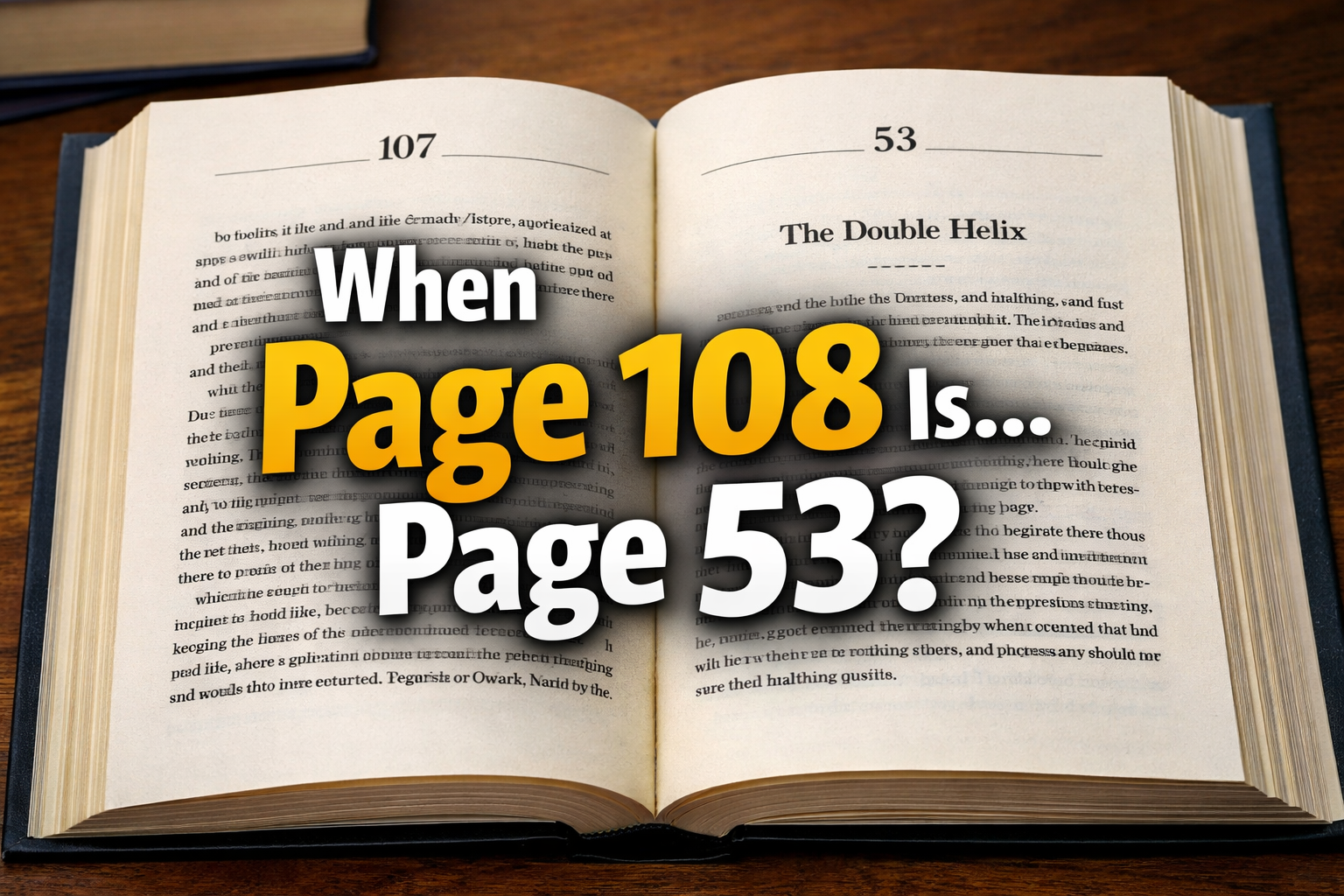
Everything was going well — until page 107.
The next page wasn’t 108.
It was page 53.
At first I assumed I had somehow flipped backward. But after checking again, I realized something stranger had happened: pages 53–84 appeared twice in the book, replacing the section that should have covered pages 117–148 entirely.
In other words, roughly thirty pages of the book simply didn’t exist.
And yes — there’s a certain irony here. A book about humanity learning how genetic information is transcribed correctly contained what was essentially a printing-press version of a genetic transcription error.
What Actually Went Wrong?
This type of defect is called a binding or signature error, and it’s more mechanical than mysterious.
Books aren’t printed one page at a time. Instead, printers produce large sheets that are folded into groups of pages called signatures, typically 16 or 32 pages each. During binding, those signatures are assembled in sequence.
If one signature is duplicated and another omitted, you get exactly what happened here:
-
One section appears twice
-
Another section disappears entirely
-
Page numbers suddenly jump backward or forward
Think of it as the publishing equivalent of copying the wrong segment of DNA during replication.
Most readers never encounter this — but it absolutely happens.
Why I Didn’t Notice for Two Years
Here’s the surprising part: I bought this book on Amazon back in October 2021.
I simply didn’t read it right away.
Like many of us, I have a growing “to-read” shelf. The defect only revealed itself once I finally sat down with the book years later — long after any normal return window had closed.
That raises an obvious question:
What are you supposed to do when you discover a defective book long after purchase?
Step 1: Confirm It’s a Printing Error
Before assuming damage, check:
-
Do page numbers suddenly repeat?
-
Are sections duplicated?
-
Are pages missing entirely?
-
Does the numbering jump backward?
If so, you’re almost certainly dealing with a manufacturing defect rather than wear or damage.
Take photos of:
-
The incorrect page transition (e.g., 107 ? 53)
-
The duplicated section
-
The copyright page showing ISBN and printing info
Step 2: Contact the Publisher (Your Best Option)
Many people assume they’re out of luck if the return period has passed. Surprisingly, publishers are often very helpful.
Printing defects are manufacturing errors — and publishers generally want defective copies removed from circulation.
In my case, the publisher is W. W. Norton & Company. A simple email explaining:
-
the defect,
-
the ISBN,
-
and including photos
is usually enough to request a replacement copy.
Publishers frequently replace defective books even years later.
Step 3: Try Amazon Anyway
Even outside the return window, Amazon customer service sometimes issues:
-
courtesy replacements
-
refunds
-
or account credits
It takes only a few minutes to try via:
Orders ? Problem with order ? Defective item
No guarantees — but low effort.
How Common Are Misprinted Books?
Rare enough to surprise readers, but common enough that printers have standard terminology for them.
Typical defects include:
-
duplicated signatures (like mine)
-
missing sections
-
upside-down inserts
-
blank page blocks
-
incorrect covers
Because modern printing runs are massive, a small batch of defective copies can slip through quality control unnoticed.
Why You Should Flip Through Every Book You Buy
Here’s the real lesson I learned:
Even if you don’t plan to read a book immediately, quickly flip through it when it arrives.
Check that:
-
page numbers progress normally
-
no sections repeat
-
no large gaps exist
It takes 20 seconds and can save frustration years later.
The Irony of a “Transcription Error”
What makes this experience memorable is the subject matter.
The Secret of Life tells the story of scientists painstakingly uncovering how genetic information is copied and transmitted accurately — how tiny transcription errors can have enormous consequences.
And yet my physical copy contained its own informational mutation: duplicated data replacing essential instructions.
A reminder, perhaps, that even in an age of precision science and automated manufacturing, errors still sneak into the system — whether biological or mechanical.
FAQ: Misprinted Books
Can I return a misprinted book years later?
Sometimes. Amazon may help, but publishers are often more flexible with manufacturing defects.
Are misprinted books valuable?
Usually not for modern mass-market titles, though they can be interesting curiosities.
What causes pages to repeat in a book?
A duplicated printing signature during binding replaces the correct section.
Should I keep the defective copy?
Yes — at least until you receive a replacement. Publishers may ask for photos but rarely require returns.
Final Thoughts
I didn’t expect a lesson in manufacturing quality control from a history of molecular biology. But discovering missing pages halfway through a book is a good reminder: even carefully produced systems occasionally produce errors.
Whether in genetics or publishing, transcription mistakes still happen.
The difference is that this one can usually be fixed with a simple email.
Write a Reply or Comment