
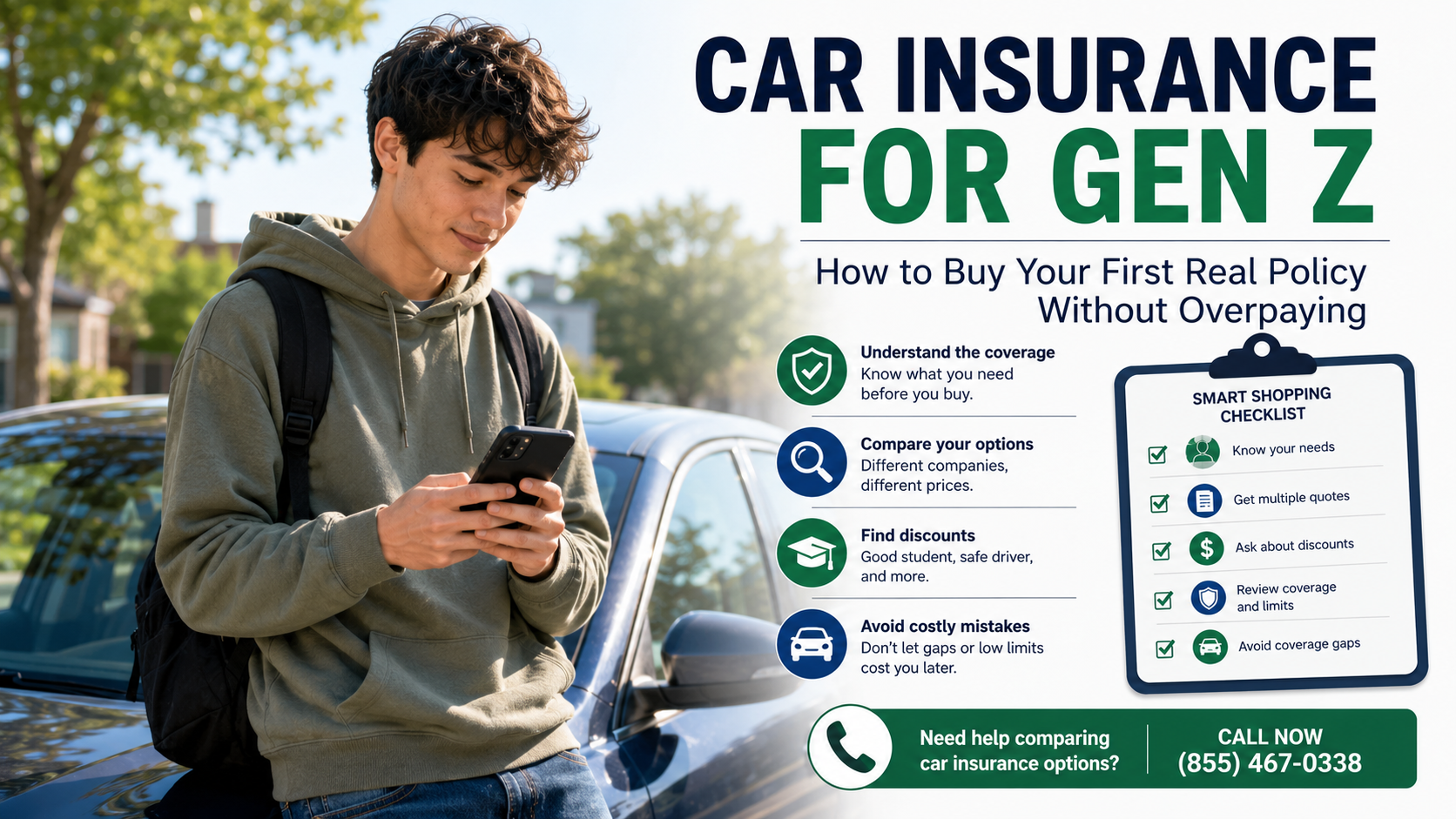
Buying car insurance for the first time is annoying for almost everyone. For Gen Z drivers, it can be especially frustrating.
Get DealyPlanet by email Practical help with insurance claims, expensive repairs and consumer problems.
You may be moving off a parent’s policy, buying your first car, moving to a new apartment, starting a full-time job, financing a vehicle, or realizing that the cheapest quote is not always the smartest choice.
Car insurance companies care about details that may feel random: your age, driving history, ZIP code, vehicle, credit-based insurance score in many states, annual mileage, prior coverage, and whether you own, finance, or lease the car. Small changes can make a big difference in your quote.
Need help comparing car insurance options?
If you are shopping for coverage, moving off a parent’s policy, or trying to figure out whether your quote is too high, you can call for help comparing options.
Call now: (855) 467-0338
Calling can be especially useful if you need coverage soon, recently moved, added a car, or are not sure how much coverage you actually need.
This guide is written for Gen Z drivers who are trying to buy car insurance without getting crushed by the price or accidentally buying coverage that does not fit their life.
Why Car Insurance Can Be So Expensive For Gen Z
Car insurance is partly about risk. Younger drivers usually have less driving history, and insurers often price that uncertainty into the policy. Even if you are a careful driver, the insurance company may not have many years of data showing that yet.
That does not mean you are stuck with the first expensive quote you see.
For many Gen Z drivers, high car insurance costs come from a combination of factors:
- limited driving history;
- moving from a family policy to an individual policy;
- financing or leasing a car that requires comprehensive and collision coverage;
- living in a more expensive ZIP code;
- choosing a vehicle that costs more to repair or insure;
- having a gap in prior coverage;
- not comparing enough quotes;
- missing discounts for school, work, telematics, bundling, or safe driving.
The mistake is assuming that one high quote means every company will charge the same thing. Insurance companies do not all price risk the same way. One company may treat your situation as expensive. Another may be more competitive.
That is why shopping around matters, especially when you are young, moving, changing cars, or buying your own policy for the first time.
Before You Get Quotes, Know What Kind Of Policy You Need
Before you start comparing prices, get clear on what you are actually buying.
If you own an older car outright, you may have more flexibility. You might choose liability coverage only, or you might decide that comprehensive and collision are still worth paying for.
If you finance or lease your car, you will usually need more than minimum liability coverage. Lenders and leasing companies commonly require comprehensive and collision coverage because they still have a financial interest in the vehicle.
That distinction matters. Two people can both say they need “car insurance,” but one may be shopping for a minimum liability policy and the other may need broader coverage because the car is financed.
If you are not sure what your lender requires, check your loan or lease documents before buying the cheapest policy you can find.
Not sure what coverage you need?
A cheap policy can become expensive if it does not satisfy your lender, protect your car, or meet your actual needs.
Call (855) 467-0338 to compare car insurance options.
The Cheapest Car Insurance Quote Is Not Always The Best Quote
It is tempting to sort quotes by price and pick the lowest one. Sometimes that works. Sometimes it creates a problem later.
The cheapest quote may have:
- low liability limits;
- high deductibles;
- no comprehensive or collision coverage;
- limited rental car coverage;
- poor fit for a financed or leased car;
- discounts that disappear later;
- coverage that does not match how you actually use the car.
This does not mean you should overbuy coverage. It means you should understand why one quote is cheaper than another.
A useful question is not just “What is the lowest monthly payment?” It is “What am I giving up to get that lower payment?”
For more on why quotes can be surprisingly high, see our guide to why your car insurance is so high.
When Staying On A Parent’s Policy May Make Sense
Many Gen Z drivers start out on a parent’s car insurance policy. That can be cheaper than buying a separate policy, especially if the driver lives at home, uses a family car, or is still considered part of the household.
But there are limits.
If you move out, buy your own car, register it in your own name, move to another state, or become financially independent, you may need your own policy. The details matter, and the wrong setup can cause problems if there is a claim.
Staying on a parent’s policy may make sense when:
- you still live at home;
- you drive a family vehicle;
- the car is registered to a parent;
- your insurer allows the arrangement;
- the household information on the policy is accurate.
Getting your own policy may make more sense when:
- you own or finance the car yourself;
- you live at a different address;
- you moved to another state;
- you want to build your own insurance history;
- your parent’s insurer says you no longer fit on the household policy.
If you are moving off a family policy, do not let coverage lapse. A gap in coverage can make your next policy more expensive.
How Gen Z Drivers Can Lower Car Insurance Costs
You probably cannot change your age or driving history overnight. But you can still improve the quote.
Compare more than one company
Do not assume the company your parents use is automatically the best option for you. It might be. It might not be. Different insurers price younger drivers differently.
Comparing quotes is one of the highest-impact things you can do.
To compare options by phone, call (855) 467-0338.
Ask about discounts
Discounts vary by company, but Gen Z drivers should ask about:
- good student discounts;
- safe driver discounts;
- driver training discounts;
- telematics or usage-based insurance programs;
- paperless billing or autopay discounts;
- multi-policy discounts;
- low-mileage discounts;
- student-away-at-school discounts.
Some discounts sound small, but several small discounts can add up.
Choose the car carefully
The car matters. A cheap car is not always cheap to insure. Repair costs, theft risk, safety features, vehicle type, engine size, and claims history can all affect premiums.
If you are shopping for a car and insurance at the same time, get insurance quotes before you buy the vehicle. You do not want to discover after the purchase that the monthly insurance bill is bigger than expected.
For more on choosing a vehicle with insurance costs in mind, see our guide to the cheapest cars to insure.
Think carefully before raising your deductible
A higher deductible can lower your premium, but it also means you pay more out of pocket if you have a claim.
That tradeoff only works if you can actually afford the deductible. If a $1,000 deductible would wreck your budget, the lower monthly payment may not be worth the risk.
Avoid coverage gaps
Letting insurance lapse can make future coverage more expensive. It can also create legal and financial problems if you drive uninsured.
If you are switching companies, make sure the new policy starts before the old one ends.
Be realistic about telematics
Many insurers offer app-based or device-based programs that track driving behavior. These programs may reward careful driving, but they are not right for everyone.
Before signing up, ask what is tracked, how long it is tracked, whether the program can raise your rate, and how the discount is calculated.
If you drive late at night, brake hard in city traffic, or have an irregular schedule, a telematics program may not help as much as the marketing suggests.
For more general savings ideas, see our guide on how to lower your car insurance.
Minimum Coverage Can Be Risky
Minimum coverage is the least insurance your state requires. It may be legal, but that does not automatically mean it is enough.
If you cause an accident and the damage is higher than your policy limits, you could be responsible for the difference. That is a serious risk, especially if you are starting your career and do not have much savings.
Minimum coverage may be tempting if money is tight, but compare the cost of higher liability limits before deciding. Sometimes the price difference is smaller than expected.
The same is true for comprehensive and collision coverage. If your car is worth very little, dropping physical damage coverage may make sense. If you could not afford to repair or replace the car, keeping more coverage may be worth considering.
Shopping for cheaper car insurance?
Price matters, but so does buying the right amount of coverage. Compare options before you settle for the first quote.
Call now: (855) 467-0338
Car Insurance Gets More Complicated If You Drive For Work
If you use your car for delivery apps, rideshare, or other work, do not assume your personal auto policy covers everything.
Driving for DoorDash, Uber Eats, Instacart, Uber, Lyft, or similar platforms can create coverage gaps. Some companies offer endorsements or special policies for this. Others may exclude certain business use.
This is especially important for Gen Z drivers because gig work can seem like a flexible way to make money, but one uncovered accident can erase a lot of earnings.
Before driving for work, ask your insurer what is covered and what is excluded. Do not rely only on the app’s marketing language.
Moving Can Change Your Car Insurance Rate
Many Gen Z drivers are in a high-change stage of life. Moving from home to college, from college to a first apartment, or from one city to another can all affect car insurance.
Your rate may change when you move because insurers consider garaging address, local accident rates, theft risk, repair costs, and state insurance rules.
If you move, update your insurer. Using the wrong garaging address can cause problems later.
A move is also a good time to shop around. The company that was cheapest at your old address may not be the cheapest at your new one.
What To Compare Before Buying A Policy
When comparing quotes, do not just compare monthly premiums. Look at the whole policy.
| What To Compare | Why It Matters |
|---|---|
| Liability limits | Low limits may leave you exposed after a serious accident. |
| Deductibles | A lower premium may come with a deductible you cannot comfortably afford. |
| Comprehensive and collision | Important if your car is financed, leased, or expensive to replace. |
| Uninsured/underinsured motorist coverage | Can matter if another driver causes damage and does not have enough insurance. |
| Rental reimbursement | Useful if you rely on your car and would need a rental after a covered claim. |
| Roadside assistance | Can be helpful, but compare the cost with other roadside options. |
| Discounts | Some quotes look better because they include discounts that may change later. |
| Payment plan | Monthly payments can cost more than paying in full because of installment fees. |
If two quotes are far apart, check whether they are actually offering the same coverage. They often are not.
A Simple Gen Z Car Insurance Buying Plan
If you are buying your first real policy, use this order:
- Figure out who owns the car. Is it yours, your parent’s, financed, leased, or paid off?
- Check whether you can stay on a family policy. If you moved out or own the car yourself, you may need your own policy.
- Decide what coverage you need. Do not choose based only on the lowest monthly price.
- Get multiple quotes. Compare companies, not just one familiar name.
- Ask about discounts. Good student, telematics, safe driving, low mileage, and bundling discounts can matter.
- Check the deductible. Make sure you could actually pay it after an accident.
- Avoid a coverage gap. Start the new policy before canceling the old one.
- Re-shop after major life changes. Moving, getting married, buying a car, changing jobs, or improving your driving record can change the math.
This does not need to take all day. But it does require more than accepting the first quote you see.
When It Makes Sense To Call Instead Of Clicking Around
Online quotes are useful, but they are not always enough.
Calling can make sense if:
- you are moving off a parent’s policy;
- you need insurance today or this week;
- you are buying or financing a car;
- you recently moved;
- your quote seems unusually high;
- you had an accident or ticket;
- you drive for delivery or rideshare work;
- you are not sure whether minimum coverage is enough.
A short call can help you compare options and avoid buying a policy that does not fit your situation.
Compare car insurance options by phone
Gen Z drivers often pay more than they expect, but the first quote is not always the best quote. Compare options before you buy.
Call now: (855) 467-0338
A Few Minutes Can Help You Save On Car Insurance For Gen Z
Car insurance for Gen Z can be expensive, but there is no reason to pay more than you have to..
The best move is to understand what coverage you need, compare more than one company, ask about discounts, and avoid buying the cheapest policy without understanding what it leaves out.
If you are moving off a parent’s policy, buying your first car, financing a vehicle, or trying to figure out why your quote is so high, take a few minutes to compare options.
Need help comparing car insurance? Call (855) 467-0338.
Write a Reply or Comment