
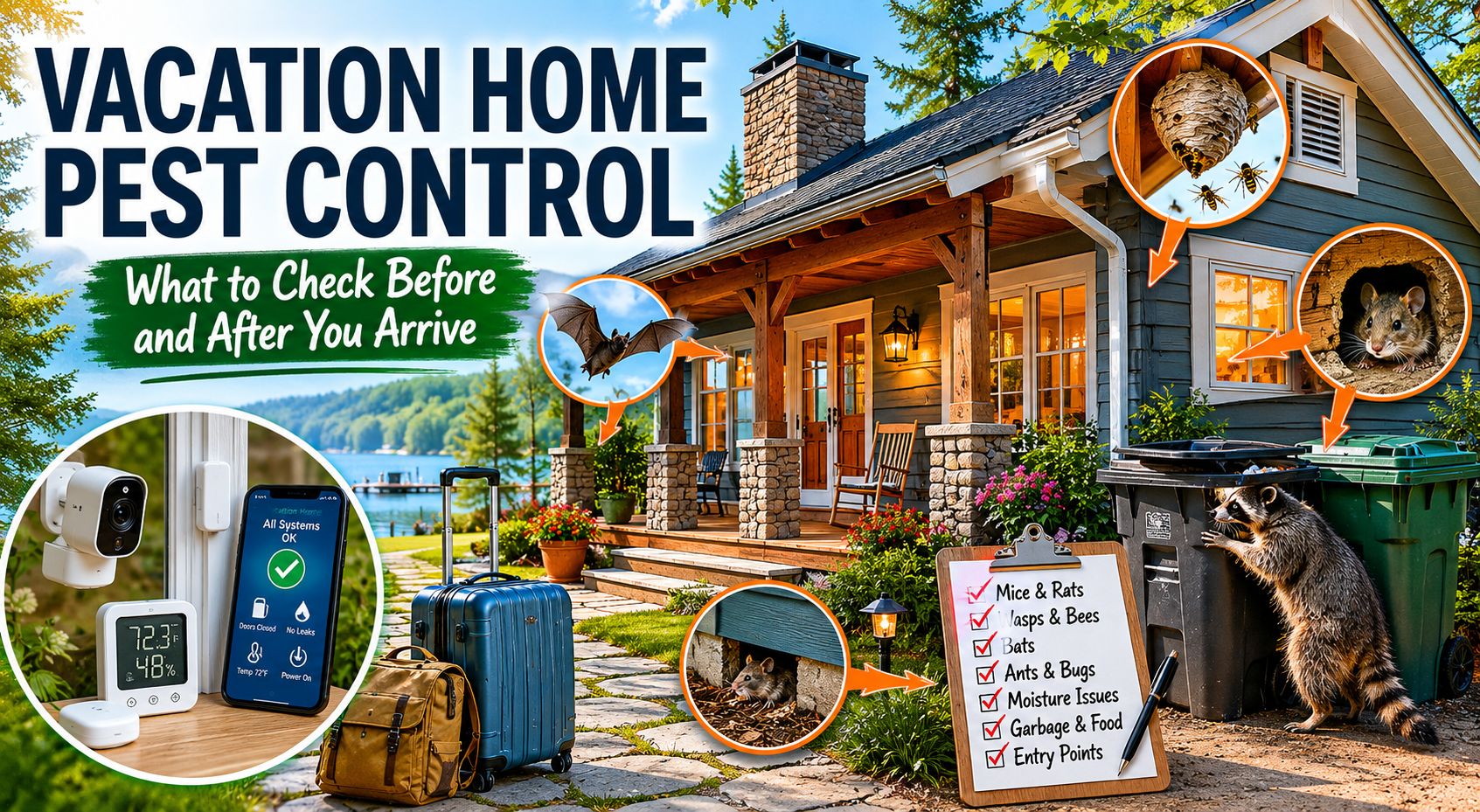
A vacation home can develop pest problems quietly.
Get DealyPlanet by email Practical help with insurance claims, expensive repairs and consumer problems.
That is the part that makes it different from a primary home. If mice get into the pantry, wasps start building near an entry, bats find a gap in the eaves, or ants move into a damp wall, nobody may notice for days or weeks.
By the time you arrive for what was supposed to be a relaxing weekend, the problem may already be bigger than a quick cleanup.
Pest control for a vacation home is mostly about timing. You want to know what to check when you arrive, what to do before you leave, and when the signs are serious enough to call for help.
Quick Answer: What Pest Problems Should You Check For At A Vacation Home?
At a vacation home, check first for mice or rat droppings, scratching noises, chewed wires, wasp nests, bee activity, bats near eaves, ants, moisture-loving insects, garbage-can problems, and signs of animals in walls or crawlspaces. Because the house may sit empty, small pest problems can grow before anyone notices them.
| What You Notice | Possible Pest Problem | What To Do Next |
|---|---|---|
| Droppings in cabinets, drawers, or under sinks | Mice or rats | Clean carefully, look for entry points, and consider pest control if signs are active |
| Scratching in walls, ceilings, or attic areas | Rodents, squirrels, bats, or other animals | Do not seal holes until you know whether animals are inside |
| Wasps near doors, decks, or rooflines | Wasp or hornet nest | Avoid disturbing the nest; call for help if it is near people or entrances |
| Bees entering a wall or vent | Bee colony in a structure | Do not simply spray and seal; removal may be needed |
| Bats near eaves or attic vents | Bat entry point or roost | Check local rules and use proper exclusion timing |
| Ant trails or damp areas | Ants, carpenter ants, or moisture pests | Look for water damage, leaks, or soft wood |
| Torn trash bags or garbage-can activity | Rats, raccoons, or other scavengers | Secure lids, clean residue, and move cans away from cover |
Why Vacation Homes Get Pest Problems
Vacation homes are attractive to pests for the same reason people like them: they are quiet.
A house that sits empty gives pests time. Mice can explore cabinets. Wasps can build undisturbed. Bats can use a small gap in the eaves. Ants can follow moisture. Animals can test weak spots around crawlspaces, vents, chimneys, and utility lines.
The issue is not that vacation homes magically attract pests. It is that nobody is there every day to notice the early signs.
In a primary home, you might see one ant trail, one mouse dropping, or one wasp near the same corner every afternoon. In a second home, the first sign may be the weekend you walk in and find that the problem has been active for a while.
What To Check When You Arrive
When you arrive at a vacation home, do a quick pest check before you fully unpack.
This does not need to be dramatic. You are looking for obvious signs that something changed while you were away.
- Kitchen and pantry: Look for droppings, torn packaging, gnaw marks, ants, or food residue.
- Under sinks: Check for droppings, moisture, leaks, and insect activity.
- Utility room: Look near water heater, HVAC equipment, laundry, and gaps around pipes.
- Basement or crawlspace entry: Look for droppings, chewed material, musty smells, or signs of nesting.
- Attic access and ceilings: Listen for scratching or movement, especially at night.
- Decks, railings, and eaves: Watch for wasps, hornets, bees, or bats.
- Garbage area: Check for torn bags, spilled food, droppings, or gnaw marks.
If you find one old dropping or one dead insect, that may just mean cleanup. If you find fresh droppings, repeated activity, nesting material, scratching sounds, or pests near entry points, treat it as active until proven otherwise.
What To Do Before You Leave
The best vacation-home pest control happens before the house is empty again.
Before you leave, focus on food, water, shelter, and access. Those are the things pests are looking for.
- Remove or seal food: Do not leave open snacks, cereal, pet food, bird seed, or pantry items in chewable packaging.
- Take out trash: Do not leave food garbage sitting inside or loose bags outside.
- Clean crumbs and grease: Rodents and insects do not need much.
- Check under sinks: A small leak can attract insects and moisture pests.
- Close doors and windows: Make sure sliders, basement doors, and garage entries are actually closed.
- Move firewood and clutter away from the house: These can create cover and nesting areas.
- Secure garbage cans: Tight lids matter, especially if pickup happens after you leave.
- Look at vents and gaps: Dryer vents, bathroom vents, soffits, and utility penetrations are common weak points.
You do not need to turn the house into a fortress. You need to make it less easy for pests to find food, shelter, and entry.
Mice And Rats In A Vacation Home
Rodents are one of the most common vacation-home pest problems because they can do damage before anyone notices.
Mice and rats are not just unpleasant. They can chew food packaging, contaminate drawers and cabinets, damage insulation, and chew wiring. In garages or parked vehicles, they can create expensive car problems too.
Common signs include:
- small droppings in drawers, cabinets, closets, or under sinks
- chewed food packages
- nesting material such as paper, insulation, or fabric
- scratching noises in walls or ceilings
- gnaw marks around openings
- musty or urine-like odors
If you are hearing scratching in the walls or finding fresh droppings after each visit, this is probably bigger than one trap.
For a deeper look at costs, see our guide to how much an exterminator costs for mice.
Wasps, Bees, And Bats Around A Seasonal Home
Wasps, bees, and bats can be especially frustrating at a vacation home because the problem may be outside until it suddenly affects how you use the property.
A wasp nest near a deck, porch, shed, or main entrance can make part of the house hard to use. Bees entering a wall or vent may require more careful handling than a simple spray. Bats near eaves or attic vents can involve timing and legal restrictions, depending on where you live.
The basic rule is simple: if the pest is using the structure, be careful before sealing anything.
Sealing an opening while animals or insects are inside can make the problem worse. They may die inside the wall, move deeper into the structure, or find a way into living space.
Related guides:
Bugs, Ants, And Moisture Problems
Not every pest problem is a dramatic animal-in-the-wall situation.
Sometimes the first sign is ants in the kitchen, insects near a damp basement wall, or bugs that seem to appear after the house sits closed up.
In vacation homes, moisture matters. A slow leak, damp crawlspace, clogged gutter, or poor ventilation can create better conditions for insects. Carpenter ants, for example, are often a sign to look more closely at moisture-damaged wood.
If you see ants repeatedly in the same area, do not just spray the trail and move on. Look for the reason they are there:
- food residue
- water or condensation
- soft or damp wood
- gaps around doors or windows
- vegetation touching the house
- wood piles or debris nearby
If the same pest problem returns every time you visit, the house is telling you something.
Garbage Cans And Outdoor Attractants
Outdoor trash is one of the easiest ways to invite pests to a vacation home.
This is especially true if trash pickup happens after you leave, if cans sit near brush or fences, or if bags are left outside the bin because the can is full.
Rats, raccoons, and other animals learn routines. If your garbage area smells like a reliable food source, they may keep coming back.
Before you leave:
- do not leave loose bags outside cans
- use tight-fitting lids
- rinse sticky residue from bins when possible
- move cans away from walls, fences, brush, and stacked wood
- avoid leaving food waste exposed in warm weather
For more detail, see our guide to why rats love garbage cans and how to keep them out.
When To Call Pest Control For A Vacation Home
Some vacation-home pest problems can be handled with cleanup, sealing food, better trash handling, and closing obvious gaps.
Others are worth getting help for quickly.
Consider calling pest control if you find:
- fresh rodent droppings on more than one visit
- scratching in walls, ceilings, or attic areas
- chewed wiring or insulation
- wasps or hornets near doors, decks, or areas people use
- bees entering a wall, vent, or roofline
- bats in eaves, attic areas, or vents
- repeated ant activity near damp or damaged wood
- dead animals, strong odors, or signs of animals trapped inside
Need Pest Control Help At A Vacation Home?
If you arrived at a vacation home and found fresh droppings, scratching in the walls, wasps near an entrance, bees entering a wall, bats in the eaves, or signs of animals inside, it may be worth talking to a pest control professional before the problem spreads.
Call Pest Control Help: 833-770-0877
You may be asked for your ZIP code so the call can be routed correctly.
If you are dealing with an active problem, see our pest control help page for a quick checklist on what to check and when it may be time to call.
How Remote Monitoring Can Help
Remote monitoring will not stop pests by itself.
But it can help you catch the conditions that make pest problems worse: open doors, water leaks, humidity, temperature problems, power outages, and activity around the house.
For example, a door sensor can tell you if a basement or garage entry was left open. A camera may show animals visiting a garbage area. A humidity sensor may help you notice a damp basement before insects become a recurring problem.
Pests are only one part of managing an empty house. If you also worry about leaks, freezing pipes, open doors, or power outages, GadgetWisdom has a guide to vacation home remote monitoring.
For temperature and humidity issues while you are away, see GadgetWisdom’s guide to vacation home temperature monitoring.
Vacation Home Pest Control Checklist
If you want the short version, use this checklist before and after each visit.
When You Arrive
- Check kitchen cabinets, drawers, and pantry shelves for droppings or chewed packaging.
- Look under sinks for leaks, droppings, ants, or moisture.
- Listen for scratching in walls, ceilings, attic spaces, or crawlspaces.
- Check decks, eaves, vents, and entrances for wasps, bees, bats, or nests.
- Inspect garbage cans and outdoor areas for torn bags, droppings, or gnaw marks.
Before You Leave
- Remove food trash and do not leave loose garbage bags outside.
- Seal pantry items in hard containers or remove them.
- Clean crumbs, grease, and food residue.
- Check that doors, windows, garage doors, and sliders are closed.
- Move firewood, brush, and clutter away from the house.
- Secure garbage-can lids.
- Look for new gaps around vents, pipes, doors, and utility lines.
The Goal Is To Catch Problems Early
Vacation-home pest control is not about pretending you can prevent every mouse, wasp, ant, or bat from ever noticing the property.
The goal is to catch problems early, remove easy attractants, and avoid giving pests weeks of quiet time before anyone notices them.
Check the house when you arrive. Leave it clean and sealed when you go. Pay attention to repeated signs. And if the problem involves active rodents, animals in walls, wasps near people, bees in a structure, or bats in the eaves, do not wait until the next visit to figure it out.
A vacation home should not become a pest project every time you arrive.
Write a Reply or Comment